The zombie-vampire genre gets a refreshing makeover
Radical's most recent, successful attempt at providing readers with cutting-edge stories with gorgeous artwork - in this case by Roy Allan Martinez, who proves to be a revelation - breaks a multitude of conventions in a variety of ways.
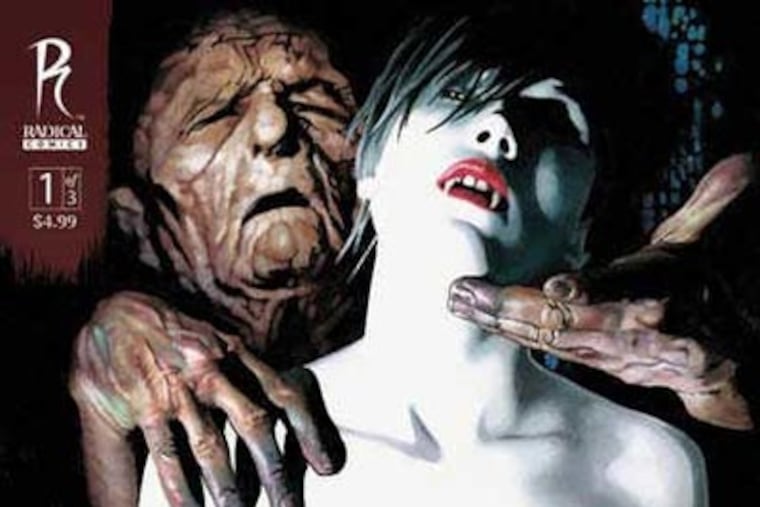
Radical's most recent, successful attempt at providing readers with cutting-edge stories with gorgeous artwork - in this case by
Roy Allan Martinez
, who proves to be a revelation - breaks a multitude of conventions in a variety of ways.
First, "FVZA" is one of the titles in the company's "Bigger Books! Bigger Value!" campaign. That means readers are treated to a prestige-format, 64-page debut issue for only $4.99 - or only a dollar more than Marvel is charging for 22-page installments of their most popular titles.
Second, "FVZA" is not adapted from a film, novel or even a movie pitch as many comics are these days. Instead, it was inspired by a Web site (www.fvza.org) that claims to represent the authentic history of the vampire and the zombie through past centuries up until the present day.
The site is fronted by a man named Hugo Pecos who plays a key role in the comic - and not only gives a detailed "History and Science of the Undead" from medieval times to the present, but also in-depth essays on how to combat vampires, zombies and werewolves and a forum to enable the public to submit sightings of the undead from around the world.
What is fascinating about "FVZA" is that the history is detailed enough to provide fodder for countless stories, yet it also demands that the science of the undead has to remain consistent. As a result, "FVZA" breathes fresh life into a genre that has been beaten like a dead corpse by clichés and familiar elements. It dismisses most of the vampires and zombie myths that have been promoted through movies and novels. In the world of "FVZA," the idea that a vampire casts no reflection is rejected as nonsense.
In fact, what writer David Hine has done is completely deromanticize the vampire genre by making those in his tale twisted, ugly and impotent - a sharp contrast to the sexy seducers they are usually portrayed as.
As for the zombies, Hine ratchets up the terror level by having these zombies retain some degree of awareness of their humanity. So instead of the usual mindless moans, these zombies use them to express despair and self-pity.
Of course, Hine has not made these creatures unrecognizable. There are familiar elements. Vampires are still creatures of the night who shun daylight. They still feed on blood and once bitten there is still no escape. People either bleed out or die or become transformed into the beings they fear the most.
Hine powerfully conveys that what makes these familiar creatures so intriguing and horrifying at the same time is that vampires and zombies are neither alive nor dead. They aren't really human, but they are more than just animals.
Through them, Hine explores what it is that makes all of us truly alive and what makes us truly human. The fact that in the world of "FVZA" anyone can be infected and no one can take his or her humanity for granted means that the characters place greater value on the things that define humanity - like love, loyalty and self-sacrifice.
In "FVZA," Hine also is clearly aiming for a political subtext. His vampires are parasitic, elite exploiters. His zombies, on the other hand, are considered little more than rabble to be used as cannon fodder.
There are also political undertones evident in how Hine decides to show the need for the "FVZA" - which had been shut down for decades - by how he brings the vampires and zombies back.
With no real vampire sightings in years, some of the bored, well-to-do twentysomethings have formed a punklike underground cult called vamps. Most of them have permanent fang implants, all wear black and stay out of the sun to preserve their deathly pale complexions and some even drink each other's blood.
When five of them meet a man named Mandrake, who says he grew his fangs, and he offers them hundreds for a "kinky" night . . . well, let's just say the night isn't as fun as the vamps had hoped.
In addition to making it clear that true vampires have returned, it is later revealed that Mandrake contaminated the water supply of a small town with a zombie virus, as a way of showing "them" what can be done if his demands aren't met.
Whether you're a conservative who feels Mandrake's actions are an example of what happens to young people who are growing up in an increasingly values-less society and when the country lets its guard down against terrorism or you're a liberal who feels this is what happens when government spending is reduced or cut off from essential agencies - it is clear Mandrake's actions have demonstrated the need for the FVZA to start up again after being shut down for decades.
Only the vast knowledge of Hugo Pecos, who dedicated most of his life to the agency, and the fighting skills of his grandchildren, Landra and Vidal, seem to give the FVZA a chance against an alliance of the undead that seeks to takeover the United States.
It should be one exciting, memorable ride for the next couple of issues as the FVZA seeks to end the threat of the undead once and for all.
E-mail comicsguy@phillynews.com