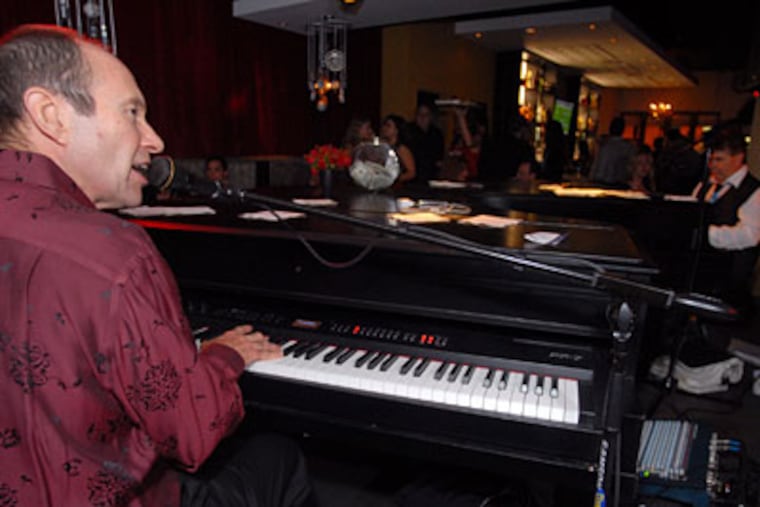
Someone says "piano bar," and you'll likely conjure up an image of something romantically Old World. Dark, smoky room. Tuxedo-clad musician. Sinatra, Sondheim and Styne fans heartily singing old, boozy songs and stuffing dollars into a giant snifter.
Yet lately there's another kind of piano scene playing:
This one has hipsters in pricey jeans, guys with names like "Tony T" and "Wildman Joe" pounding eighty-eights and belting "Rich Girl" and "Stray Cat Strut." It has waitstaff hula-dancing on stage.
Joining the standbys like the gayborhood's Tavern on Camac and Bistro Romano on Lombard Street is a new breed of Philadelphia piano bar.
They attract younger patrons (although older ones still flock), perform more mash-up musical repertoire (but don't forget the standards), and serve swankier drinks. But experts say they share the same camaraderie created by group song and silliness that their predecessors possessed.
Attending the Wednesday opening night of Jolly's Dueling Piano Bar in late October was Rachel Timmerman, a 30-year-old ad exec at Red Tettemer.
"There's nothing like this in town," she said. "I love the music, the vibe, and that neither I nor my friends have to be reserved. I think I'm going to request 'Tiny Dancer' in a minute."
Due east is 2nd Street Annie's, a dueling-piano bar that opened in Northern Liberties in March. (Its first location opened in North Wildwood five years ago.) Of course, manager Nick Passio doesn't even like to call it a piano bar, for fear of invoking an image of a guy "with the big glass sitting in front of him."
"We get people in here ages 22 to 62, a lot of bachelor and bachelorette parties," Passio said. "The music is varied, but it's definitely more rock-and-roll than anything else. We like to call ourselves a honky-tonk bar."
For 50-year-old owner Jolly Weldon, dueling pianos - a concept that started in 1930s New Orleans - are the kick in the pants for those who spend too much time on the Internet interacting with screen names.
Here, on Chestnut Street, "they become part of the event, of the evening," Weldon said. "There are no televisions here. The patron isn't sitting, staring, and drinking."
Nightlife aficionado and entrepreneur Harry Jay Katz says Philadelphia's piano bars hold the "lure of easy sociability." Having once owned his own piano bar within the walls of the legendary Erlanger Theater, Katz speaks longingly of the popular nightspots of the 1960s and '70s, including Cobblestones on South Fifth, the Society Hill Hotel in Old City, and Backstage.
"You could be stupid there, singing and carousing," Katz said. "During a time of the Blue Law Sundays, they'd serve alcohol into the evening in coffee cups. It was a blast."
Over the last 40 years, piano bars have been more associated with gay nightlife, offering show tunes, power ballads, and torch songs, said David Grazian, associate professor of sociology at the University of Pennsylvania.
"But like a lot of gay culture - disco, voguing, metrosexuality - piano bars recently emerged as a mainstream pleasure for straight men and women, especially among the affluent, cosmo-sipping set," said Grazian, author of On the Make, about young people and nightlife in Philadelphia.
Set lists today are just as likely to include Bruce Springsteen and Guns 'N Roses as Andrew Lloyd Webber.
"Few nightlife scenes generate the same kind of warmth and shared collective experience as a barroom full of friends and strangers joining together in drunken revelry and song," Grazian said.
And it's the diverse customer base that usually creates an intoxicating atmosphere. "Twenty-one to 91 and lots of women to boot," says Weldon of Jolly's patrons.
Of course, Weldon has music in his blood.
His family opened the Prime Rib restaurant in Washington, D.C.; its first pianist was Stef Cartagi in 1971. Eventually, he and his brother Garth came to Philadelphia in 1997 to start one here. Later came Jolly's at the Latham Hotel, the Redhead on 17th Street, and Jolly's Sporting Saloon on 19th. All had piano bars.
"One of my favorite sayings," Weldon notes, "is, 'You can have a good time drinking and eating without music, but why chance it?' "
Rather than go with old reliables like big band, jazz standards, Broadway's best, or saloon balladry, Weldon decided that his new venue would have dueling pianos.
The concept is cool because of the combination of live music and audience participation, while being able to hold a conversation at the same time, said musician Steve Odabashian.
Odabashian, a pianist who's had gigs at Piano Bar at Arch, Helium Comedy Club, and 2nd Street Annie's, prides himself on his ability to switch from Mötley Crüe to Madonna, or rip through Cheap Trick and Kelly Clarkson at great speed.
"I don't do show tunes unless you count the theme from Action News . . . I do whatever I consider fun and cool."
Some lament the new cool.
For one, there's no smoking, says Katz.
"What are you going to sing? Rap music. Sadly, oldies-but-goodies don't always cut it for today's alleged hipsters."
And in his opinion, the piano bar scene demands that you be a big drinker, a good tipper, and a great sport (buying rounds for everyone in the house is de rigueur) - and how is that possible in this economic climate?
"You have to have players with panache, really Tony-the-Tiger terrific. If not, who needs it?" Katz asked.
Still, it's the recession that helps make Weldon confident. After being reminded that the dueling pianos of New Orleans came about during the Great Depression, Weldon smiles. And sings:
"Happy days are here again. . . ."