On Movies: Mortensen breaches postapocalyptic frontier
TORONTO - Director David Cronenberg, who cast Viggo Mortensen as a Russian mob lieutenant in Eastern Promises, tells how his star would disappear from the London shoot on weekends, not revealing where he was going, and return Monday with photographs and objects, tattoo books, and snatches of Russian street slang he had gleaned during his stealth getaways to Moscow and St. Petersburg.
TORONTO - Director
David Cronenberg
, who cast
Viggo Mortensen
as a Russian mob lieutenant in
Eastern Promises
, tells how his star would disappear from the London shoot on weekends, not revealing where he was going, and return Monday with photographs and objects, tattoo books, and snatches of Russian street slang he had gleaned during his stealth getaways to Moscow and St. Petersburg.
For The Road, it wasn't possible for Mortensen to pursue that same sort of diligent research. After all, how do you delve into the apocalypse?
"One of the things that attracted me to this story is that there is nowhere to hide," says Mortensen of the film based on Cormac McCarthy's Pulitzer Prize winner - a novel about a father and his young son wandering a devastated, ash-dusted America. "Not that doing research is hiding, necessarily, but The Road is very bare-bones. You know, people say, what happened? Was it a war? Was it an environmental catastrophe? Climate change?
"And in a sense it doesn't matter, because it's a device, it's a means to exaggerate a concern that everyone can understand. . . . And that's inherently dramatic, but it's also, as an actor, a big challenge. There are no tricks. You either have to believe that these people are father and son, that they love each other, that they really are going through some difficult things, or you don't. And you have to believe their harrowing emotional journey."
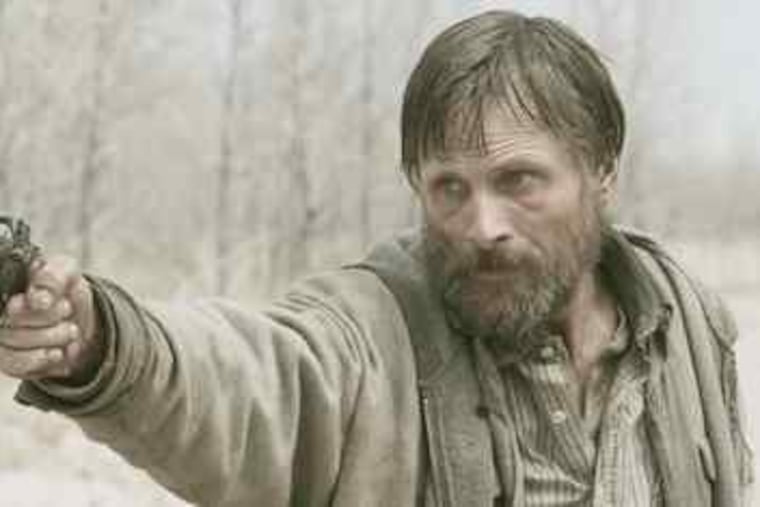
Harrowing, indeed. A bleak, beautiful film, directed by John Hillcoat (and shot mostly in western Pennsylvania, and edited and with visual effects and post-production done mostly in Philadelphia), The Road opens at the Ritz Five and Showcase at the Ritz Center/NJ on Wednesday. With its depiction of solitary, frightened survivors and roving bands of cannibal marauders, the film is not exactly your typical Thanksgiving feel-good fare. But it is, in its own dark way, a celebration of the bonds of family, of father and son, husband and wife (Charlize Theron, seen in flashbacks).
"My entry point was obviously being a parent, and having a boy, and remembering how he was at that age," says Mortensen, the soft-spoken Lord of the Rings icon. In The Road, Mortensen's nameless character is left with his son (also nameless), who looks to be 8 or 9 - and is played by the spookily talented Australian Kodi Smitt-McPhee.
Mortensen, in a hotel room following the gala premiere of The Road at the Toronto International Film Festival in September, cannot wax more effusive about his diminutive costar, who was 10 at the time of filming.
"If you don't have a child that has the gift, the emotional availability, and more than anything the intelligence to have that through-line . . . if you don't believe him, and believe the boy and the man's relationship, there's no faking it in the story," he says.
Mortensen went out of his way to befriend the young actor - spending off- time together, going to museums and baseball games, hitting a Mexican bodega in Pittsburgh to buy boxes of glazed crickets - insects that the two of them are seen eating in the film.
"We walked around. I talked to him about movies. I would talk to him about Montgomery Clift and Marlon Brando . . . you know, these guys that revolutionized film acting in terms of naturalism. . . . He basically didn't know who they were. And it's amazing to see someone do that, do what he does, without having that knowledge. . . .
"Kodi has a certain wisdom and a certain presence that was undeniable," Mortensen says. "I felt like I was working with an experienced actor."
Robert Duvall, who has a small but pivotal role in The Road, was likewise impressed, Mortensen says.
"We had just done a couple of takes and Duvall turned and he said, 'Where did you get this kid?' He was amazed at his ability as an actor, not just because he was precocious, or cute, or appropriate-looking, but that he actually could do some very complicated things as an actor."
Mortensen and Smitt-McPhee appear in the vast majority of scenes together - it's man and boy against what's left of the world. And it's harsh, horrible stuff, but there are glimmers of hope.
"The audience is rewarded with moments of compassion, of love, even of humor," he says. "But they have to be earned. The hard stuff has to be hard, it has to be there."
Warrior Woo. "I have always dreamed of making a movie like Lawrence of Arabia or Spartacus or The Seven Samurai - of course, not as great, but at least I fulfilled my dream," says John Woo, the Hong Kong action maestro, who has indeed delivered a grand historical epic, the third-century Chinese war movie Red Cliff.
Shot in the southern provinces and deploying as many as 1,500 soldiers on loan from the People's Liberation Army, along with scores of stunt men, hundreds of horses, 25 battleships (digitally augmented to become a vast flotilla), and the stars Tony Leung, Takeshi Kaneshiro, and Zhang Fengyi, Red Cliff is based on the beloved Chinese novel Romance of the Three Kingdoms. The film, which was released in Asia last year, already has grossed more than $125 million. It bows in Philadelphia, playing at the Ritz at the Bourse, on Wednesday.
Woo's late-'80s and early-'90s cops-and-gangsters sagas starring Chow Yun Fat - A Better Tomorrow, The Killer, and Hard Boiled - brought the director to Hollywood, where he made, among other hits, Face/Off with Nicolas Cage and John Travolta and Mission: Impossible II with Tom Cruise. Red Cliff is Woo's first feature shot in mainland China; he still lives in Los Angeles and is an American citizen now, but he says the experience of working in his homeland (he was born in Guangzhou) was deeply satisfying.
"One of the biggest reasons I wanted to make this film is that I grew up with the story, with the book, with its characters," he says, interviewed during a recent visit to New York. "I've been thinking of making this film for over 30 years. But for many years we didn't have the money, we didn't have the technology."
In Red Cliff, Woo and his team seamlessly mix computer graphics with live action. One extraordinary 21/2-minute sequence follows a pigeon as it flies over terrain from one vast military encampment to the opposing army, assembled across the river. It's breathtaking.
While Woo has plans to make a martial-arts film (and also a remake of Jean-Pierre Melville's moody hit-man classic, Le Samourai), the combat in Red Cliff hews closer to traditional war pictures, not the impossible whirligig kick-boxing stuff of, say, Crouching Tiger, Hidden Dragon.
"The action had to be realistic," he explains, "because this is a war movie, this is not a kung fu film."