Books as beauty upon the tabletop
Art, science, photography, even mathematics are on glorious display in this selection of works.
With all the talk these days about the demise of the book, it is useful to remember that not all books are created equal. An eminently disposable paperback of a Dan Brown thriller picked up at the airport is one thing, the
catalogue raisonné
of a master artist's work issued by a major museum quite another. Amazon's Kindle is a wonderfully convenient device, and it may be possible, in the not so distant future, to download onto it an entire art book in all its glorious shades of color. But don't expect a coffee-table Kindle anytime soon.
Paging through any of the volumes featured below will quickly demonstrate why: The books themselves - by virtue of their size, shape, and even the texture of their pages - are objets d'art. They are more than the sum of their contents.
The volumes chosen here cover a broad range: from the self-explorations of one of the founders of depth psychology through the scene at a quintessential Chelsea art loft to a look at Venice so vivid you can practically hear the water lapping in the canals.
Prices cited are list, but shop around. Discounts abound.
The Red Book, by C.G. Jung (Norton, $195). This is a facsimile of an illuminated manuscript - handwritten in elaborate calligraphy and illustrated with brilliantly colored paintings - in which the famed psychiatrist recorded a series of visions he seems to have induced in himself over about 15 years, starting in 1914. It has lain in a Swiss vault since his death in 1961. Both beautiful and strange, it is the prophetic book serving as the ground for all his subsequent work. (The book itself will be on display at the Rubin Museum of Art, 150 W. 17th St. in New York City, through Jan. 25.)
Evolution: The Story of Life, by Douglas Palmer, illustrated by Peter Barrett (University of California, $39.95). Charles Darwin was born in 1809 and 50 years later published On the Origin of Species, the most persuasive explanation yet of nature's diversity. This large and colorful tome celebrating Darwin's double anniversary presents its tale as a sequence of snapshots, each focusing on a particular time and place in our planet's history. A pretty entertaining way to learn about cladistics, embryophyta, euarthropoda, and a good many other non-household words.
A Photographer's Life 1990-2005, by Annie Leibovitz (Random House, $50). This could well amount to more than you would ever wish to see of the über-photographer, her family, and her longtime companion, writer Susan Sontag, whose death from cancer is chillingly recorded. Nevertheless, in its mix of narcissism, voyeurism, and plain old sensationalism, the book proves spellbinding. There's a great shot of Scarlett Johansson, too.
The Math Book, by Clifford A. Pickover (Sterling, $29.95). Ever think of using Bayes' Theorem to calculate what the chances are that the Collatz Conjecture could be demonstrated by employing Pig Game Strategy? Bet not. Most of us don't even know what the theorem, conjecture, or strategy are. Still, however unpleasant your memories of math may be, you will almost certainly find this handy and handsome volume hard to put down.
The Infinity of Lists, by Umberto Eco (Rizzoli, $45). Asked by the Louvre to organize a series of conferences, exhibitions, concerts, and readings around a subject of his own choosing, Eco chose lists. The book resulting from this project amply demonstrates that from the 10 commandments (a to-don't list) and medieval litanies through Whitman's catalogs and right up to the chorus lines of the Ziegfeld Follies, lists have been central to literature and culture. Boasting great reproductions of art you may not be familiar with but ought to be (Gustave Moreau, Paul Delvaux) and excerpts from authors who ought to be better known (J.-K. Huysmans and Blaise Cendrars), this smallish volume is jam-packed with riches.
Sphinx: The Life and Art of Leonor Fini, by Peter Webb (Vendome, $95). Leonor Fini (1907-1996) is one of those artists whose life may have been her greatest work, and who certainly deserves to be as well known as Frida Kahlo. And the work itself is intriguing, especially the illustrations for Baudelaire's Les Fleurs du Mal and Shakespeare's The Tempest.
Norman Rockwell: Behind the Camera, by Ron Schick (Little, Brown $40). Fascinating juxtapositions of thrice-familiar illustrations and the photographic studies Rockwell made beforehand as aids to developing his narrative imagery. A lot of posing went into those down-home postures.
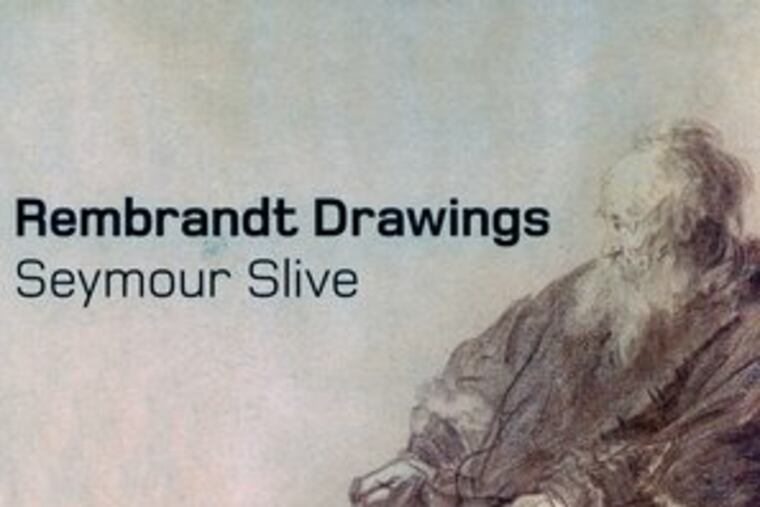
Rembrandt Drawings, by Seymour Slive (J. Paul Getty Museum, $49.95). The master at his most immediate, from a lifetime of self-portraits, to copies of other artworks, to wonderfully observed animals (notably, Albertina the elephant).
Bellissima Venice, by Michel Setboun (Abrams, $50). There probably isn't any next best thing to going there, but if there were, these gorgeous photos of La Serenissima would be it. (Did you know that the Bridge of Sighs got its name not from the sighs of lovers, but from those of prisoners who crossed it on their way back to their cells?)
Small Trades, by Irving Penn (J. Paul Getty Museum, $49.95). Long associated with Vogue magazine, Irving Penn - who died in October at age 92 and who studied at what is now the University of the Arts - was also a master of portrait photography (the famous close-up of Picasso in a wide-brimmed hat). This collection is of ordinary, anonymous workers - plumbers, bakers, house painters, and street artists in Paris, London, and New York. Each and every one is compelling.
When Art Worked: The New Deal, Art, and Democracy, by David Larkin and Roger G. Kennedy (Rizzoli, $75). Revisit those thrilling days of yesteryear when the federal government paid artists to lift the country's spirits during the Great Depression. Actually, the murals and posters and other works are well worth more than a glance.
Philadelphia Originals, by Joseph Glantz (Schiffer, $34.99). OK, Philadelphia is taken in a broad sense to include its suburbs. That earns a mention for Oscar Hammerstein II, who lived in Bucks County. There are also some glitches - Hammerstein's partner, Richard Rodgers, did not live in Bucks County, and the fruit-and-veggie stand at Ninth and Washington in South Philly is called Giordano's, not Giordanis. But why quibble? Plenty here to make you proud of our fair city. Philo T. Farnsworth, inventor of TV, did a lot of his work in Mount Airy; CBS got its start in Philly, and WCAU was its flagship station. Oh, and the computer age started with Penn's ENIAC. And that's only the tiniest bit of the story.
The Jazz Loft Project: Photographs and tapes of W. Eugene Smith from 821 Sixth Avenue 1957-1965, by Sam Stephenson (Knopf, $40). Photographer Smith shared the eponymous Manhattan loft with composer Hall Overton, jazz trumpeter Dick Cary, and artist David X. Young. Everybody seems to have stopped by, from Thelonious Monk to heiress Doris Duke (who studied with Overton). Terrifically evocative shots and well-chosen snippets of conversation bring the whole super-cool scene back to life.
The First Resort: Fun, Sun, Fire and War in Cape May, America's Original Seaside Town, by Ben Miller (Exit Zero $29.95). Bet you never knew that Henry Hudson visited Cape May. Or that it was originally named Cape Mey (after Dutch sea captain Cornelius Mey). This is probably as complete a look at the ups and downs of the Jersey Shore's proto-resort as you are likely to see.
Waterbirds, by Theodore Cross (Norton, $100). According to the U.S. Fish & Wildlife Service, there are 48 million American birders. So you are bound to know someone who would love to have this book. Actually, the photos gathered here are so spectacular, you may decide to keep it for yourself.