In touch with pop art's feminine side
"Tactile and engaged," the works of 18 women in the '60s are at University of the Arts.
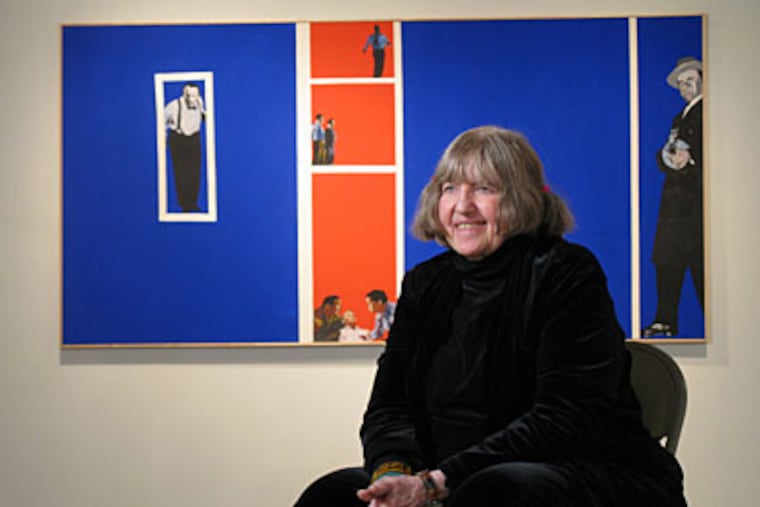
Was pop art really the mostly male art movement it's generally been made out to be? Sid Sachs - director of exhibitions at the University of the Arts and a pop art aficionado well aware of the stature of Marisol, Niki de Saint Phalle, and several other women working within pop - didn't believe it for a second.
Sachs became increasingly curious about the missing women while organizing a retrospective at UArts' Rosenwald-Wolf Gallery for Rosalyn Drexler, a pop artist who had developed a singular style and a substantial body of work in the early 1960s, before she became a successful playwright.
It was then, he recalls, that the idea that had been percolating in his mind all along sort of, well, popped: There was an exhibition just waiting to be done on the female contributors to pop art, and he had to do it.
Hundreds of phone calls, letters, e-mails, eBay trawlings, and Googlings later, Sachs has organized one of the most fascinating revisions of an art movement that Philadelphia - or any major city for that matter - has seen. "Seductive Subversion: Women Pop Artists 1958–1968," opens tomorrow at the university's three largest galleries - Rosenwald–Wolf Gallery, Borowsky Gallery at Gershman Hall, and the Hamilton Galleries in Dorrance Hamilton Hall. It offers a fresh view of pop art through the works of 18 women, and a decidedly less circumscribed one than the movement populated by Andy Warhol, Claes Oldenberg, James Rosenquist, and Roy Lichtenstein.
"The American pop work by men was reserved, distant, cool," Sachs says. "The women's art was tactile and engaged."
Finding the forgotten women of pop art turned out to be less difficult than he had feared. "A lot of the living artists were in the phone book," he says, still sounding a bit surprised.
Persuading galleries to lend was another matter.
"It was hard to get galleries to realize this was an important project," he says, recalling numerous attempts to plead his case to baffled gallery staff. "It's sort of like archaeology - this is work that is half a century old, and many young people working in galleries aren't familiar with these artists."
In a few rare cases, such as those of Drexler, Marjorie Strider, and Idelle Weber, many works were still in the artists' possession. But Sachs also pursued specific pieces that he found had been sold by galleries to collectors, then had simply disappeared.
"Dorothy Grebenak, who was older than many of the women in the pop movement and died in 1970, made hooked rugs for 20 years and she showed with the Allan Stone Gallery and Zabriskie Gallery," he says. "She was mentioned in articles in Art in America and the New York Times, and her rugs were bought by Nelson Rockefeller, Carter Burden, Albert and Vera List, John and Komiko Powers, and Bill and Noma Copley - many of the top people who were collecting at the time. Now many of her rugs have vanished."
The three Grebenak rugs he was able to borrow, from New York's Allan Stone Gallery and Komiko Powers, are among the revelations of this show. In 1964, the same year in which Andy Warhol made his facsimile of a Brillo box, Grebenak made rug facsimiles of Babe Ruth baseball cards, a Bugatti, and a two-dollar bill.
She also made a rug version of a box of Tide, but Joshua Mack, a grandson of the Lists, who owned the piece, told Sachs it had fallen apart. Sachs did, however, have access to a black-and-white photograph of the piece and had it replicated for his show by a contemporary fiber artist, Emily Peters.
British pop artist Pauline Boty was even better known in her lifetime than Grebenak was - she was also an actress who had a role in the 1966 film Alfie and lost out to Julie Christie for the lead in Darling. But she died in 1966 when she was only 28, and the bulk of her paintings of pop icons languished in her brother's barn in Kent for decades. Finally, art historians David Mellor and Sue Tate sought them out and put them in their 1993 exhibition "The Sixties Art Scene in London," at London's Barbican Art Gallery. (Tate is a contributor to this show's catalog and will participate in a symposium next month.).
To Sachs, though, the pieces most conspicuously missing from the annals of pop are the early (1960 to about 1962) reliefs and transfer paintings of Chryssa, which predate the neon works for which she became known. He says her oil painting Newspaper II (1961) "looks like a Rauschenberg transfer drawing" and that "she was doing grids before Yayoi Kusama and Warhol."
Then again, Kusama, whose early works also have a prominent place in this exhibition, was no slouch, either. "She was making soft sculptures before Oldenburg," Sachs says.
Asked why there were so few women in the official ranks of pop art - his show also includes the efforts of Evelyne Axell, Vija Celmins, de Saint Phalle, Kay Kurt, Kusama, Marisol, Mara McAfee, Barbro Ostlihn, Martha Rosler, Alina Szapocnikow, Joyce Wieland, and May Wilson - Sachs shrugs.
"It was OK for women to be dancers in that era, probably because of the history of Martha Graham and the Judson Church Group. There was no equivalent in pop art."
The female pop artists simply may not have been the single-minded careerists their male counterparts were, either, he suggests, citing the peregrinations of the most successful of them: "Every time Marisol started to become well-known, she would leave New York. She had a show at Leo Castelli Gallery before Jasper Johns did, in 1957. Then she left the city, and when she came back, she left Castelli for the Stable Gallery."
But, he concludes, the shortage of women in pop art ultimately may have been due to the short window of time the movement occupied.
"Pop was thought to be jovial and fun," he says, "but the mood of the world became kind of sinister. There was Vietnam. Robert Kennedy was assassinated. Warhol was almost killed.
"All those things seemed more serious than images of soup cans or cartoons. The women who were never considered first-tier fell by the wayside. It wasn't fair, but that's the way it was."