Dancers from different traditions to share a stage
'I never know where to say I'm from," says Amanda Miller. "I'm more comfortable when I can feel like the outsider, because that's what I'm used to."
'I never know where to say I'm from," says Amanda Miller. "I'm more comfortable when I can feel like the outsider, because that's what I'm used to."
Miller, an alumna of Pennsylvania Ballet and Phrenic New Ballet, has been artistic director of Miro Dance Theatre since 2003 and is featured this week in the U.S. premiere of its thought-provoking, moving, and sometimes very funny piece, How Am I Not Myself?
Growing up as a Navy brat, Miller moved every few years, a lifestyle that left her without a hometown. It also made her intensely curious about different people, places, and ideas. "I crave adventure and travel," she says, and that's reflected in the wide-ranging subjects of Miro's repertoire: modern Mexican painting, a 19th-century Austrian composer, advanced physics.
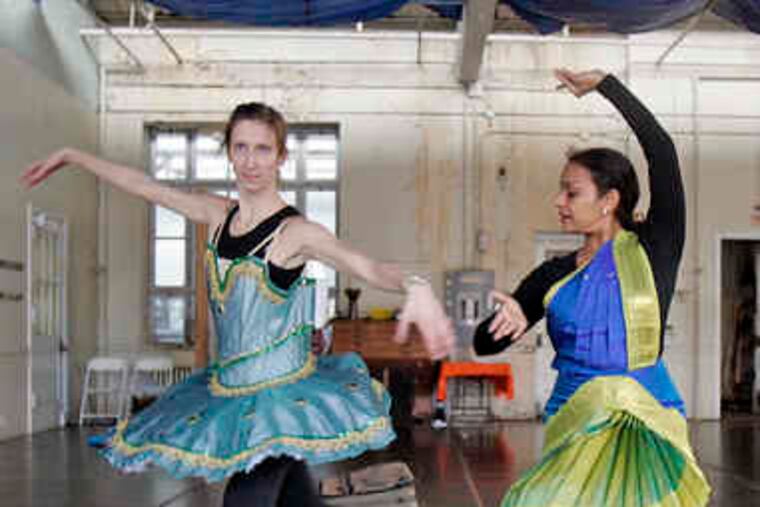
The company's latest work, to be performed Friday and Saturday at the Painted Bride, was inspired by Bharatanatyam (South Indian classical dance) and is a duet for Miller and Viji Rao, a Bharatanatyam dancer from India. At first this seems odd, since it's difficult to imagine two more different types of dance.
Ballet has its roots in 17th-century French court entertainments, while Bharatanatyam goes back at least 2,000 years, to Hindu temple dancers. In traditional ballet, women wear tutus, tiaras, and pointe shoes; a female Bharatanatyam dancer sports ankle bells - and her feet are bare. While ballet focuses "up," Bharatanatyam stays close to the earth: The dancer bends her knees and stamps her feet.
There are similarities between these art forms: Both ballet and Bharatanatyam have very demanding techniques (the latter stresses precise hand positions and eye movements) that take years to master. Also, both are narrative forms, one based on European folk tales, the other on stories of the Hindu gods.
And it turns out that Miller and Rao are more similar than they would ever have imagined.
Miller and her husband, Tobin Rothlein (an accomplished video artist and the writer/director of How Am I Not Myself?), met Rao in 2007. During a recent interview at their Girard College studio, Rothlein explained the genesis of this new piece.
"I recorded interviews with the women," he said, "and found amazing parallels in their lives and careers." Miller and Rao were born less than a week apart. Both began studying dance 30 years ago, at age 4, had their first performances at 5, and went on to become professional dancers. Both experienced the same sort of mid-career crisis, wanting to explore more contemporary styles, and both went to London to do so.
Today, Miller and Rao draw on the classical techniques they learned as youngsters to create entirely new types of movement. But their uneasiness continues. How Am I Not Myself? is about this identity crisis.
Carrying suitcases, the dancers walk onto a stage that is bare except for a clothes rack. As one woman unpacks her costumes, the other tells the story of her life through movement, emphasizing her love/hate relationship with the art form she has served for so long.
Miller and Rao both perform brief solos, each in her own and the other person's style; at various points they execute abstract, contemporary movements, to a score by Indian composer Praveen D. Rao (no relation to Viji). Some of the piece's most effective moments occur when the dancers, dressed in street clothes, engage in verbal dialogues with their classical selves. This is accomplished through Rothlein's innovative films, and showcases the dancers' comedic chops.
"The real question," Miller says, is, "what does it mean to 'contemporize' a classical form?" This is the issue facing many 21st-century artists: How do you keep traditional dance alive and vital, without introducing some innovations? Yet how much can you change, without compromising your artistic roots?
It is typical of Miro Dance Theatre to delve into the deeper philosophical and political issues surrounding whatever project it undertakes. Last year the company premiered Spooky Action, based on a quote from Albert Einstein describing quantum entanglement. To better understand the phrase, Miller and Rothlein visited Fermilab, the particle physics laboratory outside Chicago, to consult with researchers.
Similarly, for How Am I Not Myself?, Miller studied Bharatanatyam with Rao, who learned ballet from Miller. And, as part of their commitment to understanding both sides of this cross-cultural experiment, last month Miro held the work's world premiere in India.
All three artists were nervous about how Indian audiences, unfamiliar with ballet and contemporary dance, would react. In the end, Rothlein said, "The audience feedback we got in India was amazing. . . . They had a completely different take than a U.S. audience would." And despite occasional uneasiness - for example, about when, or if, to laugh - viewers responded positively. In fact, he said, Miro won ovations in both Bangalore and Ahmenabad.
After their weekend at the Painted Bride, Miller says, "I'm not sure what life this show will have." Ideally, she says, "I'd like to see it tour in colleges and universities."
Meanwhile, Miro already is working on its next project: a five-year collaboration with Sophiline Cheam Shapiro, a distinguished performer of classical Cambodian dance.
A Stage for Indian Artists
Who knew there were so many local groups that perform, and/or teach, classical Indian music and dance and related "fusion" forms? Here are just a few:
Usiloquy Dance Designs
Artistic director Shaily Dadiala choreographs pieces combining traditional Bharatanatyam with elements of Indian cinematic ("Bollywood") dance and other forms. She also teaches classes in both through the Archana Dance Academy. See www.usiloquydance.org and www.thearchanadanceacademy.com.
Three-Aksha Dance Company
Established by Viji Rao in 2003. Information about it and Rao's Philadelphia-based Three Aksha Institute of Performing Arts at www.artindia.net/viji.
Spoken Hand Percussion Orchestra
These drummers play music comparing and combining North Indian, Brazilian, Afro-Cuban, and West Indian percussion traditions. See them at the Painted Bride May 7-9. Information: www.spokenhand.org.
Also the Indian Music and Dance Society posts news and events in Pennsylvania, New Jersey and Delaware at its Web site, www.sruti.org. And, just for fun, check out the YouTube clips for celebrated young tap dancer Jason Samuels Smith and Chitresh Das, a master of Kathak, another kind of Indian classical dance. The two toured together in 2009.
- Nancy G. Heller
EndText