Ready for 'incredible opportunity'
David R. Brigham, new CEO of the Academy of the Fine Arts, is preparing for the day the Convention Center - and its 1.5 million visitors - appear outside his front door.
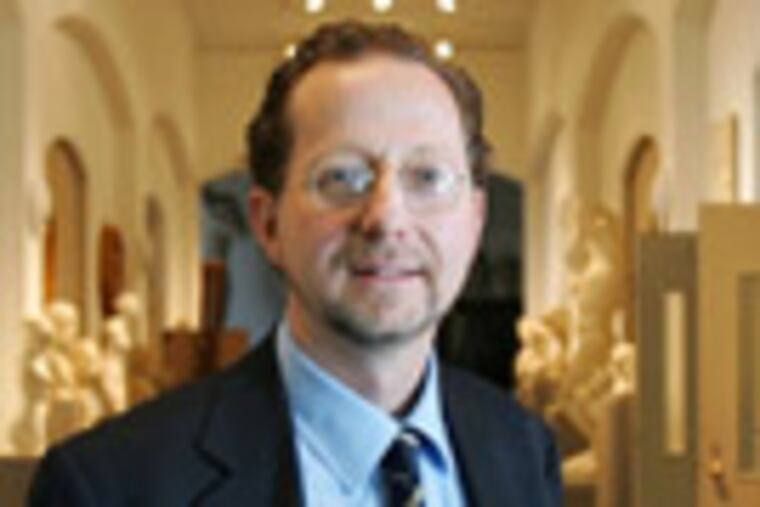
David R. Brigham has eased quietly into the position of president and chief executive of the Pennsylvania Academy of the Fine Arts, at a time that could prove transformative for the nation's oldest museum and art school.
But if Brigham's assumption of the academy's top job has been understated, his conception of the importance of the academy now and in the future is not.
With the westward expansion of the Convention Center, thousands of conventioneers and out-of-town visitors will now come streaming out of that great barn's North Broad Street entrance.
The academy sits directly across the street.
"The Convention Center is anticipating 1.5 million visitors a year," Brigham, 45, noted the other day, as he sat in a third-floor conference room of the academy's Samuel M.V. Hamilton Building at Broad and Cherry Streets. Directly out the windows behind him, the raw girders and angled cranes of Convention Center construction dominated the streetscape. "That's casual traffic like we've never had before on North Broad Street," he said. "It's an incredible opportunity."
The man chosen to lead the 205-year-old museum into this new, heavily trafficked world was named museum director in 2007. Before that he was executive director of the Allentown Museum of Art and director of collections and exhibitions and curator of American art at the Worcester Art Museum in Massachusetts.
He has been instrumental in helping manage the academy through the recent fiscal rapids. While more than two dozen museums nationwide have faltered and closed within the last year, according to the American Association of Museums, the academy's budget is balanced; although some consultancy positions have been trimmed, there have been no layoffs; no exhibitions have been postponed or scaled back; no publications have been canceled.
"David, in our opinion, did an extraordinary job with the museum," said academy board chairman Donald R. Caldwell. "He clearly knows the museum business. He knows how to get it done. He knows how to acquire the resources to get it done. And he has a wonderful vision of the future."
Part of that future is about to leap from the drawing board to the street. Last month, City Council approved a request to close about 200 feet of Cherry Street west of Broad Street, clearing the way for the academy to begin work on its proposed Cherry Street Plaza. The constructed space will link the Hamilton building with its studios, exhibition spaces, and student facilities on the north side of Cherry Street and the landmark Frank Furness-designed gallery and museum spaces on the south side.
Philadelphia's Olin partnership will handle architectural and design work for the fully funded $3 million plaza.
In Brigham's mind, this project potentially weaves together all of the academy's disparate communities and audiences.
Plans are afoot for a major sculptural commission to distinguish the space. A "projects" area will be given over to temporary efforts created by students and faculty from the school and curators from the museum. A restaurant will open on the ground floor of the Hamilton building, creating a Rive Gauche-like atmosphere to the area - or at least some street activity, if not exactly on a Boul'Mich scale.
"First of all, it will unite the campus," Brigham said. "Having the Hamilton building and the historic landmark building side by side for the last five years [since Hamilton was acquired and renovated] has created opportunities for the museum and the school to work more closely together and to feel like the two parts of the whole that they are."
"Creating the Cherry Street Plaza will be the thread that knits it together as a campus. It will also create civic space for interaction between curators and students and faculty and the public."
And then there is the Convention Center, now directly across the street.
"That plaza will be the first impression people have, when they walk out of the Convention Center, of the Philadelphia cultural landscape, so we want to make sure this is their first stop as they visit the city and take advantage of the many cultural opportunities that we have here."
Brigham is sensitive in discussing such projects to two of his institution's key constituents - students and the city, particularly its African American community.
Cherry Street, in his mind, represents a symbolic unification of the academy's two roles, as museum and school, which have not always enjoyed a peaceful coexistence. But Brigham has spent a great deal of time teaching himself and is married to an artist and teacher, Holly Trostle Brigham, who studied at the academy in the early 1990s, eventually receiving her MFA from George Washington University.
"We're one of very few institutions nationally and the only one in Philadelphia that has a first-class museum and a first-class school of fine arts. It's a defining characteristic."
As museum director, Brigham has overseen exhibitions of well-known academy graduates and faculty members, including Philadelphia painters Liz Osborne and Sidney Goodman. A major show by academy graduate Barkley Hendricks recently closed.
Hendricks, one of the school's few African American students in the 1960s, has just been awarded the College Art Association's award for distinguished body of work. About a quarter of this year's freshmen are African American, Brigham said - a major increase from the days when Hendricks attended.
But there are now no African American curators or full-time faculty members, and Brigham has vowed to work hard to change this. (Hendricks, a faculty member at Connecticut College, taught at the academy part-time this past year, as did Moe A. Brooker, an African American artist on the full-time faculty of Moore College of Art and Design.)
In 2011, the academy will present the first major Henry Ossawa Tanner exhibition in 20 years. Tanner enrolled at the academy in 1879, studied with Thomas Eakins, and was one of the first black art-school graduates in the country. Brigham is excited about the show. For one thing, at least 10 "lost" Tanner works have been discovered since the Philadelphia Museum of Art hosted the last exhibition in 1991.
"In the 20 years since then we've had a generation of scholarship about Eakins, about the relationship between photography and American art, about American ex-patriates, about African American art, about orientalism, about French academic art," Brigham said. "These are all things that we can bring to bear on Henry Tanner. There is so much to say."