Art: Graphic breadth and depth
Philadelphia's ideal for Philagrafika 2010, an international printmaking festival. The city has put its stamp on the art for 200 years.
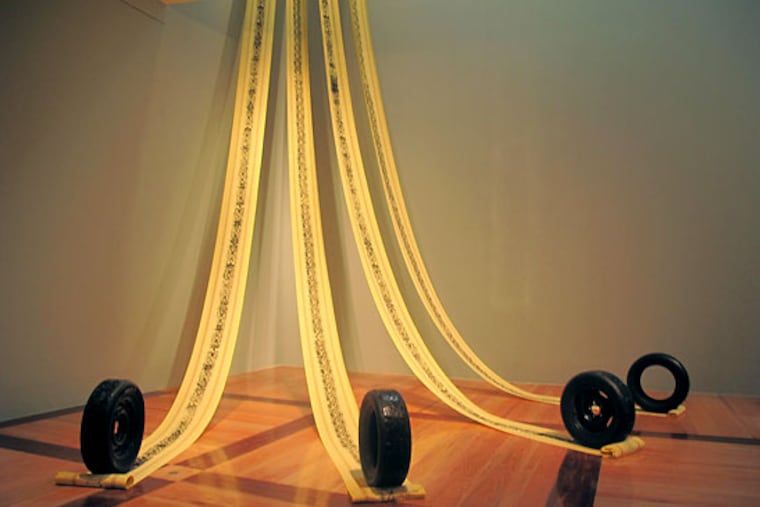
Since the first flowering in Venice in 1895, international art festivals have spread around the globe like kudzu. Now there's even one in Tierra del Fuego - Biennial of the End of the World. (Literally true; check your world map.)
From time to time, some Philadelphia artists have proposed that their city climb aboard this cultural bandwagon. And why not? Center City is a more appealing destination for art tourists than the tip of South America.
Philagrafika 2010, which opens this weekend and runs through April 11, could be the realization of this dream. It appears to be the city's best opportunity to make an impression (no pun intended) on the art world at large, not only because it's international in flavor but also because it's specifically focused on the graphic arts and graphic processes.
The festival is a cornucopia of exhibitions large and small at 88 venues - mostly museums, galleries, and art centers, the majority within the city but including a few in the near suburbs. About 300 artists, many from outside the United States, are participating.
Philagrafika 2010 isn't just another celebration of traditional graphic media such as engraving, etching, lithography, and screen printing, although it presents examples of those.
It aims first to describe how new technologies have extended the expressive range of graphic art. More important, it seeks to demonstrate how integral to contemporary art graphic methods and strategies have become.
In practice, this means many artists today are imposing graphic concepts and techniques on other media to create art that one might not recognize as printmaking per se. A glance at the program indicates that the festival contains many examples of such interdisciplinary coupling.
As artistic director José Roca puts it, "We want to take printmaking out of its ghettoized state, where it has been defined too narrowly. We want people to realize that multiplicity and accessibility are central to contemporary art practice."
Roca explains that, in essence, a print involves three things - a matrix (image), ink or another way to reproduce that image, and a support on which it can be copied, in multiples. Traditional prints use ink and paper, but artists can also use clay, metal, cloth, or even video to achieve comparable results.
Realize, too, that the festival's catholic vision applies not just to traditional printmaking but also to printing technology in general - to any means of mass communication through the printed word such as posters and magazines. It even embraces decoration, which is explored in a presentation at Moore College of Art and Design.
Given those parameters, Philadelphia is an ideal location for an international graphics festival. It has been prominent in fine-art and commercial printing since the early 19th century.
The etching revival of the 1870s and '80s flourished here, and subsequently the city produced a number of artists remembered for their graphic output, among them John Sloan, Joseph Pennell, Benton Spruance, Dox Thrash, Earl Horter, Sam Maitin, Herbert Pullinger, Robert Riggs, and Raymond Steth.
The Print Club, known since 1996 as the Print Center, has been a major generator of graphic activity in the city since its founding in 1915. In the late 1940s, the celebrated British artist Stanley William Hayter conducted weekly etching workshops there.
The most recent expression of Philadelphia's continuing embrace of graphic art is the organization called Philagrafika, founded 10 years ago as the Philadelphia Print Collaborative.
In 2001, the Collaborative, an umbrella organization of 35 museums, galleries, studios, schools, and workshops, organized an exhibition that can be considered the precursor of the current festival. That event, which offered 56 exhibitions, was designed to advertise the city's eminence as a center of printmaking.
Philagrafika 2010 goes beyond that, not only by bringing the world to the city but also by demonstrating that graphic art has gone mainstream.
Roca himself is a symbol of this outreach. A Colombian national, he has had extensive experience running international art events, notably in San Juan, Puerto Rico, and Sao Paulo, Brazil.
He and five local curatorial associates - John Caperton, Sheryl Conkelton, Shelley Langdale, Lorie Mertes, and Julien Robson - have built the festival in three layers.
The top slice, a five-part exhibition called "The Graphic Unconscious," is distributed among five institutions - the Print Center, Moore College, the Philadelphia Museum of Art, the Pennsylvania Academy of the Fine Arts, and Temple Gallery, Tyler School of Art.
Each component elucidates a different theme; for instance, at the Academy seven artists "treat conventional media in new and imaginative ways."
Thirty-five artists are involved in "The Graphic Unconscious," many from Latin America and Asia.
The second festival layer, "Out of Print," plays off history. At each of five institutions - the University of Pennsylvania Museum, the Rosenbach Museum and Library, the Independence Seaport Museum, the Historical Society of Pennsylvania, and the museum of the American Philosophical Society - an artist has executed a project that extends or reinterprets some aspect of the collection.
The festival's largest division, "Independent Projects," consists of shows and activities at 78 galleries, museums, and other organizations that relate, albeit sometimes tenuously, to what's happening under the main tent.
These shows aren't necessarily related to each other, but they're all supposed to address graphic art in some way. As you make the rounds, keep in mind Roca's observation that you'll find traditional and contemporary values in constant tension, "sometimes within the same work."
As you can see, Philagrafika 2010 presents a daunting challenge for anyone who chooses to tackle its menu. Not only is it dispersed around the city, but its quality is bound to vary among the many venues. Multiple excursions will be needed to fairly test its presumptions.
But there's a free map of all the venues and, more important, a guidebook that should be useful in deciding what to see and what to skip. It costs $15, but it's worth the expense if you're planning to put more than a toe in the water.
Note that the festival title includes 2010 - a hint that more of these extravaganzas are planned. Philagrafika (the organization) would like to make the festival a triennial, which would allow the city to establish a tradition to rival those elsewhere.
Whether that happens depends on the turnout for the inaugural, and on the organizers' ability to cover another million-dollar-plus budget - this year's program cost $1.3 million.
Art:
Edward J. Sozanski's and Edith Newhall's reviews
of the five exhibitions that make up "The Graphic Unconscious" will appear in Arts & Entertainment on Feb 14.
EndText
Art: Graphics Galore
Philagrafika 2010 opened Friday and will end April 11; however, dates of the 88 individual exhibitions and projects vary. Shows, especially those in the "Independent Projects" portion, may open and close earlier or later. Check the festival Web site, www.philagrafika2010.org, or the official guidebook for dates and hours of opening. The guidebook is available online or at the five locations for "The Graphic Unconscious." A free map locating all festival sites is available at art venues around the city. EndText