Exploring African roots and branches
'It's a dream that has become a reality," Senegalese choreographer Germaine Acogny said of the creation of Les écailles de la mémoire ("The Scales of Memory"). The work took the United States by storm during a 2008 tour that culminated at the Brooklyn Academy of Music, where Acogny's all-male, Senegal-based Compagnie Jant-Bi and Brooklyn's Urban Bush Women danced its visceral Afro-European choreography.
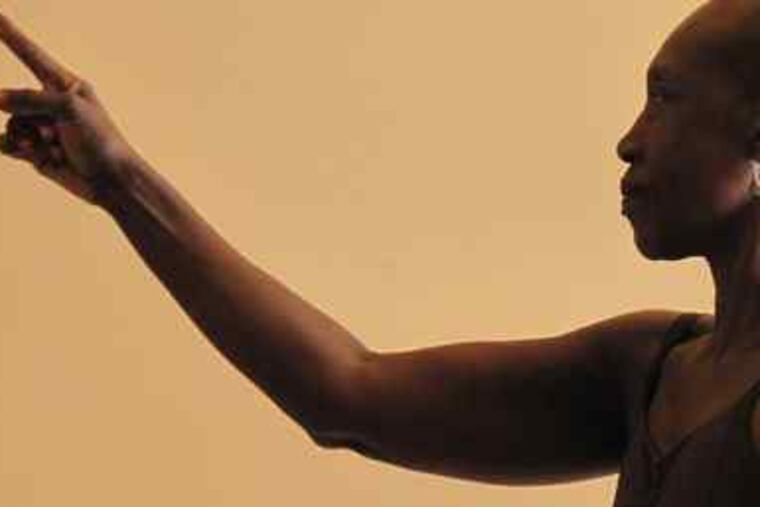
'It's a dream that has become a reality," Senegalese choreographer Germaine Acogny said of the creation of
Les écailles de la mémoire
("The Scales of Memory"). The work took the United States by storm during a 2008 tour that culminated at the Brooklyn Academy of Music, where Acogny's all-male, Senegal-based Compagnie Jant-Bi and Brooklyn's Urban Bush Women danced its visceral Afro-European choreography.
This weekend, Urban Bush Women will dance the female section of Les écailles at Bryn Mawr College, at the opening celebration of the newly renovated Goodhart Hall and the college's Performing Arts Series' 25th anniversary. The evening promises stunning virtuosity as well as deep sociological and political import, with the Bush Women's propulsive locomotion and Jant-Bi star Pape Ibrahima Ndiaya (stage name Kaolack) in his solo J'Accuse.
"To bring together, to unite Africa and its diaspora," says Acogny, "what way could be better than through dance?" But collaborations can prove problematic when the finished work has no clear auteur. In the case of Acogny and UBW director/choreographer Jawole Willa Jo Zollar, the collaboration grew slowly over several years, beginning with in 2004 at the University of Florida, where both were featured lecturers at a conference on African studies and dance research.
"When I met Jawole for the first time, I immediately felt her telluric force," Acogny said in an artistic statement. This earthy force is the shared attribute that allows the two choreographers to bridge the divide between their cultures.
Brenda Dixon-Gottschild, dance historian, author and critic, puts it best in her program essay, describing one of the signposts of Africanist techniques as "groundedness in body posture, meaning a sure-footed contact with Mother Earth."
Acogny, who began her career in Senegal working with Mudra Afrique, Dakar, created by Belgium's Maurice Béjart, eventually moved to Brussels to work with Béjart's company. There she absorbed the European contemporary dance that informs her choreography. Currently she and her husband, Helmut Vogt, divide their time between Europe and Senegal, where they founded Jant-Bi in 1998.
Zollar founded Urban Bush Women in 1984 and is marking 25 years of dance about empowering diasporan black women, who she says epitomize the "expressive, dramatic movement and an encyclopedic range of movement motifs centered around polycentric, polyrhythmic use of the body" - also on Dixon-Gottschild's list of Africanist movement traits.
"Germaine and I were drawn to one another based on a shared source of inspiration - the role of individual identity within a community," says Zollar. "We met five times with the promise not to work on the piece unless we were all together."
Lisa Kraus, a former Trisha Brown dancer who has turned her hand to choreography and dance writing, is now coordinator of the Performance and Art Series at Bryn Mawr. "We began talking to Germaine and Jawole in the fall of 2008," she said. "Last February we got word we had funding to present a portion of Les écailles from Dance Advance," the regional dance-support group.
Jant-Bi made its mark in the United States when it toured German choreographer Susanne Linke's and Israeli choreographer Avi Kaiser's brilliant, controversial Le Coq est Mort ("The Rooster is Dead"), with its unsettling images of modern men regressing to apes.
This spirit of encountering choreographers from different cultures informs and electrifies the cultural fusions of Jant-Bi. Their collaboration with Japanese choreographer Kota Yamazaki resulted in the 2007 Bessie Award-winning Fagaala ("Genocide" in the Senegalese language Wolof), a fusion of Japanese Butoh and traditional and contemporary African dance that movingly explored the Rwandan genocide. Yamazaki directs the Japanese modern-dance company Fluid Hug-Hug, seen here in 2008.
Acogny, at 65, is creating a new solo called Songook Yakaar for the Bryn Mawr appearance. "After all her work in Europe, Germaine chose to go back and reexamine her native heritage," Kraus marveled. "She's like an ultimate postmodernist in that way."
Bush Women dancer Catherine Dénècy will also perform a new solo. "And Jawole," said Kraus, "who is a show woman, will dance her fabulous solo from Walking with Pearl . . . Southern Diaries, which honors Pearl Primus."
"In Les écailles, we embody the idea of resistance," said Zollar, "for the men, to colonialism and loss of identity, and for us women, resistance through the civil rights and equal rights movements."
Divided by a vast ocean of space and time, these two choreographers and the dancers they work with no doubt share a small pool of genes that make their collaboration seamlessly authentic.
Urban Bush Women & Pape Ibrahima Ndiaya
Urban Bush Women
& Pape Ibrahima Ndiaya
8 p.m. Saturday at Goodhart Hall, Bryn Mawr College. Tickets: $10-$18. brownpapertickets.com or 610-526-5210
EndText