Art: The clatter of creation by Chinese weavers
Colorful tapestries emerge at the Fabric Workshop, figures based on memories of Anne d'Harnoncourt.
'Fallen Blossoms" began with a sequence of bangs on Dec. 11 when a giant firework lotus blossom dazzled a shivering crowd on the east terrace of the Philadelphia Museum of Art.
The multipart project by Chinese artist Cai Guo-Qiang will end more quietly in a few weeks, when five tapestry looms at the Fabric Workshop and Museum fall silent after several months of shuttling and clattering.
Cai is renowned for large abstract drawings made with burning gunpowder; four of these remain on view at the Art Museum through March 21.
At the workshop, he has explored the transience of memory, particularly recollections by founder and artistic director Marion Boulton Stroud of her longtime friend Anne d'Harnoncourt.
Cai created two installations on this theme. Time Scroll is a 120-foot-long gunpowder drawing on a wide ribbon of silk that has been immersed in water coursing through a stainless-steel trough since December.
The running water is supposed to gradually efface the images on the silk, creating an analog to the vagaries of memory. Yet after nine submerged weeks, the portraits of both women remain legible, along with most, if not all, of the abstract smudges and streaks produced by the gunpowder.
With four weeks to go (the installations remain on view through March 22), it seems unlikely that Time Scroll will be bleached Rinso-white, or anything close to it. Water isn't all that powerful a solvent.
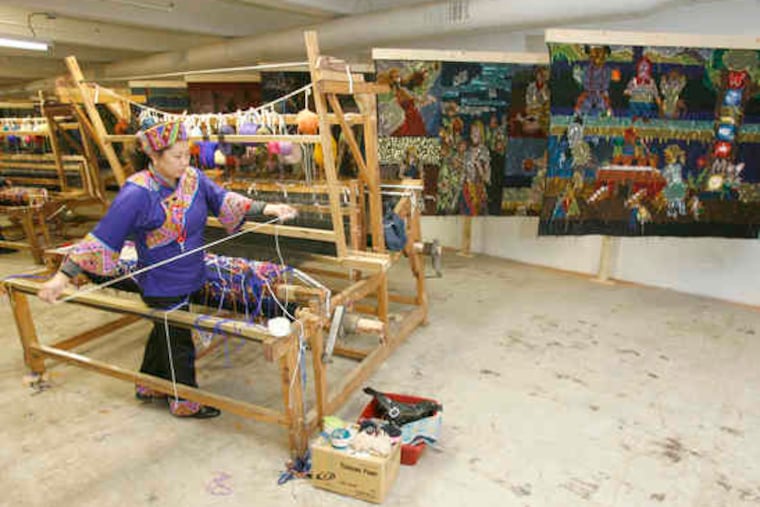
Cai's weaving installation, Time Flies Like a Weaving Shuttle, has produced far more positive results. Since Dec. 11, five weavers from China's Hunan province have produced an impressive amount of woven imagery based on Stroud's narrative.
By Feb. 12, when I visited, the women had completed 13 colorful tapestries, each about 5 by 7 feet. They had been working every day, eight hours on weekdays, five on weekends; they took last weekend off for the Chinese New Year.
Five partially finished pieces were on the large, clattering Chinese looms. The weavers' goal is to produce 20 tapestries before they return home on or about March 1.
Time Flies Like a Weaving Shuttle is a curious project in that it began at zero and took shape as the weeks passed. Visitors don't get to see its entirety until after the women stop working Thursday. At this point, though, there's abundant evidence to evaluate how they responded to their commission, which must have been daunting.
Consider: The weavers, chosen by Cai, were dropped into an alien culture for 10 weeks. Whatever they know of the United States, the two museums, and Anne d'Harnoncourt they gleaned from the World Wide Web.
They speak only Mandarin and their native Hunanese - translators facilitate communication with visitors. They were given an extended reminiscence, in text form, by Stroud about d'Harnoncourt, director of the Art Museum from 1982 until her death, and asked to translate that into tapestries. Degree of difficulty - formidable.
Yet the two master weavers and three apprentices, working on larger looms and with a brighter yarn palette than they usually use, have delivered the goods.
They have created a suite of figurative images that include views inside the museum where d'Harnoncourt began as a curator, her wedding to fellow curator Joseph J. Rishel, and a Center City scene blended with Chinese motifs such as the Great Wall.
In China, the weavers work with vegetable dyes in smaller formats, and abstractly. The workshop tapestries, executed from designs developed by the masters, are figurative. They're typically montages of various elements that occasionally incorporate English words such as "Welcome" and "How Time Flies."
The tapestries don't display the fine detail that one notices, for instance, in the decorative banding on the weavers' blue blouses, but some contain multiple figures that are defined sufficiently to allow one to recognize a Picasso self-portrait in the Art Museum's collection.
I must advise you here that Cai hasn't made it easy for visitors to recognize anything without some effort. This is why:
The completed tapestries are hung from L-shaped frames that line one long, relatively dark wall of the gallery in which the weavers are working. The frames are set at an angle to the wall, and they are fixed in one position.
The angled frames allow all the tapestries to fit into the space available for display. This arrangement means that one can't just walk along a line, as one would to view a hanging of paintings. One must zig and zag.
A more serious problem is that Cai has chosen to hang the tapestries wrong side out. They're simple weaves, meaning there is only one finished side. Cai apparently found the unfinished sides, with their tailings of yarn and somewhat abstract blocks of color, more visually interesting.
The hanging scheme, which obscures half of each image, is eccentric at best, perhaps even perverse. Visitors can see the "finished" sides only by walking between the frames, into angular, confined and poorly lit spaces that don't permit a long view.
The unfinished sides are intriguing to a point, but I doubt that the majority of visitors would find them so compelling as to command their primary attention. I wonder, too, how the weavers feel about having their work displayed this way.
Well, "Fallen Blossoms" is Cai's show, and his international acclaim (he did the spectacular fireworks at the 2008 Beijing Olympics) guarantees such prerogatives. Yet this odd decision prompted me to wonder about another disturbing aspect of the project that isn't visible to the public.
As the tapestries demonstrate, the workshop portion of "Fallen Blossoms" is all about Philadelphia. It's particularly about a personal relationship between two of the city's cultural leaders. One would expect, then, that some portion of it would remain here after the exhibition closes.
When artists produce multiples during residencies at the workshop, an example customarily ends up in the permanent collection. This isn't inevitable with "Fallen Blossoms."
According to Stroud, her organization's contract with Cai doesn't specify that it will acquire one or more tapestries. She added, however, that the artist promised to be "generous" in this regard. One can only hope.
The tapestries are Cai's to do with as he pleases. However, they are so site- and subject-specific that one can't imagine any other venue where they would make complete sense.
Let's hope that generosity prevails, and that somehow, in some measure, this tribute to a woman who raised the city's art profile to international stature can continue to delight future generations of Philadelphians.
Art: Woven Memories
Time Scroll and Time Flies Like a Weaving Shuttle continue at the Fabric Workshop and Museum, 1214 Arch St., through March 22. Thursday is the last day to watch the Chinese weavers in action. Hours are 10 a.m. to 6 p.m. Mondays through Fridays and noon to 5 p.m. Saturdays and Sundays. Admission is $3. Information: 215-561-8888 or www.fabricworkshopandmuseum.org.
EndText