New Recordings
Pop This one feels like a gift. Johnny Cash died in 2003, and a flurry of posthumous releases immediately followed, including the 2003 box set Unearthed and 2005's American V: A Hundred Highways, all drawn from the ongoing American Recordings sessions with producer Rick Rubin, which typically found the imposing and iconic master of American vernacular music singing accompanied by little more than an acoustic guitar.
Pop
American VI: Ain't No Grave
(American Recordings/Lost Highway ***1/2)
nolead ends This one feels like a gift. Johnny Cash died in 2003, and a flurry of posthumous releases immediately followed, including the 2003 box set Unearthed and 2005's American V: A Hundred Highways, all drawn from the ongoing American Recordings sessions with producer Rick Rubin, which typically found the imposing and iconic master of American vernacular music singing accompanied by little more than an acoustic guitar.
But there had been nothing since until American VI, a 10-song collection said to be the final installment in that series, recorded mainly in the months between the death of Cash's wife, June, in May 2003 and his own in September of that year. There's one new Cash original, "I Corinthians 15:55," plus covers familiar (Kris Kristofferson's "For the Good Times" and Bob Nolan's cowboy song "Cool Water") and surprising, such as Queen Lili'uokalani's sweet farewell "Aloha Oe."
Cash's still resonant voice may quiver, but his spirit is strong, and the spare arrangements, which feature ace players such as Mike Campbell and Smokey Hormel, are elegant in their simplicity. "Ain't no grave can hold my body down," Cash sings on Brother Claude Ely's title song, and six years after his death, American VI finds him singing out, sure and true, with undiminished, heart-wrenching power.
- Dan DeLuca
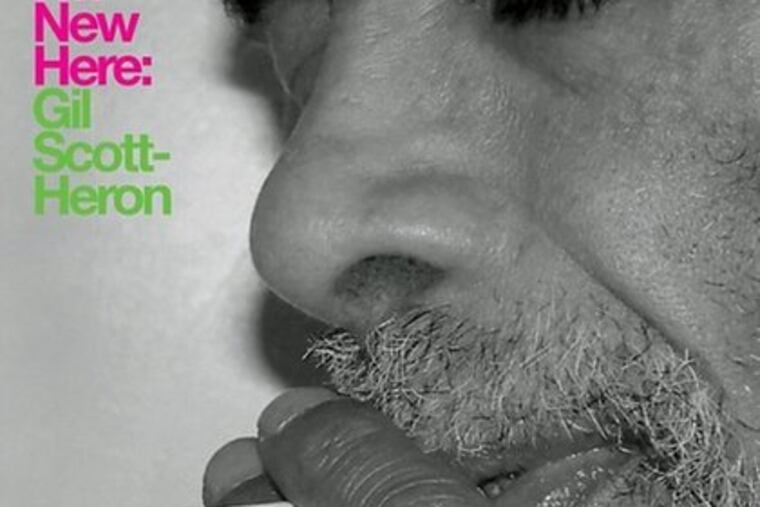
nolead begins Gil Scott-Heron
nolead ends nolead begins I'm New Here
nolead ends nolead begins (XL ***1/2)
nolead ends "If I hadn't have been as eccentric, as obnoxious, as arrogant, as aggressive, as introspective, as selfish," Gil Scott-Heron confides on a spoken interlude on his short and stunning first studio album in 16 years, "I wouldn't be me. I wouldn't be who I am."
And if Scott-Heron hadn't followed a stubbornly unconventional artistic path in his 1970s heyday with penetrating - and sometimes pedantic - jazz/R&B/spoken word explorations such as "The Revolution Will Not Be Televised" and "The Bottle," he wouldn't have been tagged with such sobriquets as "the black Bob Dylan" and "the godfather of Rap."
After two drug-related stints in prison and decades out of the spotlight, however, Scott-Heron, 60, returns sounding as warm and inviting as ever, though no less astute. I'm New Here starts off with a well-earned and impressively eerie take on the Robert Johnson blues "Me & The Devil," thoroughly modern in its production and timeless in its evocation of dread. At 28 minutes, I'm New Here, whose title cut is a wry acoustic cover of a song by Smog's Bill Callahan, is a concise musical autobiography. He doesn't sing much anymore, but in commanding, cigarette-scarred voice, he sure talks a good game, with a knack for spoken, off-the-beat phrasing to rival Willie Nelson. I'm New Here ranges wide as it makes smart use of Kanye West samples and references to Greek mythology and outlines the battle between good and evil with "Your Soul and Mine" at stake. And it knows full well the answer to the musical question "Where Did the Night Go"?
- D.D.
nolead begins Ali Farka Toure
and Toumani Diabate
nolead ends nolead begins Ali & Toumani
nolead ends nolead begins (Nonesuch ****)
nolead ends This is the third collaboration between guitarist Ali Farka Toure and kora player Toumani Diabate, both from Mali, ending a process that began with 2005's Grammy-winning In the Heart of the Moon. It's the final recording for both Toure, who died in 2006, and the great Cuban bass player Orlando "Cachaito" Lopez, who died last year.
Full of slow-paced grooves and subtle modal melodies, Ali & Toumani balances Toure's deep, bluesy acoustic guitar with Diabate's trebly, pointillistic harp on a set of traditional African melodies. It's a quiet, moving, peerlessly beautiful album. While many tracks include bass, percussion and/or brief vocals, it comes across as an instrumental duo recording. Yet it's so colorful and articulate that it never risks disappearing into background music: it's as easy to get lost in telepathic interplay between Toure and Diabate as to let the songs wash over you in shimmering, transcendent waves.
- Steve Klinge
nolead begins Daniel Merriweather
nolead ends nolead begins Love & War
nolead ends nolead begins (J-Records ***)
nolead ends Great artists often have a go-to-guy they use repeatedly when they need to show off. Martin Scorsese has Leonardo DiCaprio. Seth MacFarlane has himself. And producer Mark Ronson has Daniel Merriweather. The Australian vocalist with the soulful, airy pipes graced Ronson's little-heard 2003 effort Here Comes the Fuzz. On the smashing Version (2007), where Ronson had inventive singers Amy Winehouse and Lily Allen by his side, Merriweather reigned with a coolly emotional "Stop Me" medley of the Smiths' "Stop Me If You Think You've Heard This One Before" and the Supremes' "You Keep Me Hangin' On."
Now, Ronson repays the favor by producing Merriweather's debut and bringing Version's band the Dap Kings to horn up the likes of the hypnotic Motown-ish "Impossible."
Merriweather's gusty winds are designed for R&B-flavored melodies like "Water and a Flame," a duet with smoky diva Adele. His voice is huffy at every slow burn. But the nicest thing about this CD is how Merriweather proves he's no one-trick pony. Sure, there's plenty of acrobatic leaping about from the 27-year-old, but he pares down nicely on the folkie ballad "Red" and the singsongy "Change" for music tender and low-key.
- A.D. Amorosi
Country/Roots
Reform School Girl
(Eclecto-Groove ***)
nolead ends As a guitarist with the Fabulous Thunderbirds, Nick Curran was one of several successors to the impeccable Jimmie Vaughan, who played on Curran's national debut in 2003. Now, for his third album, the onetime apprentice to Ronnie Dawson gets the imprimatur of another great roots-rocker, Blasters singer Phil Alvin, who duets with Curran on their cowritten "Flyin' Blind" and who hails him in the liner notes as a "pedal to the floor American rock-and-roll musician, the kind that made you love rock music in the first place."
Alvin's got that right. Curran is an unabashed throwback who flirts with being excessively derivative, but he delivers everything with his own ripped-throat intensity and dirty-toned flair. Save for one ballad, Reform School Girl hurtles along relentlessly, a glorious cacophony of guitars, horns, and piano, from the Little Richard-style wailing of "Tough Love" to the girl-group homage of the title song and the psychobilly of, well, "Psycho." Curran's only misstep is "Kill My Baby," whose nasty sentiments seem out of place on an album that is one huge blast.
- Nick Cristiano
nolead begins Eric Bibb
nolead ends nolead begins Booker's Guitar
nolead ends nolead begins (Telarc ***)
nolead ends The title of Eric Bibb's new album refers to the National guitar of the late Delta bluesman Bukka White, which Bibb got to play with the help of a fan in Britain. As he tells it in the liner notes, the experience inspired the modern-day bluesman to deepen his connection to traditional country blues.
The result is a set that honors the tradition with intelligence, grace, and feeling. In the title song, Bibb sings, "Booker's guitar got a story to tell." And so does Bibb. Working with just harmonica player Grant Dermody, the singer-guitarist offers 13 original songs among the album's 15. Some, like "Flood Water" and "Sunrise Blues," can seem like "a Delta flashback," to use his term. But he also draws from his own experience: "Turning Pages," for one, celebrates his own joy in reading, and "A-Z Blues" puts a clever spin on the road song, underscoring the way Bibb has put his own stamp on this still-vital musical form.
- N.C.
Jazz
Restored, Returned
(ECM ***)
nolead ends Norwegian pianist and composer Tord Gustavsen creates another bewitching CD. This soft-focus session with its delightful silences and slowly baked vibes pushes the leader beyond a trio, which dominated his last two ECM releases, Being There and Changing Places.
Here Kristin Asbjørnsen offers a few achy vocals, including one on the bluesy "Lay Your Sleeping Head, My Love." She can sound like a mix of Norah Jones and Tom Waits. Tenor and soprano saxophonist Tore Brunborg pretties up a few moments, too.
The tunes tend to be short, storylike vignettes, pulsed by the subtle offerings of drummer Jarle Vespestad and bassist Mats Eilertsen. This CD seems more experimental than his earlier ones and harder to appreciate. The title track is a bit formless.
But "The Child Within" is one of those tunes that make Gustavsen special. It's a simple and arresting duet between piano and saxophone with a melody that might make residents of Garrison Keillor's Lake Wobegon express some dark emotions. Gustavsen shows he's definitely above average.
- Karl Stark
nolead begins Sam Sadigursky
nolead ends nolead begins Words Project III: Miniatures nolead ends nolead begins
(New Amsterdam **1/2)
nolead ends Pianist and composer Sam Sadigursky is a rarity in jazz: he plays with words.
His second CD presents 18 poems in jazz and pop settings, covering works from Americans William Carlos Williams, Carl Sandburg, David Ignatow, and Emily Dickinson to Portuguese writer Fernando Pessoa, Colombia's León de Greiff, and Russian Maxim Gorky, among others.
The global selections suit Sadigursky, whose classically trained parents met at a conservatory in Moldova. Sadigursky grew up in L.A. and studied with bassist Rufus Reid at William Paterson College in North Jersey.
His arrangements often obscure the poems, which can be hard to make out without the notes. Many exude a trancelike quality with light and busy percussion, intense voices, or occasional pop settings.
His effort lacks the impact of, say, pianist Fred Hersch's Leaves of Grass of 2005. But Sadigursky's fuzzy focus often makes it intriguing in an art-house kind of way. Williams' "Danse Russe" comes with a happening jazz bass, while Maureen N. McLane's "Ode" is a pretty ditty with a very familiar intro a la Leonard Cohen.
- K.S.
Classical
Schumann: Dichterliebe. Brahms: Lieder
Malcolm Martineau, piano
(Sony ***1/2)
nolead ends nolead begins Songs by Schubert, Wolf, Faure and Ravel
nolead ends nolead begins Martineau, piano
nolead ends nolead begins (Wigmore Hall Live ***1/2)
nolead ends For all of his glamorous "barihunk" appeal, Simon Keenlyside has long been a serious art-song interpreter, though on these two recent discs, he seems to have progressed to performances of even greater emotional specificity and imagination. On the Sony Disc, the Brahms songs are among the best recently recorded: Though the composer wasn't one for song cycles, each individual song is full of dense, sophisticated piano writing that creates a world unto itself, especially with Keenlyside's sense of dramatic focus, born of his command of the German language and unmannered use of vocal shading. Schumann's more-famous Dichterliebe is a tad less successful: Keenlyside gets overly operatic at key moments and comes off a bit strident.
The Wigmore Hall recital shows an even greater range, though unlike many singers, he doesn't oversell the descriptive animal effects of Ravel's Histoires naturelles. As in the Sony disc, the most distinctive performances are in music that singers find most challenging: Hugo Wolf, whose often knotty songs have a simultaneous sense of musical inevitability while taking you deep into their poetic worlds.
- David Patrick Stearns
nolead begins Baltic Exchange
Music of Ugis Praulins, Maija Einfelde, Urmas Sisask and Vytautas Miskinis
nolead ends nolead begins Choir of Trinity College, Cambridge, Stephen Layton conducting
nolead ends nolead begins (Hyperion ****)
nolead ends Early this year when the local choir the Crossing unveiled great music by the little-known young Latvian composer Eriks Esenvalds, you had to wonder what other riches were out there. One answer is in this disc of unaccompanied choral works, all by living composers from Baltic countries in the last 20 years. They treat the medium with the kind of range and complexity one associates more with symphonic writing.
Soaring melodies, folklike tunes, drones with religious gravity, and stylized speech are all encompassed by these works, the biggest among them being Ugis Praulins' Missa Rigensis - one of the most original and personal settings of the Mass text imaginable. Best of all, this is a disc to live with: There's much to enjoy on first hearing, but all the pieces have dramatic new revelations on subsequent encounters.
- D.P.S.