Another busy year for Art Museum's Michael Taylor
"I think," said Michael R. Taylor, flashing a bright smile, "I'm going to take a little break now." It's not that he's haggard from pulling together the Philadelphia Museum of Art's next big exhibition, Picasso and the Avant-Garde in Paris, which opens tomorrow with more than 200 paintings, sculptures, and works on paper.
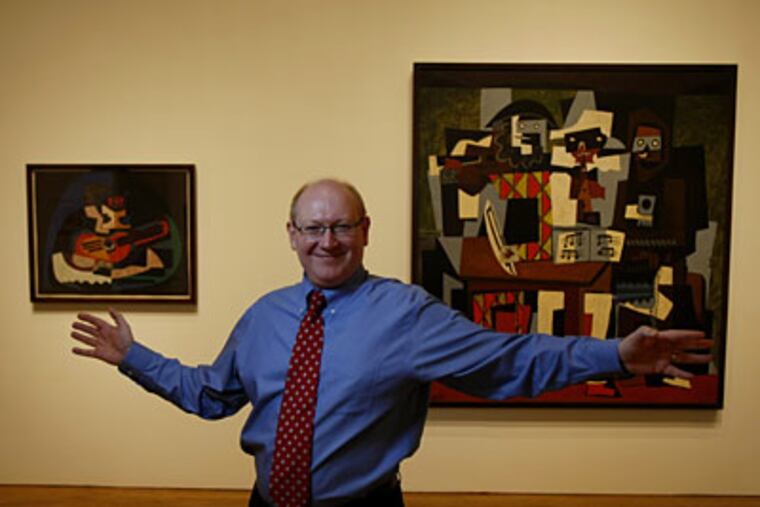
"I think," said Michael R. Taylor, flashing a bright smile, "I'm going to take a little break now."
It's not that he's haggard from pulling together the Philadelphia Museum of Art's next big exhibition, Picasso and the Avant-Garde in Paris, which opens tomorrow with more than 200 paintings, sculptures, and works on paper.
In fact, the Picasso extravaganza has been immensely satisfying, a kaleidoscopic coda to 2009, Taylor's annus mirabilis, during which art and its public presentation and discussion poured out of him in tidal flows.
The museum's curator of modern art has been, it could be said, a busy man, and his prodigious output leaves colleagues, friends, and observers amazed.
"I don't know how he does what he does," said Therese Dolan, former interim dean at Temple's Tyler School of Art and a professor of art history specializing in French modernism. "He's so productive. When he takes something on, he takes it on. He doesn't shirk at all."
There was, of course, the museum's last mammoth exhibition, the transformative Arshile Gorky: A Retrospective, which closed here last month and has just opened at the Tate Modern in London.
Before that, Taylor pulled together the epic Marcel Duchamp show, Étant donnés, a meticulous exploration of a single complicated and mysterious work of art that ran from August to November.
He was a major force in the art museum's startling Bruce Nauman exhibition at the Venice Biennale, winner of the Golden Lion Award at the 53d international festival last summer.
He produced Henri Matisse and Modern Art on the French Riviera - a show that spent most of last year shedding sunlight on the first floor of the museum's Perelman Building.
He contributed expertise and an essay for Cezanne and Beyond, the museum's spectacular spring show; he edited the Gorky and Duchamp exhibition catalogues, and wrote copiously for them as well. He wrote an essay on Nauman for the museum's biennale catalog, and somehow, amid all that, managed to spend hours at his home near the museum with his wife and daughter, who is just starting to walk and talk and listen to stories.
"The pace of things has been remarkable," said Christine Poggi, a professor of art history at the University of Pennsylvania who specializes in Cubism, Futurism, and other aspects of classic Modernism. Taylor is teaching a class at Penn at the moment, too, and has offered the Picasso show as a suitable seminar setting. He welcomed students into the Duchamp show as well.
"For me, its a fabulous opportunity to work with him," Poggi said. "To have a seminar devoted to the subject at the Philadelphia Museum of Art presents a terrific opportunity. He's really a great colleague. You can feel the enthusiasm."
The 42-year-old, London-born Taylor came to the museum in 1997 but already had spent time in Philadelphia while researching his Courtauld Institute doctoral dissertation, on Duchamp's ready-mades. Then-museum director Anne D'Harnoncourt spotted him in Paris when he curated a 1995 Duchamp segment of a show at the Pompidou Center, and within two years had brought him to Philadelphia, where he became curator of modern art in 2004 and has been sprinting ever since.
Yet at the moment, Taylor is hardly gasping for time off. When he says he wants a break, he means something a bit different.
"One of the things about doing back-to-back-to-back exhibitions is that there are some things I simply can't do," he said in a recent interview. "Chief among that are things like acquisitions. I think I want to spend the next couple of years really looking at acquisitions, and I think another thing I want to do is build for the next show, which will probably be about 2013."
What that show might be is still under wraps, but Taylor is happy to talk about the looming Picasso, which he carved almost entirely out of the museum's own holdings.
The spirit of d'Harnoncourt, who died in 2008, infuses much of what Taylor has produced in the last year, he said. And the presence of her successor, Timothy Rub, can be felt with Picasso.
"A lot of these shows were planned already," Taylor said. "But with Anne's passing, there was a kind of urgency about them, I felt, especially with the Duchamp, the Nauman and the Gorky. There was a sense of, 'We can do this. We can put these shows on and do a fabulous job, a sense of continuing her legacy and the standards that she set.'
"And then Picasso was also something. I knew once Timothy was hired it was going to be the beginning of a new era. It was the first show where he and I really walked through the galleries together and discussed the themes of the show and the way in which the galleries would tell that story about Picasso and modern art in Paris in the first half of the 20th century."
Many considerations went into the museum's decision to slot a Picasso show at the beginning of the spring season. From a curatorial perspective, the museum has rich holdings, many fragile and rarely seen. These drawings, paintings and sculptures have a story to tell. Why not tell it?
From an operations perspective, mounting a show drawn largely from the museum's own collection is far less costly than a show consisting largely of loaned material.
Taylor understands the financial realities of the moment. But he also sees Picasso as special.
"Any modern art curator worth their salt dreams of a Picasso show," he said. "You get one shot at it, really, in your lifetime. And this is my shot. I'm thrilled with it. I think it's going to be a really fascinating show."
Taylor says he conceived of the Gorky exhibition as a tragedy in three acts. But the story of Picasso is "a novel," a bildungsroman of aesthetics in the 20th century.
"It basically takes you from him arriving in Paris, and becoming the leader of an avant-garde," he said. "So the early rooms are devoted to mapping out Cubism as it developed, the beginning of collage, papier-collé, the return to color in Synthetic Cubism."
In textbook accounts, Taylor went on, Cubism essentially ends in 1914 with Georges Braque heading off to war and Picasso remaining in Paris, becoming involved, eventually, with the Ballets Russes.
"But with our collection we have the Three Musicians, which is a huge painting, 1921 - it's kind of the culmination of Synthetic Cubism and allowed me to build a room called 'Cubism Between the Wars' that really shows that Cubism didn't end with the First World War and continues in earnest in the '20s and '30s, undergoing many changes, bringing new artists to the ranks."
Another aspect of the show will be the evocation of the 1912 Paris exhibition that unveiled radical Cubist experimentation for the public.
"We're going to recreate the 1912 Salon d'Automne, which is the first time the public saw Cubism," said Taylor. "The reaction was, obviously, horror, and this was the year before the Armory show," which introduced modernist works to New York, "and there was a similar reaction, a similar disbelief. But also amongst artists, this thrilling thing. They'd heard about Cubism, but they hadn't really seen it. And to have it on the walls like that!"
Taylor relishes the thought of visitors to this exhibition, visitors who can be awakened to all that there is to know about Picasso in Paris.
"The vast majority of the scholarship on this artist is on Cubism, and it's on that 1908-to-1914 moment," he said. "You look at Picasso in the '20s, the '30s, there is a lot to be said. And we're tackling that in the show. . . .
"Amazing building. Amazing collection. So I'm happy here, I must admit."
If You Go
"Picasso and the Avant-Garde in Paris" opens tomorrow and runs through April 25. Ticket information: 215-235-7469 or www.philamuseum.org.EndText
Review on Sunday
Contributing art critic Edward J. Sozanski's review of "Picasso and the Avant-Garde in Paris" will appear in Sunday's Arts & Entertainment section and will be available at Philly.com on Friday.EndText