Art: Ravaged landscapes, ugly yet not
A photographer searches " for a dialogue between attraction and repulsion."
Edward Burtynsky is the Ansel Adams of despoliation. Where Adams depicted nature in its sublime state, the Canadian photographer examines the negative impact of man's industrial interventions.
Yet it isn't quite that simple, because, as Burtynsky observes in a statement, his large-scale color images are conceived as "metaphors for the dilemma of our modern existence. They search for a dialogue between attraction and repulsion, seduction and fear."
In other words, while photographs of vast oil fields, streams tinted orange by mine tailings, and hillsides defaced by railroad cuts might strike one initially as ugly, there is often a countervailing beauty in such scenes, if one considers them purely on aesthetic grounds.
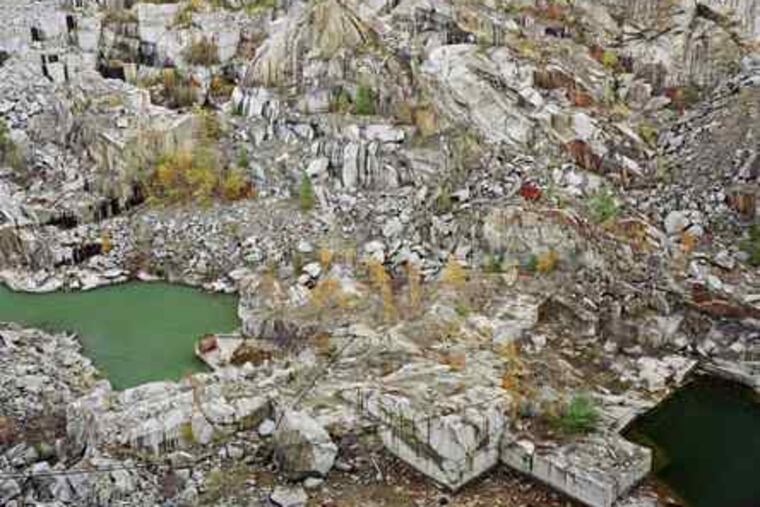
I'm thinking particularly of three photographs included in Burtynsky's exhibition in the Berman Museum at Ursinus College in Collegeville. Made in 1991, they depict faces of a granite quarry in Barre, Vt. Two sections were then being worked; the other was abandoned and partially overgrown.
The patterns formed by the extraction of blocks of gray stone in vertical layers simulate a cubist abstraction, something like Willem de Kooning's famous 1948 canvas Excavation. Even the palette of dry, light gray granite and stone darkened by moisture, with edges dusted by snow, is apposite.
The two working faces are arguably the most beautiful pictures of the 18 in the show. The abandoned quarry, dotted with small, golden-leafed birches and accented by a pool of turquoise water, presents a different aspect, one that's almost natural.
Elsewhere, the tension between beauty and the beast is more tightly calibrated. Burtynsky concentrates on extractive industries such as mining and oil drilling and on transportation, in this case railroads and ships.
The most striking image of those in the oil suite is also the most superficially benign, depicting multiple silver pipelines zigzagging through a clearing cut through a boreal woodland in Alberta.
That contrasts profoundly with a beige landscape in California in which walking-beam oil pumps stretch to the horizon. It's as awe-inspiring in its own way as Adams' picture of Half Dome in Yosemite.
For a more heavily compromised landscape, Burtynsky turned to the Tang-colored stream carrying tailings from an Ontario nickel mine, and to the carcasses of derelict cargo ships being dismantled by laborers called shipbreakers on the oil-soaked beaches of Bangladesh.
He also photographed immense piles of metal scrap and crushed oil drums that fill the frames of these 40-by-50-inch prints, and railroad cuts in British Columbia that caused steep hillsides to slump toward the tracks. The trains in the pictures, dwarfed by the scale of the landscape, look like toys.
Finally, there's the most awesome image of all, one that Frederic E. Church would have appreciated, a spectacular, multicolored cavity in western Australia from which gold is being extracted by a crew barely visible at the bottom of the gigantic pit.
The conflict between aesthetic magnificence and the environmental implications of earth-moving on such a gargantuan scale couldn't be described more eidetically. Burtynsky proves himself a master not only of scale and detail but of the ethical ambiguity inherent in modern industrial processes.
Faster than a blink. When Harold Edgerton's ultra-high-speed photographs first appeared in the late 1930s, they dazzled the public.
Edgerton wasn't an artist, he was an electrical engineer who taught at Massachusetts Institute of Technology. There he developed a photographic technique that used brief pulses of intense, stroboscopic light to stop even the fleetest motion in its tracks.
Over the next several decades, Edgerton created a compendium of black-and-white and color images that became enshrined in surveys of 20th-century photography.
These pictures, made with exposures in millionths of a second, are esentially analytical. They depict with stunning precision what happens when a rifle bullet strikes soft tissue - an apple or a banana.
They document the neatest card trick of all time, cutting a playing card by firing a bullet through it edgewise. In one of three such images, the camera freezes the projectile just after it has passed through a jack of diamonds.
In one of Edgerton's most memorable images, dramatically white on pink, a drop of milk splatters into a perfect coronet of blob-tipped spikes.
The Delaware Art Museum received 18 such photographs as a gift from the Harold and Esther Edgerton Foundation in 1996 (he died in 1990). Curator Heather Coyle decided to make an exhibition of them now to give the museum a photography show for this season.
She further observed that she wanted to capitalize on "nostalgia for traditional photography in the face of digital manipulation. Mine might be the last generation (Generation X) to be amazed by them."
This generational barrier hadn't occurred to me when I saw the exhibition; though I had seen Edgerton images since the 1950s, I still found them amazing, even the 1938 print of a high-topped shoe putting an impressive dent in a football as the kicker swung his leg forward.
The most amazing photo, one I hadn't seem before, depicted an atomic explosion in its first hundred-millionth of a second as a speckled gray ice-cream ball on a stick.
Whether it's possible to re-create such effects in the computer through digital manipulation I have no idea. Coyle's point, well-taken, is that Photoshopping has become so ubiquitous that viewers who grew up with such techniques might not find Edgerton's achievements remarkable.
Conversely, old soldiers like me who grew up with Brownie Hawkeyes can more readily put stroboscopic photography in perspective, which is why this show retained its wonder for me.
Are Edgerton's photos art? They probably weren't created for aesthetic effect, which he likely perceived as an unintended consequence. Suffice it to say that they're canonical, and everyone who enjoys photography, especially its history, should become familiar with them.
Art: Ravaged Terrain
EndText