Resurgence of a gypsy spirit
The legacy of Django Reinhardt, groundbreaking guitarist and now Apple pitchman, resonates anew with a global fan base.
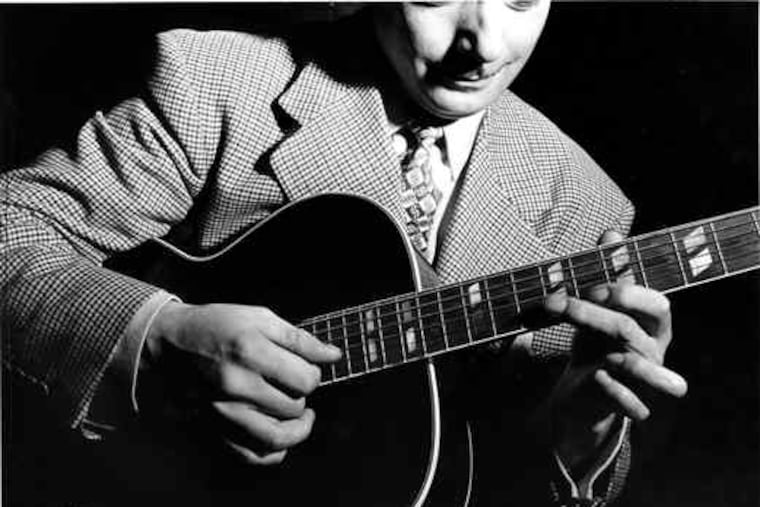
When Apple CEO Steve Jobs recently unveiled his new touchscreen iPad, he wanted a musical soundtrack just as magical and breakthrough as his new device.
He chose a perky, fast-paced tune called "Swing Guitars," played by Django Reinhardt, a young gypsy guitarist and part-time chicken thief who somehow played his instrument with only two fingers. Django made the recording 73 years ago in front of a lone RCA microphone.
That Apple, arguably the world's hippest consumer electronics company, selected such a vintage, low-tech recording to showcase its high-tech device isn't surprising to Django Reinhardt's worldwide fan base. Long after his death in 1953 at the age of 43, Django's music and mystique endure.
This year Django is getting special attention, because it is his 100th birthday. Around the world, hundreds of Django-inspired festivals and concerts are being held to summon the gypsy's spirit. New books, films, and CDs featuring Django's colorful life and distinctive "gypsy jazz" sound are coming out. At this year's Grammys, one of the best-received live performances was rock guitarist Jeff Beck's interpretation of Django's version of "How High the Moon." Someone even named a newly discovered minor planet 94291 Django.
In Philadelphia, World Cafe Live is hosting a "Centennial Django Party" tonight, featuring one of the best-known gypsy-jazz bands, the John Jorgenson Quintet. The evening also includes a popular local gypsy-jazz group, the Hot Club of Philadelphia, named after Django's own band, the Quintette du Hot Club de France.
A Grammy winner and three-time Academy of Country Music Guitarist of the Year, Jorgenson seems ideal to champion the gypsy-jazz movement. Earlier in his career, he achieved chart-topping success playing rock and country with the Desert Rose Band and the Hellecasters, and even wrote the score for the 2000 Sydney Olympics. He has appeared alongside stars from Elton John to Bob Dylan, Sting to Willie Nelson.
But it is the music of Django that inspires him most.
"Django really was the first guitar hero," says Jorgenson. "Django influenced scores of modern musicians, and his influence is heard across many styles of music and guitar playing. Pioneers like country legend Chet Atkins, pop icon and inventor Les Paul, and jazz innovator Charlie Christian were all directly influenced heavily by Django and attempted to copy his style and recorded his compositions. They, in turn, passed this along to all of their followers, including Wes Montgomery, Jeff Beck, Clarence White."
Though Django was a Belgian-born Roma who played much of his career in Paris, he drew his much of his inspiration from two Philadelphia jazz musicians: guitarist Eddie Lang and violinist Joe Venuti. In the 1920s, Venuti, a classically trained musician, teamed with Lang, the son of a Philadelphia instrument maker, and gained notoriety as the first to integrate guitar and violin into popular recordings. Their recordings were widely listened to in Europe - including by Django and his violinist partner, Stéphane Grappelli, who modeled their music and partnership after the two Philadelphians, music historians say.
According to Michael Dregni's recent New York Times best seller on his life, Django: The Life and Music of a Gypsy Legend (Oxford University Press), Django grew up in gypsy caravans and learned to steal chickens without alerting the local farmers. When he was 18, his left hand was crippled in a caravan fire, leaving him with use of only two fingers on that hand (the one that most righthanders use to play the fingerboard on the guitar). Yet it was with those two fingers that he fingered his scorching arpeggios and chord melodies.
After years of playing banjo and guitar in local dance halls, he went on to popularize the Manouche guitar, an acoustic instrument constructed to play loud enough to make the guitar a centerpiece of a band's sound. Django's style was admired by the great Duke Ellington, who invited him to play several concerts in the United States. One of his gigs was at Philadelphia's Academy of Music in November 1946.
"Django played two or three songs with the [Ellington] band - then came out in front of the curtain and played by himself," recalls Ted Gerike, a Philadelphia pianist and drummer who attended Django's Academy of Music concert as a teenager. "It was very well attended, but not too many people knew who Django was at the time."
In tone and texture, gypsy jazz is misnamed because it doesn't resemble the dry, ethereal sounds of modern jazz. Rather, it is an exuberant, swinging blend of Eastern European folk music and popular music from the '20s, '30s, and '40s, usually played fast on acoustic instruments. Gypsy-jazz advocates are quick to point out that much of its allure is its pure, finger-popping sound, which utilizes none of the plugged-in technology favored by many modern musicians.
"It's music before they had computers and pitch-control machines," explains local guitarist Barry Wahrhaftig, whose Hot Club of Philadelphia packs local venues such as the Mermaid Inn in Chestnut Hill. "And for that reason, to a lot of people it's really a kind of life-changing music. People react to it very strongly, and they come from all over to hear it."
The Hot Club's first CD, entitled Wrap Your Troubles in Dreams, was released last month and features Wahrhaftig, a resident of Glenside, and an array of other well-known local players, including violinist Mark Campiglia, Bob Butryn on clarinet, Phyllis Chapell and Denise King on vocals, John Matulis on accordion, Carlos Rubio on flamenco guitar, and Jim Stager on accordion. Howard Alden, who played guitar on Woody Allen's soundtrack to his 1999 movie Sweet and Lowdown, also makes a strong appearance. That movie, which marked the beginning of the modern Django movement, featured Sean Penn playing a guitarist who aspired to be Django. It was nominated for two Academy Awards.
Jorgenson says that when he started playing gypsy jazz in the late 1970s, it had only a cult following and there were very few players.
"There were a small handful of guitarists in Southern California, where I grew up, that were interested in Django, and a few up in the San Francisco Bay area, too, as well as a few guys on the East Coast," he says. "No one was really out there performing this music."
Today, most cities and regions have a local Hot Club band playing gypsy jazz. There's a Hot Club of Tucson, even a Hot Club based in Maui. Gypsy-jazz festivals (often nicknamed "Djangofests") originated a few years ago on the West Coast and have spread across the country, including to Philadelphia.
Django's music continues to sell well and will likely be helped by the Apple exposure. Jorgenson's recent gypsy-jazz CDs have done well, too. His 2007 CD Ultraspontane (on Pharaoh Records) went to the top of the Billboard jazz charts; his current CD, One Stolen Night (Pharaoh), was recorded live in Nashville in front of vintage RCA ribbon microphones, like the ones Django used, to give it an authentic sound.
Jorgenson believes it is the combination of emotion and high energy of gypsy jazz that attracts listeners: "It combines the swing and improvisation of jazz, the high energy of rock, the dynamics, romanticism, and virtuosity of classical, and the string-band sound of bluegrass into a highly accessible blend which is equally joyful and melancholy."
Just as often, listening to gypsy jazz brings a smile.
"Americans really love guitar music of all kinds, and especially styles that are flashy and technically demanding," he says. "So when they've had the chance to see this music live, they are nearly always captivated."
Jorgenson, an avowed Apple user, is delighted that Steve Jobs chose Django's sound to showcase his newest industry-changing device: "I think that maybe he was unconsciously or perhaps consciously trying to link his new product with something timeless, spirited, and stylish."
Djangomania
 Centennial Django Party with the John Jorgenson Quintet, with special guests the Hot Club of Philadelphia, at 7:30 p.m. today at World Café Live, 3025 Walnut St. Tickets: $25-$37.
Information: 215-222-1400, http://tickets.worldcafelive.com
Frank Vignola's Hot Club: Celebrating 100 Years of Django Reinhardt, plays 7:30 p.m. Tuesday, Miller Center for the Arts, Reading Area Community College, 4 N. Second St., Reading. Tickets: $18. Information, 610-607-6205, www.racc.edu/millercenter.
Art Howe, a mobile company executive and former newspaper executive and Inquirer reporter, has been trying to play gypsy jazz for 30 years, grabbing lessons and copying licks from pros such as Jorgenson and Wahrhaftig whenever he can.See DJANGO on H11