The Amish romance: Bonnets, but no bosoms
Avon Books has been publishing romance novels for nearly 70 years. Its current catalog includes titles such as Wicked, Sinful Nights, and The Hellion and the Highlander, and their covers feature the standard steamy look: heaving bosoms and huge manes of hair.
Avon Books has been publishing romance novels for nearly 70 years. Its current catalog includes titles such as
Wicked, Sinful Nights
, and
The Hellion and the Highlander
, and their covers feature the standard steamy look: heaving bosoms and huge manes of hair.
Then there's Winter's Awakening (Avon Inspire, $12.99 paperback), a book with an altogether different cover. A beautiful, bonneted Amish woman, chastely dressed, stands alone against a wintry background, her eyes demurely downcast.
If you think readers of romances are after only one thing, maybe you haven't heard of inspirational romance, a genre that never features anything racier than a kiss and a proposal.
Avon publishes its inspirational romances under the Avon Inspire imprint, but the publisher isn't alone in the market. Secular and religious publishers alike have been seeking a bonnet bounty among readers looking for more restrained romance.
Beverly Lewis, doyenne of the bonnet authors, has made the New York Times best-seller list with two of her Amish romances. More than 12 million of her books are in print, according to her publisher, Bethany House. Her next novel, The Telling, due out from Bethany House on April 6, will have a first printing of 325,000, according to the book industry magazine Publishers Weekly.
Inspirational is "kind of a code word for 'Christian'," explains Cynthia DiTiberio, a HarperCollins editor who acquires and edits books for Avon Inspire.
"Inspirational romance was a small segment that just kind of exploded. Now it's the most popular genre within inspirational fiction," DiTiberio says.
HarperCollins, which owns Avon, launched Avon Inspire in 2007 to capitalize on the books' growing popularity. Since their content is chaste, many of the romances published under the banner of inspirational fiction are also historical fiction - presumably because a sex-free courtship strikes readers as more plausible if it's set in a more innocent time. One of the first books DiTiberio took on was Defiant Heart by Tracey Bateman, which takes place on a wagon train heading west.
But from the start, DiTiberio says, she wanted an Amish book. An Amish romance. The best of both worlds for readers who don't want rough language or steamy scenes in their reading, Amish fiction is both contemporary and clean.
She got her wish in Shelley Shepard Gray, the author of Winter's Awakening. Gray, who has written more than two dozen novels, first approached DiTiberio with a historical-novel proposal. The editor liked Gray's writing style but encouraged her to try her hand at an Amish book instead; Gray agreed, ultimately producing a series called Sisters of the Heart, which made its debut last year. Among other themes, the books touched on Rumspringa, when Amish teenagers get to experience the material pleasures of the wider world.
In Winter's Awakening, the first book in Gray's new series, Seasons of Sugarcreek, an English (i.e., non-Amish) family moves in next door to the Amish Grabers, and their teenage daughter catches young Joshua's eye.
Joshua works in his family's store, selling jam and quilts to tourists, and he's expected to marry his sweetheart Gretta, who frankly has been getting on his nerves with all her talk of babies. What he doesn't know is that non-Amish Lilly is pregnant herself, by the star of her high school's football team.
In placing the two lifestyles side by side - as happens in real-life Amish communities - Gray has built a kind of tension that's classic to romance stories: a forbidden, or at least problematic, attraction.
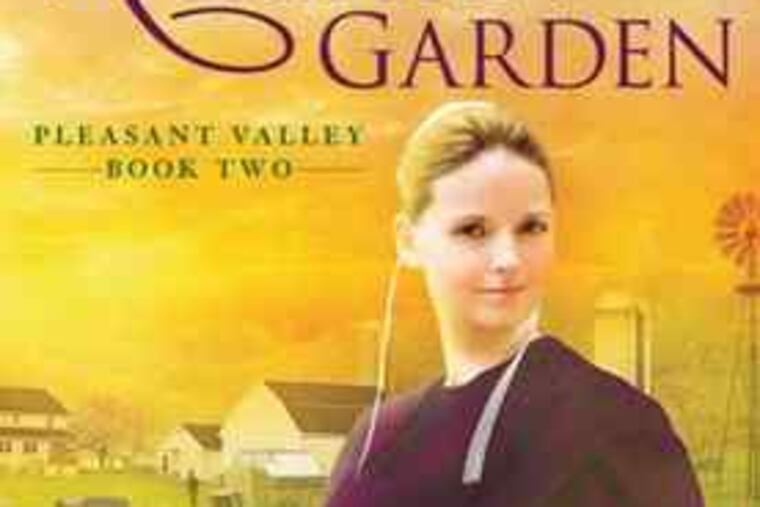
Much of the appeal of Amish fiction seems to be in picturesque details. Rachel's Garden (Berkley, $14 paperback), out this month, opens with the titular heroine looking out the kitchen window of her old farmhouse in Pleasant Valley (a fictional place) as she washes a bowl she's used to make snickerdoodles.
Rachel is grieving the loss of her husband, who was killed in an accident while building a barn, and she's struggling to forgive the man who was with him when it happened. Such relationships and losses are the stuff of any novel - indeed, any life. But a large part of the pleasure of this book is in watching Rachel be Amish, as she sells snapdragons and pansies to both Amish and "English" at an outdoor market, and taking in snatches of Pennsylvania Dutch. (A glossary at the back defines the word blabbermaul as "talkative one.")
But what about Amish people themselves? Do they read these books too?
"Oh, my goodness, yes," says Margaret Perella, director of the Pequea Public Library in Lancaster County. "This is not all the Amish read by any means, but they are very popular with the Plain sects."
The Pequea library and its smaller branch in nearby Gap had 200,000 items in circulation in 2009, about half of which were checked out by Amish patrons, who have always been big readers, Perella said.
"I can always tell what time of the year it is by my inspirational shelf," she said. "In May and October there aren't many out, the shelf is pretty full. In August and December, January, and February it's much emptier. That's the agricultural calendar, the months when the Amish have more time to read."
Perella vouches for the accuracy of the books, and indeed, the writers tend to have a personal connection to Amish or Mennonite communities. Marta Perry is a lifelong resident of rural Pennsylvania who has Pennsylvania Dutch roots, and Gray has set her new series in Sugarcreek, Ohio, the real Amish community she visited with the quilting group from her church, eventually making close friends with an Amish woman who lives there.
"I've met several Amish and Mennonite women who certainly do read Amish fiction," Gray said in an e-mail interview. "I send every book I write to my Amish friend in Sugarcreek. She, in turn, passes it to many of her friends. My friend always writes to tell me what she and everyone thought about the book.
"I find it a little nerve-racking, to be honest. I'm always anxious to get that letter. By and large, the Amish are extremely honest, so she would definitely tell me if I got a detail wrong or she didn't like a story line.
"So far I've been lucky, and they've liked my books well enough to tell others about them."