Galleries: Three venues showcase the diversity of ceramic artwork
While most shows of works by ceramic artists open this week to coincide with the 2010 conference of the National Council on Education for the Ceramic Arts, a few got a head start and should not be overlooked.
While most shows of works by ceramic artists open this week to coincide with the 2010 conference of the National Council on Education for the Ceramic Arts, a few got a head start and should not be overlooked.
"Corporeal Manifestations," organized by Sasha Reibstein for the Mutter Museum, is so perfectly attuned to its site you may not initially realize you've entered a special exhibition that is separate from the museum's celebrated collection of anatomical specimens, models, and medical instruments.
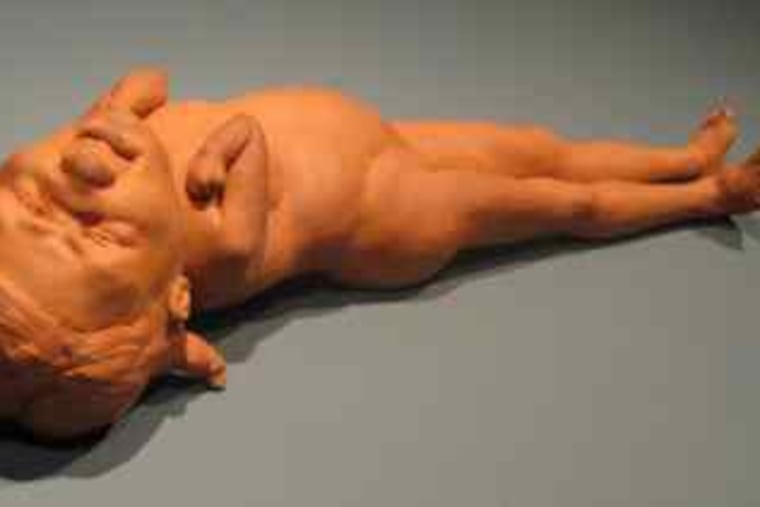
Piggy, Anne Drew Potter's terra-cotta sculpture of a recumbent figure that is half-child, half-adult, rivals any of the Mutter's specimens and models, as do Melissa Mencini's two painted stoneware portrait busts - Hypertelorism, of a woman with a cleft palate and two noses, and Pure Motor Hemiparesis, of a man with a protruding tongue - and Tip Toland's hyper-real painted stoneware sculpture Survivor, showing an elderly female riddled with holes.
Some pieces are so gruesome that they're almost more disturbing than the genuine medical anomalies in the museum's adjacent galleries. Among these are Kate MacDowell's delicate, hand-built porcelain sculpture Serpentine, of a lifelike human head covered with an equally lifelike mass of wriggling snakes; Jason Briggs' porcelain Baby, an Alien-like creature of various body parts that incorporates real hair and is elegantly posed on a pillow; and Roxanne Jackson's frankly scary clay-and-pigment rendering of a skull, Cadaver Study with Grill, which features gold upper teeth (with gold roots, too) and looks as if it had been burned.
Some works are humorously repulsive. One is Jessica Kreutter's Oblation, a creepy distortion of a Thanksgiving turkey oozing a yellow goo (presumably meant to be fat). Another is Colleen Toledano's Skin Core, a porcelain facsimile of a storm-sewer cover around the perimeters of which something seemingly nasty (made of foam) is bubbling out.
Mystery and myth, rather than any particularly Mutter-driven impulse, inform the works by Tom Bartel, Sergei Isupov, and Christina West, all of which depict the human in various forms.
Galleries:
Three venues in the city showcase the wide diversity of ceramic art. Galleries, H4.
EndText
Deep dish
"Convergence: Pottery from Studio and Factory," a 37-artist exhibition organized by Judy Clowes, director of the Design Gallery at the University of Wisconsin, and sponsored by Philadelphia's Clay Studio, host of the NCECA conference, has landed on the second floor of the Philadelphia Art Alliance, an appropriately civilized space for the display of tableware.
Mind you, these are not the usual hand-me-down plates or teapots - unless your forebears were hunters of the brilliant designs of their time. Some of the works were or continue to be mass-produced; others are or were produced in limited editions. All are sought after by discriminating collectors.
In the hands of Marek Cecula and Edyta Cielock, delicate white tea sets take on the surfaces of rocks or trees while remaining indisputably elegant.
Ted Muehling evokes all things undersea in his "Maritime and White Coral Tablewares," whisper-thin vases and plates decorated with tiny holes and impressions, and two shell-shaped objects.
Humor in pottery dates back to pre-Columbian days, but Jonathan Adler makes you think it's a new development (or maybe it's that his humor is so ironic, so 21st century). Adler's "Platinum Aorta Vases" references the many-spouted "weed pots" of midcentury studio pottery; his Prozac Canister, a prettier version of the old-fashioned druggist's jar that also references Upper East Side WASP/gay taste, is still in production if you're looking for a present for that perennially depressed WASP/gay friend.
The classics of mid-to-late-20th-century tableware design are here, too, by Walter Gropius and Katherine De Sousa, Edith Heath, Richard Latham, Heinrich Löffelhardt, Timo Sarpaneva, Russel Wright, and Eva Zeisel.
Both sides now
Androgyny, ever more topical since the publication of rocker Patti Smith's memoir,
Just Kids
, is the theme of Wexler Gallery's "The Hermaphrodites: Living in Two Worlds." Even so, you might be surprised at the number of ceramists - 20 in this show alone - exploring the subject.
There are some artist overlaps here with the Mutter Museum exhibition, among them the works of Jason Briggs, Sergei Isupov, Anne Drew Potter, and Tip Toland. Toland's ceramic sculpture, Tender Flood, of a zaftig reclining figure that's as male as it is female, is the most riveting of the works at Wexler, followed by Chris Antemann's erotic porcelain and luster figurines, Cynthia Cosentino's stoneware male/female figure, Undivided, and Potter's strange union of two ceramic childlike figures, Sym and Asym.
You leave these three shows marveling at the diversity of ceramics, in every sense of the word.