'No Crossover' explores when the courts ruled Iverson
Back in 1993, when Steve James was living in Chicago and working on Hoop Dreams, the acclaimed documentary that tracked two young African American basketball players' hopes of making it to the NBA, the filmmaker kept hearing about a spectacular high school athlete embroiled in a controversy that was racially dividing his hometown of Hampton, Va.
Back in 1993, when Steve James was living in Chicago and working on Hoop Dreams, the acclaimed documentary that tracked two young African American basketball players' hopes of making it to the NBA, the filmmaker kept hearing about a spectacular high school athlete embroiled in a controversy that was racially dividing his hometown of Hampton, Va.
"My father was sending me newspaper clips about Allen Iverson," said James. "He said to me, 'I've never seen anything like this kid.' "
James' documentary No Crossover: The Trial of Allen Iverson will be screened as part of the Philadelphia Film Festival's Spring Preview next Sunday at the Prince Music Theater. The film premiered last month at the South by Southwest Film Festival in Austin, Texas, and will appear on ESPN at 8 p.m. April 13.
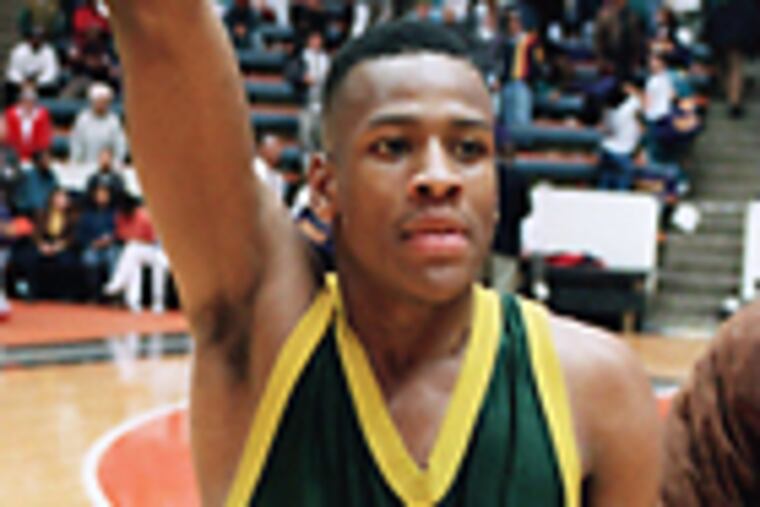
The "kid" James' dad raved about was an electrifying two-sport athlete nicknamed Bubba Chuck. As a junior, Iverson led Bethel High School in Hampton to state championships in basketball and football.
As Hampton pastor Marcellus Harris puts it in No Crossover, Iverson's accomplishments gave him a "golden-child image" in the local African American community. But on Valentine's Day in 1993, the future Sixers superstar's rise from brutally impoverished beginnings was thrown into serious jeopardy.
That night, Iverson was at a bowling alley when alleged use of the n-word incited a brawl between a group of black teenagers and white adults, and Iverson was accused of hitting a woman over the head with a chair. The trial that followed would stir passions in Hampton and attract national attention.
"I felt like I was convicted before I went to court by the media," Iverson told news anchor Tom Brokaw at the time.
The case would play a pivotal role in the development of a not-yet-tattooed Iverson into a massively popular, me-against-the-world hip-hop antihero, one who built up Hall of Fame credentials during a decade-long run in Philadelphia that peaked when he led the 76ers to the NBA Finals in 2001 and was named that season's most valuable player.
It would also result in Iverson's serving four months at the minimum-security Newport News City Farm after he and two other black teenagers were convicted of felony charges under a "maiming by mob" statute designed to prosecute lynch mobs.
At the time of the trial, Iverson said he had left the bowling alley when the brawl had broken out. In a 2006 ESPN interview with The Inquirer's Stephen A. Smith shown in No Crossover, however, Iverson said: "I'm not saying I did what they said I did, but . . . I deserved to be exactly where I was at" when he went to prison. He added: "I went through what I went through because God said go through it. And I overcame it."
The Iverson trial "almost tore this town apart," one resident observes in No Crossover. It was a regional rehearsal for the polarizing sports and celebrity firestorms that have saturated the media ever since.
"People have said that what happened in Hampton was like the O.J. trial before O.J.," James, 55, said from his home in Oak Park, Ill. "There are certainly very big differences. Allen obviously didn't kill anybody, and he wasn't accused of killing anybody, either. But they're very similar in that they both very quickly became for the black community about one thing, and for the white community something else."
Was Iverson a transcendent athlete unjustly cut down by a justice system that saddled him with a 15-year felony conviction for his difficult-to-determine role in a melee that caused no serious injuries? Or was he a supremely talented but selfish thug in basketball shorts who got what he deserved?
James is sympathetic to the former view, one shared by his father, a rabid fan and former hoops star for the Hampton High Crabbers. James remembers his father saying, "They could ruin him."
Iverson avoided ruin. Virginia Gov. Douglas Wilder commuted his sentence on the way out of office. Wilder had been pressured by social activists, not to mention pianist Bruce Hornsby, a former Virginia high school basketball star who says he once beat Iverson one-on-one. (At first Wilder freed only Iverson, but after two weeks responded to pressure and freed the other teens.)
James first got the idea to explore the Iverson story when working on Hoop Dreams, but considered it a missed opportunity until ESPN approached him. The title No Crossover plays on Iverson's trademark crossover dribble, which James shows him executing to perfection on Michael Jordan during his rookie season with the Sixers.
The director also creates crossover, however, by hearing out all sides, even though "people would rather bury the past, not reflect on it."
Among the people who refused to be interviewed for the movie was Allen Iverson. James wasn't surprised that Iverson, who did not respond to a request for an interview for this article, didn't talk.
"It was a combative and tough time in his life," said the filmmaker, now working with author Alex Kotlowitz on The Interrupters, about inner-city violence.
Still, Iverson comes off as a compelling, multifaceted character. Particularly charming are home movies of him donning a cap and gown to receive his high school diploma after studying with a private tutor. He blushes with pride, unafraid to show a sensitive side when the outside world isn't watching.
James said No Crossover "is about Allen at that time of his life on some level, because it has to be. But really, it's ultimately a film about the community." The director, who also helmed Joe and Max (2002), about boxers Joe Louis and Max Schmeling, said he made sports movies because "it's something in my blood, I think.
"It offers a really interesting way to get at a lot of things," said the director, who, like his father, was a basketball star at Hampton High. "It's inherently dramatic. And the best sports films are never really about sports. They go beyond that. Sports is a great arena to express things about race and class and the American dream and family."
Movie
No Crossover: The Trial of Allen Iverson
7:45 p.m. next Sunday at the Prince Music Theater. www.filmadelphia.org/, 215-253-3599.
Also on ESPN at 8 p.m. April 13.