Azuka's growth pains
As it winds down its 10th-anniversary season, nagging questions persist about the always-edgy Azuka Theatre Company. Why does it do so few shows? What the heck is an Azuka?
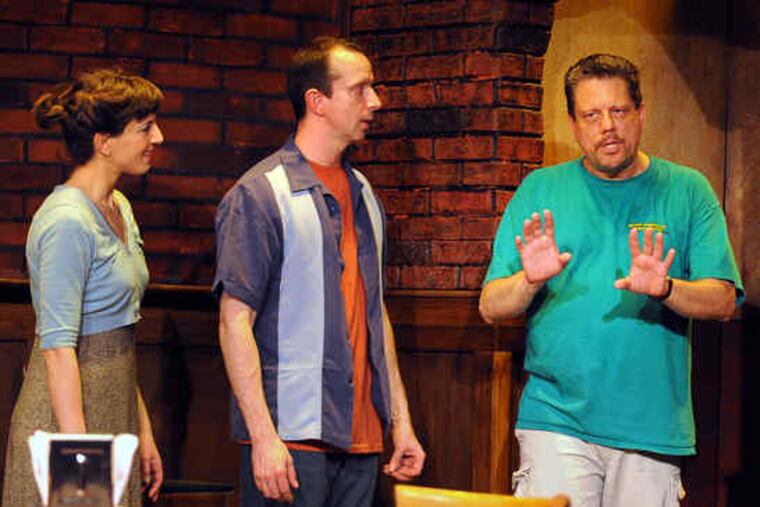
As it winds down its 10th-anniversary season, nagging questions persist about the always-edgy Azuka Theatre Company.
Why does it do so few shows? What the heck is an Azuka?
"Great questions," says producing artistic director Kevin Glaccum, who is readying the local premiere of prolific playwright Adam Szymkowicz's catty online-dating comedy, Nerve. (Previews start Thursday at the Latvian Society.)
The second question is an easy one for the man whose alternative-theater company staged local premieres of the poignant, prickly Aaron Cromie-directed drama, The Long Christmas Ride Home, the corrosively funny Whisky Neat, and a splashy, Barrymore-nominated Hedwig and the Angry Inch.
Azuka, he says, is a West African word that means "strong foundation."
Glaccum credits onetime Philadelphian (and current artistic director of San Francisco's Brava Theater Center) Raelle Myrick-Hodges with naming the company in 1999 as she and several other locals emerged from a year in the Arden Theatre's Professional Apprentice Program.
"Raelle, who was one of the founders of the company - in many ways, the driving force - had a friend with a child whose middle name was Azuka [and who was] being raised in a strong community of friends who all had a part in her upbringing."
It was as if "it takes a village" had come to life. Philly theater in 1999 felt like a family to Glaccum: Though he wasn't yet an Azukan when he acted in its first production, La Rue des Faux, he was one by the time the play ended. "Raelle liked the idea of a theater company," he recalls, "where people came together with a strong foundation to make something grow."
Back to Question No. 1: Why so few productions for Glaccum & Co. - no more than two a season?
Certainly, money is an issue, but not a lousy-economy issue or a lousy-funding issue. "I'd rather do two shows well, with good production values and people earning money, than try to stretch our limited resources to add another show," Glaccum says.
Azuka lacks a permanent home, so "it must be hard for audiences to keep up with us since we're always moving," he says. Then again, perhaps that perpetual motion, and the company's modest ticket prices, keep it thriving.
Azuka's goal is to price its seats so theater can be as viable an entertainment option as going to the movies or a bar. "Our top ticket price is $25 - low when compared to other theaters in town," Glaccum says. "Azuka's audience tends to skew younger than your typical theater audience, and we want those folks to keep coming."
Does that younger audience make Akuza Philly's hipster theater company?
Certainly some of its choices, such as like the glam-rock Hedwig, lend plausibility to that claim. And Azuka has staged several productions not in traditional theater spaces but at North Philadelphia's Latvian Society, a cultural center where Sonic Youth's Thurston Moore and Philly's psych-folk favorites Espers have played.
Azuka's happy-hour fund-raisers at the 13th Street gay nightspot Woody's (at which it stages dramatic readings of City Paper's "I Love You, I Hate You" readers' romance forum) figure into the hipster ethos. Then there's the fact that both of this season's shows - Long Christmas Ride Home and Nerve - feature puppets. Everybody knows nothing's more hipster than puppets.
"I've no particular affinity for them, but after Christmas' [serious] puppets, Nerve's abusive puppet made me laugh out loud," says Glaccum. "It gave me pause to produce two plays with puppets in the same season. Then I thought, what the hell."
Puppets aside, is 50-year-old Glaccum a closet hipster?
After joking about being an old punk rocker ("I was slam-dancing when these li'l whippersnappers. . . ."), he talks about the connection between Azuka's audiences and its productions.
"Our audience info is more observational than anything I can prove," he says. "I see a lot of theater in town and it seems to me that our audiences appear younger than the ones I see at other theaters. I do think it's the work we choose - a little edgy, a little off-center."
But other small Philly companies also do edgy new work that's socially minded, so Glaccum has strived to take it further, with nine world premieres in 10 seasons. "Plus, the work we choose has an enormous amount of heart," he says. "That's not to say these other companies don't, but I try and find plays that, no matter who they're about, our audiences will see a reflection of their own lives."
While 2008's Hedwig, about a transsexual East German rock star, couldn't be more foreign to the ordinary person's experience, Glaccum says it was really about someone trying to find her other half. Last season's Whisky Neat (based on Bruce Walsh's 2002 Fringe Fest-produced one-act Dasein) was about parking valets - the people who take your keys and your car, and you don't think about them again until you leave the restaurant. And nothing could be more heartfelt and au courant than a bitter online-dating comedy such as Nerve.
"I found Azuka online - a good way to meet theaters too, the Internet is," says playwright Adam Szymkowicz, who wrote Nerve (his 11th full-length work) as his M.F.A. thesis play at Columbia University seven years ago.
When it comes to dark, comic deconstructions of love, beauty and the accompanying foibles and fancies, Szymkowicz has it all covered.
"Most people, I've heard, write emotionally about things that happened when they were much younger." In Nerve, he notes, the "unrequited-and-requited-love thing I keep writing about" and his usual retinue of broken people doing their best to connect are both present and accounted for.
"As I say in the play, there are a lot of messed-up people looking to date online. And it's funny, and there is a puppet."
"It's two people on a first date - who hasn't been there?" says Glaccum. "Like all of what Azuka does, these are characters looking for something that everyone in the audience has looked for, edgy or otherwise."