Art: Honoring 150 years of Sketch Club tradition
The Philadelphia Sketch Club might not boast the marquee names - Thomas Eakins, Thomas Moran, N.C. Wyeth - that once graced its membership rolls, but as it marks its 150th birthday it remains a vital part of the city's art community.
The Philadelphia Sketch Club might not boast the marquee names - Thomas Eakins, Thomas Moran, N.C. Wyeth - that once graced its membership rolls, but as it marks its 150th birthday it remains a vital part of the city's art community.
The club, on South Camac Street between Locust and Spruce Streets, has about 300 members, most of them active professional artists. It occupies three contiguous, early-19th-century brick houses that recently have been extensively renovated and modernized.
The club programs a yearlong schedule of exhibitions in its second-floor gallery, one of the most congenial spaces in the city in which to view art. Part of the club's charm derives from its location, in a quiet residential pocket just a few minutes from bustling Broad Street and the University of the Arts.
In November and December the venerable artists' organization - the oldest continually active art club in the Western Hemisphere - held its sesquicentennial exhibition. (The founding date is Nov. 20, 1860, so it was almost a year early.)
The celebration is continuing through this year, with more than a dozen tribute exhibitions at other art institutions across the city and region. Most involve art produced by Sketch Club members through the decades.
Typical of these is "Kindred Spirits," on view at the Woodmere Art Museum in Chestnut Hill through Jan. 2.
Drawn from the Woodmere's collection, the exhibition commemorates a long-term relationship between club members and the museum, which concentrates on work by local artists.
The art in the show, mostly paintings and works on paper but including two bronze reliefs by Thomas Eakins, was created by Sketch Club members, ranging from Edward Moran and Franklin D. Briscoe in the 19th century to Sidney Goodman, Edna Andrade, and Ranulph Bye in contemporary times.
In between, there are paintings by Pennsylvania impressionists Walter Elmer Schofield, Daniel Garber, and Edward Redfield as well as several canvases by Antonio Martino. The works on paper include an etching by Joseph Pennell, an aquatint by Earl Horter, and lithographs by Benton Spruance and Robert Riggs.
All were prominent contributors to the Philadelphia tradition, which makes "Kindred Spirits" a condensed survey of regional art. It reminds us that the club's traditional values, having survived since the Civil War, remain valid and worth preserving.
It's too bad that the show is installed on the balcony, which is fine for prints, photographs, drawings, and small paintings but not so satisfactory for large canvases, unless one has eagle eyesight and can appreciate them from the far side of the room.
N.C. Wyeth was one of the Sketch Club's more prominent and commercially successful members. He became famous as an illustrator, yet while a member from 1911 to 1919 also attempted to establish a reputation as a pure easel painter.
The Brandywine River Museum's contribution to the sesquicentennial substantially re-creates an exhibition at the club in November 1912, in which Wyeth first showed pure landscapes. The show includes 16 of the 22 small paintings, most of them views of the countryside in and around Chadds Ford, that were juxtaposed against 10 of his illustrations.
Wyeth was a brilliant illustrator; three major painted scenes from Treasure Island in the Brandywine show attest to his ability to dramatize key scenes from the novel imaginatively and memorably. By contrast, his landscapes from the period 1910-12, when he was already a mature illustrator, can be tentative and stylistically inconsistent.
Generally speaking, they're impressionist in style, although Wyeth never achieved the luminous sparkle and vivacity that one finds in major American impressionists such as Willard Metcalf and Childe Hassam.
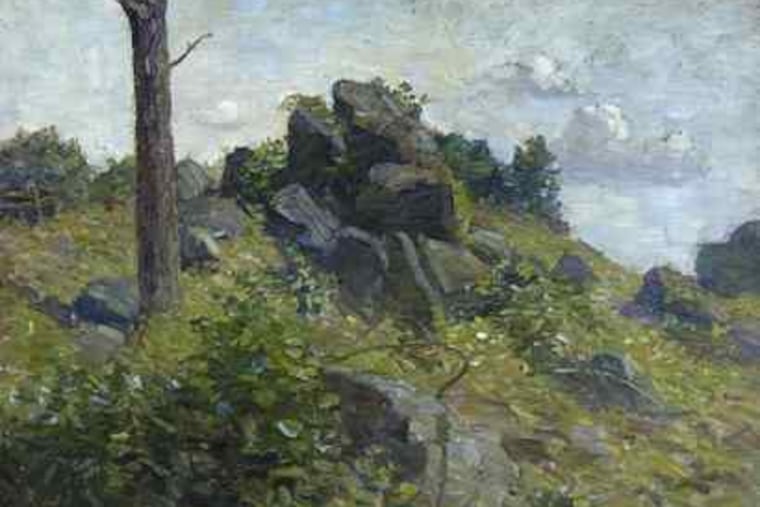
Some pictures are more atmospherically harmonious in the tonalist manner, while a few others, such as March and Rocky Hill, stand closer to pure realism. During this period, Wyeth seemed to be searching for a style with which he could feel comfortable, but if this sample is representative he never found it.
Wyeth did create some splendid easel paintings during his career, but he was such a proficient and popular illustrator it's likely that he couldn't achieve a comparable standard as a landscapist and still-life painter.
During World War I, a number of Sketch Club members contributed to the war effort by designing patriotic posters to encourage Americans to buy Liberty Bonds, work in war-related industries, and enlist in the armed services.
During most of 1917 and 1918, artists, illustrators, and designers across the country submitted more than 700 poster designs to various government agencies. These graphically bold, hortatory images symbolize the national mobilization to win the Great War.
The National Constitution Center has put up an exhibition of 23 posters that were created by members of the Sketch Club; it was organized by the U.S. Army Heritage and Education Center.
As with illustration in general, the early 20th century was the golden age of American poster art. In a time before mass electronic media, posters were a primary advertising and propaganda medium. As they did again during World War II, posters provided an ideal medium for urging citizens to support the war effort in all sorts of ways, from conserving food to donating books for the troops.
The most recognizable name among the Sketch Club propagandists is Howard Chandler Christy, known for his glamorous pinup girls. One of his posters depicts a sultry bluejacket cooing: "I want you for the U.S. Navy." Next to her, another Christy temptress exclaims: "Gee! I wish I were a man. I'd join the Navy."
Graphically, the posters are forceful, direct, and vivid, with red and orange being common colors to attract the eye and stir the blood. Slogans such as "Rivets are Bayonets, Drive Them Home" left little to the imagination, or, for that matter, to reason or conscience.
Unfortunately, to see the poster exhibition one has to pay full freight. The center should have put it downstairs in the admission-free zone.
One other Sketch Club-related show that just opened is at the Cosmopolitan Club, where a display of two-dimensional art by current Sketch Club members runs through May 14.
Future shows are on tap at Newman Galleries, the Berman Museum at Ursinus College, the Atwater Kent Museum, the James A. Michener Art Museum in Doylestown, and the Pennsylvania Academy of the Fine Arts, among other venues. A full listing is available on the Sketch Club Web site, www.sketchclub.org.
Art: Sketch Club Trio
 "Kindred Spirits" continues at the Woodmere Art Museum, 9201 Germantown Ave., Chestnut Hill, through Jan. 2, 2011. Hours: 10 a.m.-5 p.m. Tuesday-Saturday, 1-5 p.m. Sunday. Free. 215-247-0476 or www.woodmereart
museum.org.
"N.C. Wyeth and the Philadelphia Sketch Club" continues at the Brandywine River Museum, Route 1, Chadds Ford, through May 23. Hours: 9:30 a.m.-4:30 p.m. daily. Admission: $10; $6 for 65 and older, students with ID, and visitors 6 to 12. 610-388-2700 or www.brandywine
museum.org.
"Inspiring a Nation" continues at the National Constitution Center, 525 Arch St., through April 25. Hours: 9:30 a.m.-5 p.m. Monday-Friday, 9:30 a.m.-6 p.m. Saturday, noon-5 p.m. Sunday. Admission: $12; $11 for 65 and older; $8 for visitors 4 through 12. 215-409-6700 or www.constitution
center.org.
EndText