Art: Grooms honors masters, old and new
An exhibition at Bryn Mawr features portraits of artists - including himself.
Red Grooms is such a likable artist that one searches his work for reasons to find fault. Perhaps it's too facile, too comic, too uncomfortably close to cartooning. Yet no matter how hard one tries to force his art into these templates, the outcome always turns in his favor.
Grooms is not only as serious and thoughtful an artist as Daumier, he's immensely skillful in distilling the essence of character, place, or situation into memorable images. Philadelphia Cornucopia, for instance, was conceived decades ago as a temporary attraction; it wasn't intended to endure. Yet it has, because it's too piquant to fade away.
The last major Grooms exhibitions in the region were in 2004, at Doylestown's James A. Michener Art Museum, and in 1985, at the Pennsylvania Academy of the Fine Arts. So the current small but select show of artist portraits at Bryn Mawr College is a welcome opportunity to become reacquainted with Grooms' innovative brand of whimsy and his considerable talent as a draftsman.
"Old Masters and Modern Muses," installed in the rare-book room of the Canaday Library, consists of 32 works. Most are drawings and prints, including three of Grooms' signature three-dimensional pieces, whose capacity to amaze and delight never diminishes. The works cover his full career, from the late 1950s to the present.
The exhibition developed through the efforts of Bryn Mawr alumna Michele C. Cone, an art historian and friend of the artist who interviewed him for the exhibition catalog. The works were selected by Emily Croll, curator/academic liaison for the college's extensive collections of art and artifacts.
The exhibition's theme, portraits of artists, including self-portraits, speaks to a quality in Grooms' art that isn't always obvious - introspection and a respect for tradition.
These aren't qualities one often associates with current art, which tends to be more egocentric and in the present. To see a living artist celebrating the achievements of his or her predecessors is in itself a rare treat. Young artists reared in an accelerated digital culture tend not to think this way.
Yet here is the 72-year-old Grooms paying homage to Old Masters such as Rembrandt, Titian, and Goya, and to modernist saints such as Giacometti, Duchamp, Dali, Picasso, Matisse, and Pollock. Even the raucous crowd at the legendary Cedar Tavern, the abstract expressionist clubhouse in Lower Manhattan, has a place in his album.
In genuflecting to these heroes of art, Grooms includes himself in their company. Nowhere is this more evident than in the huge drawing in colored pencil called Nighthawks Revisited, in which Edward Hopper, who painted the original diner scene, himself becomes the center of attention, seated with coffee and cigarette while a youthful Grooms assumes the role of a starstruck counterman.
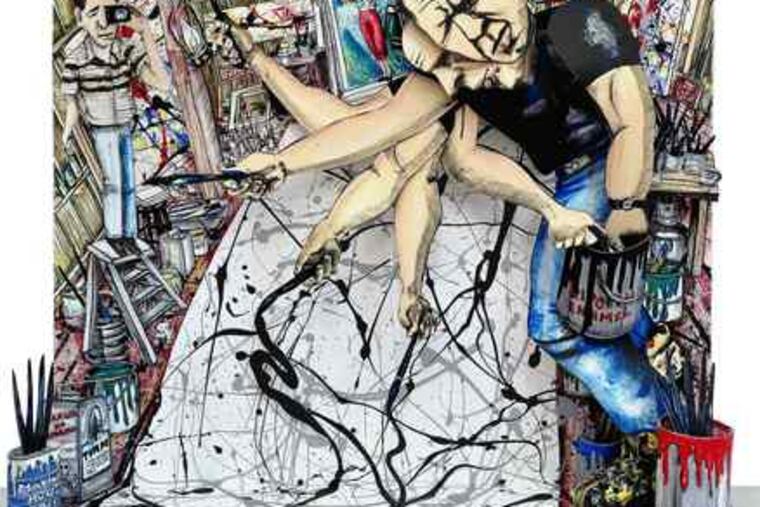
The cleverest bit of homage, a treat for me because I hadn't seen it before, is Jackson in Action, in which Grooms depicts Pollock as a multiarmed dervish flinging skeins of paint onto a canvas at his feet. The Cedar Tavern scene, a color lithograph, offers art mavens an opportunity to see how many abstract expressionists they can pick out of the crowd.
Grooms has fun with his heroes, particularly in a suite of etchings in which he portrays Cezanne gnawing on an apple and Courbet, Rodin, Degas, and Whistler in amorous encounters. He's not trying to wound, though, but to draw these artists in slightly skewed perspective, the way one might gently tease a favorite uncle.
Grooms' homage is always affectionate, even when comic or bizarre. He is showing us that the artists not only are important to art history, but also that they inspired him personally. His admiration is too sincere for him to settle for conventional flattery or idol worship.
Platinum photography. For lushness and subtlety of tone, platinum printing (sometimes combined with palladium) established a standard in black-and-white photography not likely to be equaled. From the invention of the process in the late 19th century until it went out of fashion in the 1930s, platinum printing produced beautiful images in all subject genres.
Frederick H. Evans, the London bookseller who left that business in 1898 to become a photographer, was one of platinum's masters. He believed that the process produced the purest form of photographic expression. An exhibition of platinum prints at the Philadelphia Museum of Art readily endorses this judgment.
Drawn from the museum's collection, the show presents more than 50 works by artists from Evans (a suite of eight sublime images of English cathedrals) and Alfred Stieglitz to Paul Strand, Gertrude Käsebier, Irving Penn, and several more contemporary practitioners, especially Andrea Modica.
Platinum printing was a boon to pictorialist photography, which was trying to emulate painting by imparting a softer, more romantic quality to scenes and portraits. However, modernist photographers, who supplanted the pictorialists, were more comfortable with the hard-edged, high-contrast aesthetic of gelatin silver printing.
The difference is immediately evident in examples from this exhibition, not only in photographs from the early 20th century, but in more recent work by photographers such as Modica, Nancy Hellebrand, and Jennette Williams.
Platinum/palladium produces color and tonal variations that make subjects seem more timeless and less dependent on a sense of immediacy for their impact. It's a quality absent from digital printing, which relies on computer technology rather than the old-fashioned artisanship at the heart of the platinum process.
Pots to savor. The national ceramics conference is long gone, but two exhibitions that linger deserve attention. One is at Sub Octo Gallery in South Philadelphia, where through next weekend one can see a large and varied selection of recent work by American master Val Cushing.
Cushing is a traditional potter, but his robust, wheel-thrown vessels can, in large scale, achieve sculptural presence. He uses a broad palette of glazes sensitively married to his forms, which are usually functional and sometimes elemental, but always distinctly his.
The artist will speak about his work Saturday at 4 p.m. Seating is limited; if you plan to attend, the gallery asks that you reserve a place by phone or e-mail. (2202 Alter St. Noon to 6 p.m. daily. 215-893-8812 or www.subocto.com.)
The other show, at the Philadelphia Art Alliance, features functional ware produced by industrial processes for wide commercial distribution. What one finds here, in striking contrast to most of the other recent ceramic shows, is emphasis on pure form. Decoration and surface are usually subordinate to the creation of sleek, fluid designs. (251 S. 18th St. 11 a.m. to 5 p.m. Tuesdays through Sundays. 215-545-4302 or www.philartalliance.org.)
Art: Homage in Cheek
EndText