The sounds of 'Treme' lead one to the source
From Dan DeLuca's "In the Mix" www.philly.com/philly/blogs/inthemix Halfway through watching the first episode of Treme, David Simon's new HBO series about post-Katrina New Orleans, I booked a flight for this year's New Orleans Jazz & Heritage Festival (which began last weekend - to see photos, go to my blog).
Knowing what it means to miss New Orleans
From Dan DeLuca's "In the Mix"
www.philly.com/philly/blogs/inthemix
Halfway through watching the first episode of Treme, David Simon's new HBO series about post-Katrina New Orleans, I booked a flight for this year's New Orleans Jazz & Heritage Festival (which began last weekend - to see photos, go to my blog).
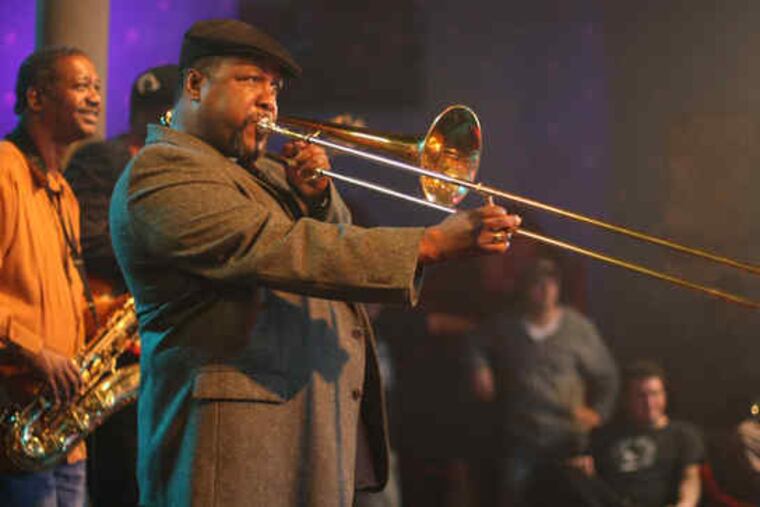
So I guess I didn't really know what it means to miss New Orleans until I saw Wendell Pierce (Bunk Moreland from The Wire playing trombone player Antoine Batiste) join the Rebirth Brass Band in the first "Second Line" parade in New Orleans after the hurricane.
But as much as the series got me hankering to get back to the Crescent City, I'm not ready to declare it a masterpiece just yet. That's partly because Simon set the bar so spectacularly high with The Wire, his five-season novelistic exploration of various institutional crises in urban American life, set in Baltimore. It's like Art Spiegelman trying to follow his groundbreaking Holocaust graphic novel Maus with just another comic book, or Picasso figuring out what to do after Guernica, or Jerry Seinfeld dithering post-Seinfeld.
And it's partly due to the air of righteousness that hangs around the show. The music is marvelous, and there's more of it I would bet - played by actual musicians, whose stories are woven into the plot - than in any dramatic series in the history of television. Something delicious can be heard every 10 minutes or so, whether it's Kermit Ruffins blowing his horn at Vaughn's bar, where Elvis Costello is in the crowd, or funksters Galactic digging into "Blackbird Special," or shaman Coco Robicheaux sacrificing a rooster in a radio studio to get a little gris-gris on the walls while "Walking With the Spirit."
But so far, a good deal of the time I'm watching Treme I feel like I'm being lectured. The pedantic speechifying might be coming from John Goodman's university professor Creighton Bernette, or Steve Zahn's obnoxious DJ/piano player Davis McAlary, who tries to irritate the gay neighbors he sees as evil gentrifiers by blasting Mystikal's "Shake Ya Ass." Or by the street musician (whose girlfriend is played by concert violinist Lucia Micarelli), who gives church-group volunteers from Wisconsin attitude for having the temerity to come to Louisiana to lend a hand to the Lower Ninth Ward.
The prickliness, though, is understandable. The last time I was in New Orleans was for Jazz Fest in 2006, the first one after the hurricane, just a few months after these early episodes of Treme are set. At that time, lots of the natives I talked with were exasperated with the army of invaders who had descended on the city since the storm, whether it was the National Guard or FEMA representatives or out-of-town construction workers or gawking tourists on devastation tours. What Goodman's Bernette says about his daughter Sofia applies: "She just wants her city back." As well she should. And as we watch, we're implicated as unwelcome tourists.
Three episodes in, Treme is deeply steeped in character, and not so much in plot. It's hard to know where the story is going, or if the Altmanesque array of characters, like Clarke Peters' proud Mardi Gras Indian chief Albert Lambreaux, or struggling chef Janette Desautel, played by Kim Dickens, will eventually be tied together, other than by a stubborn passion for the place where they are from.
So far, Simon seems content to linger. And why not? The atmosphere is so rich you can practically taste the étouffée, the people are worth caring about, and the musicians are more than ready for their prime-time moment, even if they show a healthy disdain for affirmation from the world at large.
"All you want to do is get high, play some trumpet and barbecue in New Orleans your whole damn life?" Zahn's McAlary asks Ruffins. "That'll work," he replies in the first episode. Like Simon's story, he's not going anywhere in a hurry.
nolead begins
Viggo Mortensen, before he was Viggo Mortensen
From Carrie Rickey's "Flickgrrl"
www.philly.com/philly/blogs/flickgrrl/
A byproduct of the DVR/DVD/VOD age is the experience of rewatching a film and being startled that a star-to-be twinkled in the background, scarcely recognizable because he hadn't yet evolved his persona. Case in point: Viggo Mortensen as the Amish farmer in the shadow of Harrison Ford's boater in Witness (1987). Frisky as a puppy, Mortensen is conscious of the camera and has not yet developed the self-contained quality so striking in A Walk on the Moon, A History of Violence, and Eastern Promises. Watching him in Witness is like seeing a tadpole before he becomes the Frog Prince.
At the other end of the spectrum, sometimes a performer so powerfully establishes herself in an early outing that she is already fully in possession of her persona. Though I had never seen them before, I remember being struck by the unreadable William Hurt in Altered States (1980), the self-possessed Meg Ryan as Candice Bergen's teenage daughter in Rich and Famous (1981), and the effervescent Drew Barrymore in E.T.: The Extraterrestrial (1982). . . .