Art: 'Sunday in the Park With George' offers a look at how art-making has changed
Georges Seurat's painting Sunday Afternoon on the Island of La Grande Jatte is immutable. Sunday in the Park with George, the musical play based on the painting, is less so, yet its core wisdom remains relevant.
Georges Seurat's painting
Sunday Afternoon on the Island of La Grande Jatte
is immutable.
Sunday in the Park with George,
the musical play based on the painting, is less so, yet its core wisdom remains relevant.
I first saw George when it opened on Broadway in the spring of 1984. At first dubious that a musical could say anything meaningful about such a mysterious process as making art, I ended up admiring how cleverly composer Stephen Sondheim and librettist James Lapine elucidated the concept.
Like many others in the audience, I was especially enchanted by the final scene of Act I, when the painting magically came together on stage. I recall thinking, "Yes, that's exactly how it happens."
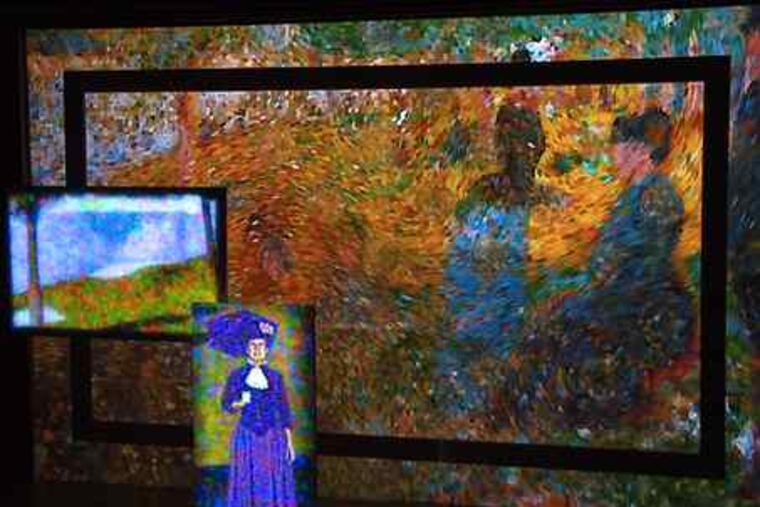
Philadelphia's Arden Theatre Company staged the play 16 years ago, and more recently there was a high-tech version on Broadway. Now Seurat, his fictional great-grandson George, and the colorful troupe of period Parisians are back at the Arden - this time, thanks to digital magician Jorge Cousineau, technologically enhanced.
As I took my seat, I wondered, has the magic survived? Would the evocation of the creative process remain thrilling? Because in truth, that's what I most wanted from this play. In 1984, the end of Act I had provided one of my most memorable theatrical moments, and I wanted to relive it.
I needn't have worried. The Arden's Act I finale is different, but just as brilliant. Instead of bits of scenery sliding together (1984), director Terrence J. Nolen has the Seurat character assemble a tableau vivant while he chants his mantra about order, design, balance, and tension.
Act I tells us that making art is hard work (making good art is even harder). Seurat spends most of his time doggedly sketching and daubing, laying down pointillist dots on a see-through canvas. He's so solitary, so consumed by his art, that what we now call a "personal life" can be no more than wishful thinking.
Act II, which I barely remembered from 26 years ago, becomes in the Arden production a powerful contrast to Seurat's obsession. It reminds us that art-making, at least at the top of the pyramid, has changed dramatically from the late 19th century.
For one thing, it has become more technology-dependent, as Cousineau's imaginative interpretations of young George's spectacular video "chromolumes" indicate. Artists today sometimes require specialist collaborators to program and manage the electronic images, which in George's case are extrapolations of Seurat's tiny colored specks.
Great-grandson George also has to cultivate wealthy patrons and deal with museum directors and critics. Not only has he become a captive of his process, he admits to becoming bored with it.
He realizes that he's just a cog in a commercial machine - a major cog, perhaps, but, unlike Seurat, no longer in control. He wonders aloud if he really has anything to say that isn't derivative of his distinguished postimpressionist forebear.
Seurat was so original that no one understood what he was doing - transforming the subjective suggestions of impressionism into optical legerdemain. But at least he was always his own man.
Contemporary George is acclaimed and beloved by the art establishment, yet he begins to doubt the worth of his "chromolumes," especially because he's so dependent on a technical collaborator (who also has become tired of the process) to make them work. Seurat was an outsider; George is an industry insider.
The play's contrast between art-making then and now is stark, and unsympathetic to current practice. Thousands of artists still work as Seurat did, following their own intuitions. But celebrity and commercial success more often accrue to the young Georges, who require support systems and generous funding to realize the fruits of their creative efforts.
Pennsylvania German art in all its variety is so thoroughly infused into the aesthetic consciousness of this region that it no longer delivers many surprises. Yet a splendid collection of such art, especially one shaped by a dedicated individual, can still delight and inform regardless of how familiar one might be with the material.
An exhibition of about 100 objects lent to the Reading Public Museum by an anonymous Berks County collector delighted me in several ways.
I was a bit surprised to come across a group of five machine-woven coverlets, bright, bold, and in magnificent condition, glowing in one corner of the gallery. Similarly, a small display of pewter hollowware stands out.
Ceramics constitute the core of this show, selected by guest curator Louisa Bartlett from the larger whole that, she says, is distinguished by its pottery. There's also an extensive display of Fraktur, both printed and hand-lettered and drawn, another strength of the full collection. The majority of these works are birth-baptismal certificates. The most unusual item in this group is an instructional text in the form of a four-part labyrinth that has to be continuously turned to be read.
The vast majority of the objects in the show originated in Berks County and date from the 18th and 19th centuries. Although they represent folk traditions, many are attributed to individual makers, which transforms what otherwise might be generic artifacts into personal statements with which viewers can more readily connect.
While Bartlett has crafted a cross-section of the lender's collection, and of Pennsylvania German arts generally, ceramic redware takes center stage. There are superb examples of common forms such as plates, platters, and covered jars, and of the principal decorative schemes, sgraffito - scratching a design through colored slip (liquefied clay) - and slip-trailing (drawing with slip), whose patterns tend to be more abstract.
One pottery, Medinger, specialized in re-creating traditional designs, as a display of four plates demonstrates. A late 19th-century covered bowl with an openwork top from Fahr Pottery is one of the more striking pieces, along with a covered sugar jar glazed a rich bottle green.
The continuation of Pennsylvania German tradition is neatly summarized by two exhibits, a contemporary pair of shallow dishes by Lester and Barbara Breininger - one sgrafitto, one slip-trailed - next to three small plates attributed to Daniel Dry (1811-72), whose abstract decorations seem equally fresh.
The museum owns a substantial collection of Pennsylvania German art that has been out of sight while its gallery is being renovated. When it is reinstalled at the end of the summer, the brief conjunction of the two displays will offer visitors an exceptional survey of Pennsylvania German artisanal skill and aesthetic ingenuity.
Art: Art = Hard Work
 Sunday in the Park with George continues at the Arden Theatre Company, 40 N. Second St., through July 4. Tickets: $29-$48. Information: 215-922-1122 or www.ardentheatre.org.
"Arts of the Pennsylvania Germans" continues at the Reading Public Museum, 500 Museum Rd., through Sept. 26. Hours are 11 a.m. to 5 p.m. Tuesdays through Thursdays and Saturdays; 11 a.m. to 8 p.m. Fridays, and noon to 5 p.m. Sundays. Admission is $8 general and $6 for children, seniors, and students with I.D. Information: 610-371-5850 or www.readingpublicmuseum.org.
EndText