Pennsylvania's 'Art of the State' show has poignance
There's a not-so-hidden element of emotion in our commonwealth's summerlong 43d annual juried competition, official and statewide, for Pennsylvania artists, held next to the Capitol in Harrisburg.
There's a not-so-hidden element of emotion in our commonwealth's summerlong 43d annual juried competition, official and statewide, for Pennsylvania artists, held next to the Capitol in Harrisburg.
And the emotion is there because that hallowed next-door place, the State Museum of Pennsylvania, which exhibits art, archaeology, and cultural history, is struggling so hard to carry on with its skeleton crew. For the reality is that 139 people have been cut from its staff because of the state's budget crunch.
So, this display salts summer aspects of our local atmosphere with a special blend of poignance. And like articles of faith in the continuing vitality of tradition, the works on view here resonate with memories. But more important, much of the show's best art captures a mature strength emanating from a wide variety of sources.
Featured are 151 works in various media by 152 artists from 34 counties, chosen by three jurors from 2,073 applications sent in by 778 Pennsylvania artists.
Leading the list of the four counties with the largest representation of artists is, not surprisingly, Philadelphia, with 18 artists, followed by Montgomery and Lancaster Counties with 16 each and Allegheny (Pittsburgh) with a cool dozen - a big year for them. Delaware County has eight artists represented, Bucks and Chester Counties a mere five each, although the eastern counties as a whole did well in the prize winners' column. And a large, confident Pittsburgh delegation long will be remembered for attending the opening ceremonies for this show, cosponsored by the State Museum and the Greater Harrisburg Arts Council.
The display's most captivating work, bar none, is Play in a Round, an airy, toylike, kinetic rolling-ball sculpture by Larry Shull of Landisburg. They just can't get people away from it and wanting to touch it. So to protect it, they've built a cabinet around it. Shull built his own house, taught physical education, and invents tools and machinery. You'll want to spend at least 10 minutes watching the action of this piece. Who said exhibits aren't fun?
My vote for the two finest abstract paintings goes first to Final Tribute, a salute to his late father, a woodworker, by Jerome Hershey of Lancaster, who offers a mind-absorbing pattern upon a canvas concerned with vibrant color sensation. It's a work in which Hershey seems to have met his goal of achieving something both personal and universal. The other compelling abstraction is Flight of Matta by Edward Evans of Stroudsburg, in which the artist convincingly achieves illusory depths and mysterious soft shadows in a low-key palette.
Rare is the Art of the State show that doesn't include several memorable figure paintings, and this 43d edition is no exception.
Tops in this category is Lauren, First Grade, an oil by Philip Lindsey of Chambersburg. The work doesn't so much express emotion as create it for the spectator, through an image dominated both by its form and the intensity of color surrounding a young schoolgirl. This bold vision with a fresh viewpoint is visually compelling yet conceptually disturbing, somehow. Other figure paintings, ones with lean and unadorned dignity, are by Mel Keiser of Edinboro and Geoffrey Beadle of Erie. Allen Capriotti of Altoona shows a dignified study of a man with tattoos.
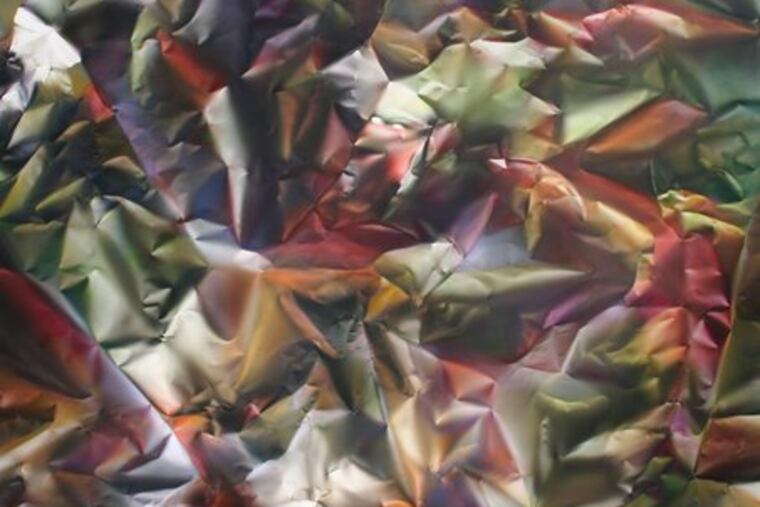
Interest in the abundance of nature is tastefully attractive and achieves a rather domesticated elegance in The Garden of Eden, a five-part large screen realized in digital ink-jet print on silk by Heather Ujiie of Langhorne.
Hints of a fascinating social commentary up the artist's sleeve, with insights into both the appearance and the emotional tenor of our time, are suggested in an intense watercolor of the inside of what appears to be the cab of a worn but working tractor-trailer, by Tristen Albright of York. Matthew Colaizzo of Philadelphia, in his effective woodcut, gives a searing idea of what can happen when a coal company closes down and leaves behind many acres of scarred earth, as happened at Marvine Colliery, Scranton, in the 1970s, portrayed here.
By contrast, taking great pleasure in her astute sighting of an autumn Philadelphia street scene is a refreshing oil by Elaine Lisle of Bryn Mawr. Joel LeBow, a resident of Jim Thorpe, who studied productively with Franz Kline in Philadelphia, paints abstractly in oil, his color laid down as a dissolving, scumbled haze.
Finally, the show's brightest moment for the environment occurs in a warmly felt three-part sculpture, Small Worlds, by Theodore Prescott of Mechanicsburg, who gathered this material from an apple orchard being cut down for a housing development. Of unusual depth, and with a firm connection to that land, the three shaggy spheres he's made of wooden fragments offer a sense of humility and a way of conveying continuity with the past while embracing the present. Good, solid show.