Art: Kaneko's massive masterpieces
In Reading, sculptor's larger-than-life creations and 2 videos tell a tale of creativity.
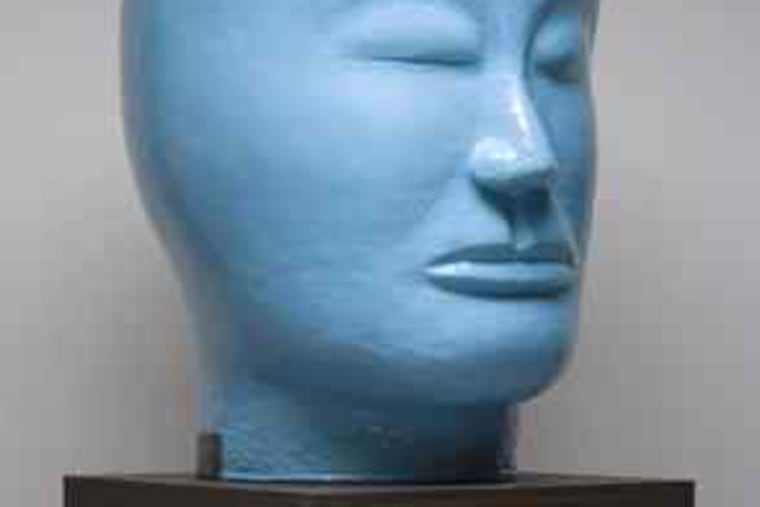
For artists who work in clay, creativity can involve as much muscle power as Eureka!-style inspiration. Rarely has this been more effectively demonstrated than in a video about Jun Kaneko called
The Fremont Project.
The video is an especially compelling element of a traveling exhibition of Kaneko's art now at the Reading Public Museum. In fact, there are two 20-minute videos in this show of 39 sculptures, paintings, and drawings. In one of them, Kaneko speaks. In the other, no one does, yet the creation story is so artfully revealed that words are superfluous.
Kaneko's large, colorful sculptures, called dangos (Japanese for "dumplings") have been prominent in Philadelphia during the last several years - at the Kimmel Center, the Perelman building of the Philadelphia Museum of Art, and Locks Gallery.
Yet because it contains lesser-known paintings and drawings, and these two videos, the Reading show has something to offer both aficionados and visitors less familiar with his sculpture.
Born in Japan in 1942, Kaneko came to the United States in 1963 as an aspiring painter. Then he fell under the mentorship of ceramic masters Peter Voulkos and Jerry Rothman, and his career segued into clay. Since 1986, he has maintained his studio in Omaha, Neb.
Even if you know the dangos - the show contains six of these, and six smaller sculptures - the Reading exhibition reveals how Kaneko's painterly instincts have informed his colorful monoliths. One can see how decorative surface treatments and expressionist markings alter one's perceptions of otherwise elemental columns, spheres, and triangles.
One can appreciate, too, how monumental scale - one dango is nearly seven feet tall - supercharges aesthetic power. One doesn't want the effectiveness of an artwork to derive primarily from its size - that seems like a cheap trick - and yet the evidence here is persuasive that it does.
Obviously Kaneko believes this as well, otherwise he wouldn't have pushed his studio practice into industrial scale, in which he requires drive-in kilns as big as a three-car garage, and where the sculptures become so large they need to be built inside the kiln.
The Fremont video - no narrative, just a music track and incidental studio sounds that create atmosphere - reveals Kaneko's creative process through a logical progression illuminated by beautifully composed details.
We see him and his assistants, in residence at Mission Clay Products Corp. in Fremont, Calif., building dangos by wrestling massive slabs of wet clay into place, like building an igloo block-by-block.
We watch Kaneko glaze the forms with colored slips (liquid clay), using masking to create surface markings and patterns, then finishing with a clear glaze. We see the kiln sealed and fired, and finally the finished pieces displayed out-of-doors before being dramatically trucked away to who knows where. (The pieces are fired twice, before and after glazing.)
While the video depicts Kaneko completing a specific project at a scale most artists can only imagine, it also serves as a lucid primer on making ceramics at any scale, from the initial wedging of the raw clay to constructing and shaping the form, through glazing and finally the firing. This marvelous documentary alone, filmed by Mitsu Takahashi, makes the exhibition worth seeing.
Yet we shouldn't forget another primary insight - that Kaneko's art devolves from painting. We are shown both real paintings and drawings, all essentially gestural, and ceramic wall plaques that function as paintings. The "pigments" here are glazes deployed in a bold, abstract-expressionist manner.
The exhibition is essentially a vanity production. All the art comes from the Kaneko Studio, with the logistics of circulating to 10 cities nationwide handled by Smith Kramer Fine Art Services in Kansas City, Mo.
It's not, therefore, the best Kaneko show one could imagine, but it is wonderfully enlightening about creativity, especially why art like Kaneko's that looks deceptively simple is anything but.
More Indian art for Allentown. Eight years ago, a substantial gift from Philadelphia art dealer Jaipaul and his family elevated the Allentown Art Museum to a regional center for the display of Indian art.
Now the museum's prominence in the field has been enhanced with another major gift, from two Philadelphia physicians, Caroline S. and Peter J. Koblenzer. The gift will enable the museum to enrich its display of Indian art - itself unusual in a museum this size - by representing a broader spectrum of images, historical periods, and geographical distribution.
The bulk of the Koblenzer donation, part of which is promised, is on view at the museum in an exhibition called "Myths, Religion and Ritual." The show comprises about two dozen pieces in wood, stone, and metal, mostly sculptures.
Except for three pieces from tribal areas, the sculptures express or represent themes from two of the country's principal religions, Hinduism and Jainism. The tribal pieces are fascinating because in theme and visual style they appear to be closely related to African cultures.
One thinks of Indian sculpture as primarily of stone or metal, but here only half the works are executed in those media. A like number, primarily from South India, are intricately carved from wood, mainly as high-relief panels.
Classical Indian art, what the Koblenzers collect, can be difficult for Westerners because of its unfamiliar religious symbolism. Fortunately, the word avatar - a deity in human form - has become common currency in popular culture recently. "Myths, Religion and Ritual" is essentially a collection of avatars, primarily of the principal Hindu gods Vishnu and Shiva.
One of the show's most striking sculptures does not involve a deity but a Jain jina figure seated in a Buddha-like lotus position. In Jainism, a jina, also called a tirthankara, is an enlightened spiritual guide, or role model for ordinary worshippers.
This serene figure in white marble is striking because its ascetic, slightly archaic form contrasts so markedly with the exaggerated vitality of typical Hindu figures. Yet one of the show's smallest pieces, a gray stone linga, or cylindrical column, bearing the head of Shiva, conveys a similar mood of devotional contemplation.
Panels created to adorn huge ceremonial chariots attest to the ability of Indian artisans to achieve extraordinary depth and narrative complexity in carved wood. These works are less devotional than celebratory; they express the communal festiveness of Hindu observance, typified by a brilliantly painted and somewhat ferocious mask of a Shiva avatar named Bhairava.
Art: Upscale Ceramics
 The Jun Kaneko exhibition continues at the Reading Public Museum, 500 Museum Rd., through Sept. 5., 11 a.m.-5 p.m. Tuesday-Thursday and Saturday, 11 a.m.-8 p.m. Friday, noon-5 p.m. Sunday. Admission $8 general, $6 for seniors and students with I.D. Information at www.readingpublicmuseum.org or 610-371-5850. The Koblenzer collection of Indian art continues at the Allentown Art Museum, 31 N. Fifth St., through Sept. 5. 11 a.m.-5 p.m. Wednesday-Saturday, noon-5 p.m. Sunday. Admission: $6 general, $4 for visitors 60 and older and students with I.D., $3 for visitors 6-12. Free Sunday. $7 surcharge for the Koblenzer show. Information at www.allentownartmuseum.org or 610-432-4333