What's an 8-letter word for 'reinstated'?
Longtime puzzle maker returns to The Inquirer's daily pages.
An old friend has come back to please your puzzling mind and intrigue your intellect.
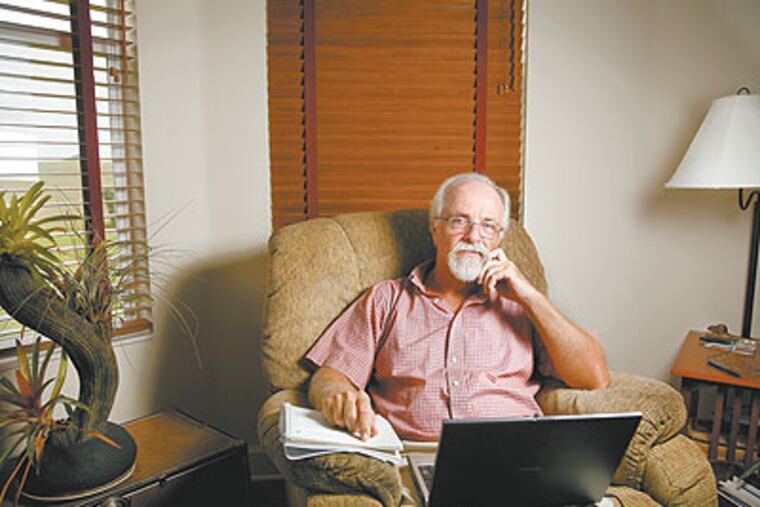
Beginning this week, Wayne Robert Williams, highly regarded for constructing and editing shelves-ful of puzzle books and magazines, is again the man behind the crossword puzzles that appear Monday through Saturday in The Inquirer.
His name might be familiar to Inquirer puzzle pencil-pushers: The paper published his crosswords for years until 2009, when Tribune Media Services stopped distributing Williams' work. He began self-syndicating his puzzles, which include word searches and cryptograms, about six months later.
"Month after month I keep gaining newspapers. Philadelphia is number 32," said Williams, who started constructing crossword puzzles as a teenager. "I'm thrilled to be back."
Williams, 62, of Clearwater, Fla., is thrilled, too, to be reintroduced to the region's crossword puzzle solvers.
Question: What is your background and how did you start making puzzles professionally?
Answer: I grew up in Scranton. . . . went to Hobart College in Geneva, N.Y. I left without a degree after 31/2 years, majoring in psychology, but I wanted to be an artist. I went to New York City and worked as a paste-up artist for various catalogs and in-house publications until I got a job at Dell Publishing and got to know people in the crossword department. . . . I began to produce legitimate crossword puzzles [around 1968]. . . . I was able to get a lot of creative satisfaction from it.
Q: Do crossword puzzle creators have different styles? What is your style?
A: There are a lot of people who have no style at all . . . with computer programs these days, you could just select a diagram, tell the computer to fill it in with words, and then write clues for those words, and you would have a puzzle - but it would be run-of-the-mill. . . . I try to use ordinary and interesting words in the diagram while keeping obscure words to a minimum. I use clues to control the difficulty level of the puzzle and to add to the fun of solving the puzzle.
Q: How do you create your crossword puzzles?
A: I sit down with my laptop and start working. I have an idea for a good theme of a 15-by-15 crossword puzzle, hopefully an original theme or a new twist on a well-traveled theme. People with birds in their names would be a well-traveled theme - a twist on that theme would be people with a bird in their name who all fit into a category, like baseball players. . . .
Following the conventional rules, I create the diagram on the computer. At that point, I've compiled the word list and the computer makes a first pass at filling it in. . . . I massage the word entries piece by piece. Once I have all the words I'm happy with, then it's time to check for various things that aren't allowed, repetition of the same word or a form of the word. Then I work on the clue list to make the clues appropriate for the difficulty level I want. Making the theme the best it can be is part of the editing process when you're editing the clues.
Q: How long does it take to create a crossword?
A: It can really vary. I could sit down and ideas could come at me thick and fast. Once I have an idea, from that point on, it could take an hour or several hours, depending on lots of things, like how well it all fits together.
Q: Can a person who earns a living making puzzles earn a living making puzzles?
A: I can, but it's very hard. There's not a lot of money to be made. At the Tribune, we had the price up to $75 apiece for a 15-by-15 daily puzzle. I've done puzzles in the past for specific requirements - I had to do some sample puzzles for government gift shops, and I only charged them $100 apiece. I guess it's whatever the market will bear.
Q: What is the best response you've gotten to your puzzles?
A: I recall one from a guy who used to visit his mother in an old-age home, and they had nothing to talk about after a while. One day he brought the crossword puzzle, they did it together, and it started conversation. Another was from a group of people who used to solve the crossword puzzle together at a factory over lunch.
Q: And the most bizarre?
A: I think the most bizarre was the person who accused me of intentionally using the word ass more than was necessary. Another was a complaint that I referred to black magic as something witches do. A Wicca organization wrote. They wanted to emphasize they do white magic.
Q: What is the most challenging part of creating a puzzle?
A: The most challenging is coming up with good, new ideas for themes after all these years. From the response I've gotten from self-syndication, I think I've achieved that.