Emma Thompson returns as Nanny McPhee in sequel she wrote
WHETHER SHE'S speaking with a reporter, a waitress or about 50 children at the Free Library of Philadelphia, Emma
WHETHER SHE'S speaking with a reporter, a waitress or about 50 children at the Free Library of Philadelphia, Emma
Thompson is charming, intelligent and never condescending.
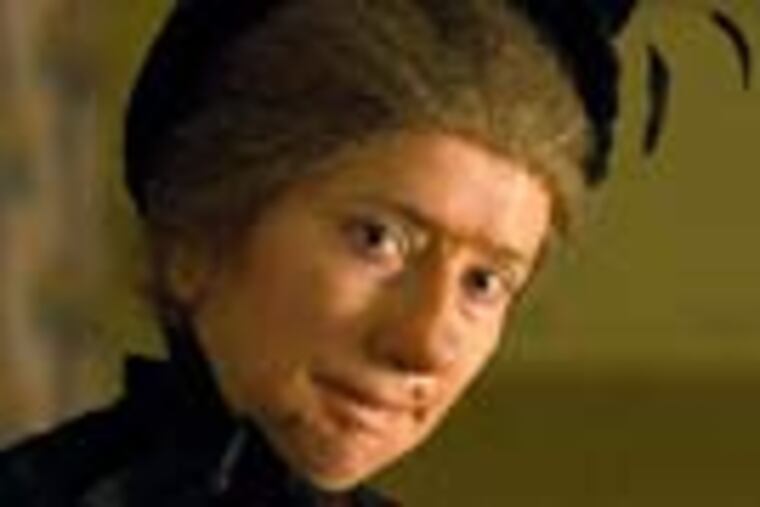
These are the same qualities she's brought to her adaptations of Christianna Brand's Nurse Matilda, turning into the mole-faced disciplinarian Nanny McPhee, who's back in theaters today in "Nanny McPhee Returns."
The first "McPhee," with a screenplay by Thompson, came out in 2005 and was a surprise smash. It's taken a while to bring her back, but a relatively short time compared with the first one.
"It took a long, long time to get the first one made - nine years," Thompson said last week at the Ritz-Carlton on Broad Street. "And actually it should take a long time to make a good film because you should spend as much time as possible making your script water-tight and as good as you can get it. Then you'll get good actors to be in it and you'll know it's worth spending a large sum of money on it. I'm not interested in working any other way, really."
Aside from her affection for the character, Thompson said she wrote the sequel (and a new novel based on the film) because when the first one came out, she thought, "I can do better than that."
"I mean I love the old one, but I was learning so much. It was slightly adapted in the sense that I took the character and principles of Christianna Brand's wonderful books but not the stories, because the stories are sort of weird and repetitive and slightly surreal. They're great but you couldn't use them for film.
"And I became very interested in the fact that it was one of the seven basic stories - a stranger comes to town. The same form as the western. I thought have I found my Clint Eastwood character, my sheriff?"
Thompson also likes that McPhee presents her with a blank canvas on which to work.
"I can tell any story I like," she said, "which is a great tabula rasa for the writer, because it's just about the resolution of conflict. So [in this case] I was very interested in doing a story in which there were two sets of children from very different backgrounds."
The very British story of "Returns" takes place in England during World War II, but Thompson is confident the story and her character are universal.
"The universality of her in European cultures is interesting because she's like the babushka in Russia," Thompson said, "and like the little old ladies who sit on their stoops and comment on the world in France and Spain and Italy. Little old ladies in black, actually, like Nanny McPhee. So she has this kind of iconic representation around most of the world. On the other hand, the 'Nanny' thing is just a word. Someone showing up at the door with a magic stick and cape on could be anyone. She happens to be called Nanny McPhee but she could just as easily be called 'Shane' and it would work just as well."
Emma Thompson
on . . .
Playing Nanny McPhee: "She's not sweet; she's subversive and rather anarchic."
Stardom: "My sister once told me - and it was devastating - 'You don't know what the world's like anymore. Everyone's nice to you.' "
Philadelphia: "The people are great and your nice bits are pretty damn nice."
Screenwriting: "I write everything in longhand until I feel I'm ready to type and then I give it to my assistant to type."
Language: "It's like Mark Twain said, 'Just the right word is the difference between lightning and a lightning bug.' "
"Nanny McPhee 3"? "I'm going to bring her into the present. I think that's the next thing I'm going to do - to deal with machines and computers and the different ways in which we communicate now."
On first-time film director Susanna White: "It's a very big movie and very complex, but what we saw in her was that she was enthusiastic about it and understood it and was very good at telling emotional stories and action sequences. But whenever you're working with a first-time director you're always taking a chance of some sort.
"But I love working with first-time directors because they're always so full of energy and so wanting to get it right. They haven't lost that hunger."
On discipline: "I think it has to be terribly lightly sketched in. Children want and need boundaries, but you have to choose the battles that are worth fighting and the ones that aren't.
"We're far too protective of our children now because we're so afraid they're going to be sold into the slave trade or whatever it is we're scared of."
The Audrey Hepburn flap: "You learned a bit about how journalists respond to one very, very small remark in an interview. You didn't really learn anything about me because that was something that was done all by itself.
"It's the weirdest thing. Now I think she's the best actress who's ever lived. I just love, love, love everything she's done. She's great."