On Movies: How myth-makers distorted Tillman's death
On April 22, 2004, Pat Tillman was shot and killed in a mountain pass in Afghanistan. The initial reports said that Tillman - the Arizona Cardinals defensive safety who left the NFL and enlisted in the Army after the attacks of 9/11 - had died while valiantly defending his fellow Rangers when they were caught in a Taliban ambush. It was a tragic story, and a great one.
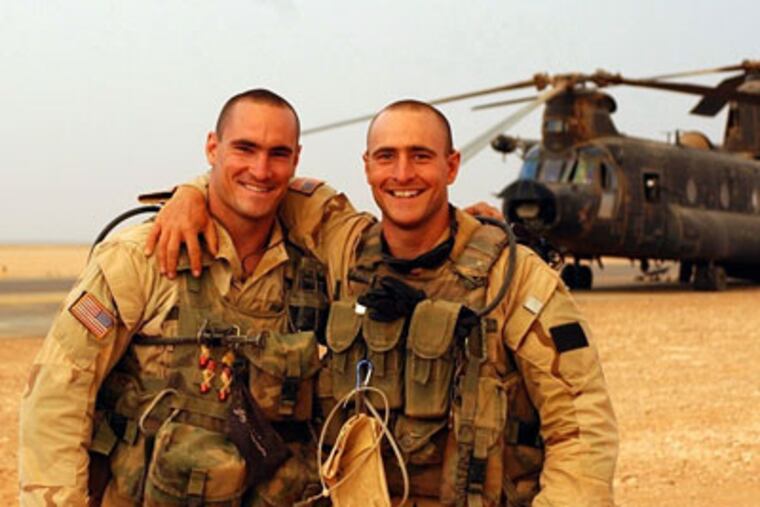
On April 22, 2004, Pat Tillman was shot and killed in a mountain pass in Afghanistan. The initial reports said that Tillman - the Arizona Cardinals defensive safety who left the NFL and enlisted in the Army after the attacks of 9/11 - had died while valiantly defending his fellow Rangers when they were caught in a Taliban ambush. It was a tragic story, and a great one.
Only problem: It wasn't true.
Five weeks later, the Army announced that Tillman had been killed by U.S. gunfire, a terrible mistake attributed to "the fog of war." But the spokesmen stuck to their story about the ambush, and the football star's valor in the heat of battle.
That, it turns out, wasn't true either.
Caught in the middle of the conflations and contradictions were the surviving members of Tillman's family: his mother, Mary "Dannie" Tillman; his two brothers, Kevin and Richard; his widow, Marie; and his father, Patrick Tillman Sr. They could easily have accepted the Army's version of events - after all, it painted their fallen loved one as a patriot, a hero.
But, as Amir Bar-Lev's wrenching documentary, The Tillman Story, reveals, the family was not ready to accept easy lies. Nor were they willing to let Pat become a symbol in a propaganda campaign. They insisted on finding out what really happened. And they defied the Pentagon, the White House, and Congress in their efforts to uncover the truth.
"There's something that we do - the media, the public - to a family in the role that the Tillmans were in that takes away their dignity," says Bar-Lev. "They can be used as a kind of prop for the pageantry that we wanted to put on to celebrate Pat Tillman's sacrifice. . . . But the Tillmans have hung onto their dignity. That's one of the most noble things about this family, is that they've resisted that. They've tried to seize control of their son's story, their husband's story, their brother's story."
Narrated by Josh Brolin, The Tillman Story - which opened Friday at the Ritz at the Bourse - offers a powerful portrait of a fiercely independent-minded clan, and an equally powerful condemnation of military and government institutions playing fast and loose with the facts. Bar-Lev's 2007 documentary My Kid Could Paint That similarly explored issues of truth: did a 4-year-old girl really paint these abstract artworks selling for five and six figures in New York galleries?
But the issue assumes far greater weight in The Tillman Story, and no one - not the generals, not the Bush administration, not the television and print news outlets that "reported" the story about Tillman's heroic sacrifice in combat - comes away unsullied. In fact, though there's plenty of culpability to go around, the news media come off as particularly complicit - and irresponsible - in their coverage of the Tillman affair.
"To me, it's really the heart of the issue. The reason that these handful of liars in the last administration were able to deceive the American people is because their deception touched a nerve," says Bar-Lev, who incorporates footage from the "rescue" of Jessica Lynch - the Army private in Iraq who was hailed as a hero, but subsequently accused the government of embellishing her story as part of a concerted propaganda effort - into The Tillman Story.
"Jessica Lynch and Pat Tillman were characters derived straight out of our movie mythology," Bar-Lev says. "And everybody gets off, basically, when it seems as though the movies have come to life.
"And the press knows that. . . . They know they can sell many, many bottles of shampoo. In other words, it's good for their advertising, it's good for their ratings. It's like mice and cocaine."
Bar-Lev wants to make it clear that The Tillman Story is not a political film. What happened under the Bush administration with Tillman and Lynch - the hagiography, the rewriting of history - has happened down through the ages.
Yes, lefty doc-meister Michael Moore hailed Bar-Lev's film when it premiered at Sundance in January. "But a few hours later somebody came up to me and said, 'Well, I'm an American exceptionalist and an ardent pro-military conservative and I thought your film was amazing,' " Bar-Lev reports.
"Obviously, there are people in some quarters who are angry about [the film], but it's an interesting debate to have. . . . The soldiers and the veterans who have seen the film have very much responded to it and have felt it to be accurate.
"I look forward to a real debate with those people who accuse the film of being anti-military. I don't see it that way.
"To me, this is a story, really, about publicists behind the scenes. Yes, publicists. And the question for people who are antiwar or pro-war is, do you want publicists running our wars, or do you want soldiers and generals running our wars?
"This is the worst example of using soldiers, and even using generals, for political photo ops."
Going the distance with Drew and Justin. If you're making a rom-com about a guy and a girl who find themselves in love, and then find themselves on opposite coasts, you'd better make the relationship believable in the first place.
And the way Going the Distance, which opened Friday, was originally scripted, that wasn't entirely the case.
"It was a problem," says the director, Nanette Burstein, a documentarian (The Kid Stays in the Picture, American Teen) making her first foray into feature films. And so Burstein, who found the screenplay lacking, took her stars - Drew Barrymore and her real-life beau, Justin Long - out and about for a couple of days of shooting in various New York City locales to establish their characters' amorous bonds.
"I relied on my documentary skills, shooting on HD cameras and finding locations with all natural light and having just a skeleton crew," says Burstein about her footage of Barrymore and Long cavorting on the Coney Island beach, eating and drinking in bars, roaming Chinatown. "Different scenarios, and in each place they'd change clothes so it would feel like a different day or time.
"And because they were a real couple, there was a lot for them to draw on - having that kind of intimacy of falling in love.
"And we were able to turn all that footage into what I felt was a very compelling love montage - and a little different from what you normally see."
A restaurant movie about - movies. Fatih Akin's Soul Kitchen, playing at the Ritz at the Bourse, is a buoyant screwball comedy set in a struggling eatery in Hamburg, Germany, whose harried proprietor tries desperately to keep the business afloat.
And although Akin's film is full of shots of a crazy chef and his gorgeous concoctions, it is also, says the Turkish-born German director, a movie that's very much about making movies, not just food.
"It's my film about filmmaking," says Akin, whose weightier work includes Head-On and the Cannes-winning The Edge of Heaven. "I think it's very boring to write or to think about a film about filmmaking. Day for Night by Truffaut, or 8 1/2 by Fellini - they were the best. But I am in the film world, it's a part of me. . . .
"And to own a restaurant is really much like owning a production company. A chef is really much like a director. And customers are really much like audiences, dishes are like films, the waiters and the cooks are like crew. . . . These are elements I could really relate to."