Art: Bringing treasures out of hiding
For its 125th anniversary, Bryn Mawr will show a bit of its seldom-seen art.
Bryn Mawr College is about to share a hidden treasure - a tiny piece of one, anyway.
Although the college offers a doctorate in art history, it doesn't teach studio art, nor does it produce a regular program of gallery exhibitions. Consequently, it comes as a mild surprise to learn that Bryn Mawr boasts a substantial and, in specific areas, distinguished art collection comprising about 50,000 objects, according to curator Emily Croll. Illuminated manuscripts and illustrated books add another 50,000.
The collection is usually used for teaching and research. Only a sliver normally presents itself publicly, most notably portraits of the college's first two presidents, James E. Rhoads (by William Merritt Chase) and M. Carey Thomas (by John Singer Sargent).
Starting Friday, however, art-lovers who aren't scholars or Bryn Mawr students can savor some of its highlights - 100 "treasures" selected to represent a wide variety of aesthetic and cultural areas, from classical Greek pottery and African sculpture to modern photography, early printed books, and art by women.
The exhibition, which celebrates the college's 125th anniversary, has been installed in the rare book room of the Canaday Library. It's not a large space, but given that each object is a prime specimen of its type, the show should prove exceptionally nourishing. (Its opening coincides with a three-day international conference at Bryn Mawr on the future of women's education.)
Most of the objects in the college collection have been donated by alumnae, faculty, and friends. Some of these gifts were both substantial and significant. The most prominent among them may be the Marjorie Walter Goodhart Memorial Library of early printed books, known as incunabula.
This collection was formed by Howard L. Goodhart to support the research of his daughter, Phyllis Goodhart Gordan of the class of 1935. He donated nearly 1,000 volumes to the college in honor of his wife, also an alumna.
Selections of incunabula in the show include a spectacular History of the World published in Nuremburg in 1493 with 1,800 woodcut illustrations. Other book and manuscript treasures include a Book of Hours, a Kelmscott Press book of Chaucer signed by William Morris and illustrated with woodcuts based on drawings by Edward Burne-Jones, and a two-volume edition of views of Naples and Vesuvius.
Joseph Clark Hoppin, who taught Greek art and archaeology at the college at the turn of the last century, donated 54 red- and black-figured Greek pots and sherds, including a plate by the artist known as "the Bryn Mawr painter" and a dramatic black-figured amphora adorned with a pair of huge eyes.
Frederica de Laguna, a longtime professor who founded the anthropology department, gave nearly 500 items, many from Arctic cultures but also including materials from the Northwest Coast and the American Southwest, such as a ceramic pot by Maria Martinez.
African art and Japanese woodblock prints are other major concentrations in the collection from non-Western cultures. Typical examples include a fringed Mende mask from Sierra Leone and prints by Japanese masters such as Utamaro and Hiroshige.
After Mary Cassatt and Edgar Degas saw an exhibition of Japanese prints at the Grand Palais in Paris, Cassatt produced a suite of 10 colored etchings that have become hallmarks of her style. The college owns eight of these; examples will be rotated through the run of the show.
Winnowing the collection down to 100 choice pieces seemed a near-impossible task when I saw the exhibition in its penultimate stage. There was so much quality on the table that any exclusions would have been painful.
The positive side of the curators' dilemma is that any choices made at the final cut were bound to affirm my belief that this collection deserved more public exposure. I hope the college can make that happen.
The Berman Museum. Ursinus College's museum has a much smaller collection, about 4,000 items. Yet, as at Bryn Mawr, almost all of it has also been practically invisible, a few sculptures excepted. But now that collection too has begun to show its face, thanks to a conspicuous addition designed by the Philadelphia architects Towers & Miller.
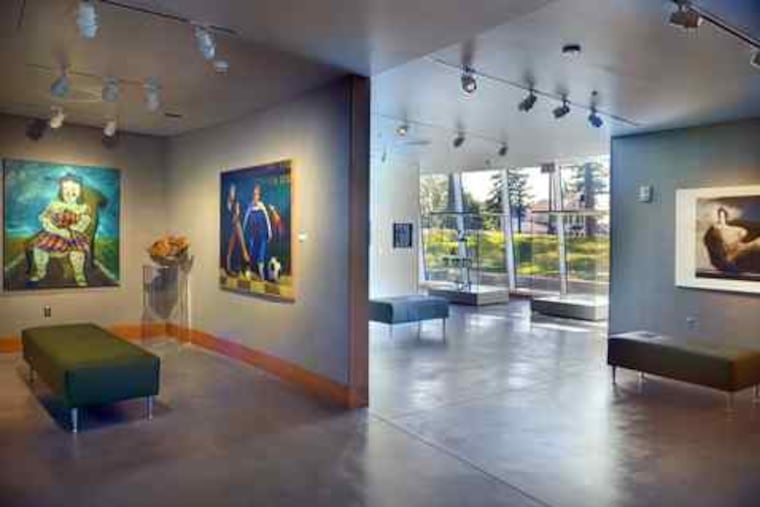
The Henry W. and June Pfeiffer wing projects from the front of the neo-Georgian museum building. It's partially below grade, and features a curved window wall that allows collection displays to be seen from outdoors.
Directly behind the wall, in an atriumlike space, the museum has installed seven large glass vitrines that contain objects such as South Asian ceramics and Pennsylvania German artifacts. A space awaits a large sculpture by British artist Lynn Chadwick. A lounge area in the atrium contains, besides a collection of art books that visitors and students can peruse, glassed-in shelves for small sculptures.
Two-dimensional art from the collection is presented in two adjacent spaces. A small gallery, also partially visible from outdoors, contains a selection of paintings that will be rotated several times a year. Pictures can also be hung in a small theater-style lecture room.
A works-on-paper study room features several dozen framed pieces on two walls and locked storage for 1,500 other works.
The addition provides one other display platform, an outdoor terrace atop the addition dedicated to the museum's patrons, the late Muriel and Philip Berman. It displays five bronzes donated by Bucks County sculptor George R. Anthonisen.
Museum director Lisa Tremper Hanover estimates that about 30 percent of the collection is now on view and that about 50 percent is accessible, meaning that works on paper in locked storage can be seen by request.
As at Bryn Mawr, almost all the museum's collection has been donated, about half by the Bermans, who were particularly fond of Chadwick. The museum houses their gift of 132 of his bronzes, the largest group in this country.
Besides Chadwick, collection strengths include Japanese prints, 20th-century American paintings and works on paper, and work by female artists. A collection of graphics by Henry Moore put together by Muriel Berman and owned by the Berman Foundation is also housed at the museum.
The Allentown Art Museum has suspended all admission charges through Sunday, Nov. 14. The museum will close Nov. 15 for expansion, and expects to reopen on Sept. 1 next year. Hours are 11 a.m. to 5 p.m. Wednesdays through Saturdays and noon to 5 p.m. Sundays. 610-432-4333 or www.allentownartmuseum.org.
Art: Out in the Open
 "Worlds to Discover: 125 Years of Collections at Bryn Mawr College" opens in the Canaday Library, 101 N. Merion Ave., Friday and continues through May 28. 9 a.m. to 4:30 p.m. Mondays through Fridays and 1 to 5 p.m. Saturdays. Closed Christmas through New Year's; hours may vary during holidays and when the college is not in session. Information 610-526-5335 or www.brynmawr.edu/library/exhibitions.html.
The Berman Museum at Ursinus College, 601 E. Main St., Collegeville, is open from 10 a.m. to 4 p.m. Tuesdays through Fridays, noon to 4:30 p.m. Saturdays and Sundays. Free. Information 610-409-3500. A community open house for the Pfeiffer wing will be held Oct. 24 from 1 to 4 p.m.
EndText
edwardsozanski.