Art: Aesthetic sense, functional forms
Wharton Esherick is the subject of a new book, and his work is on display at Penn.
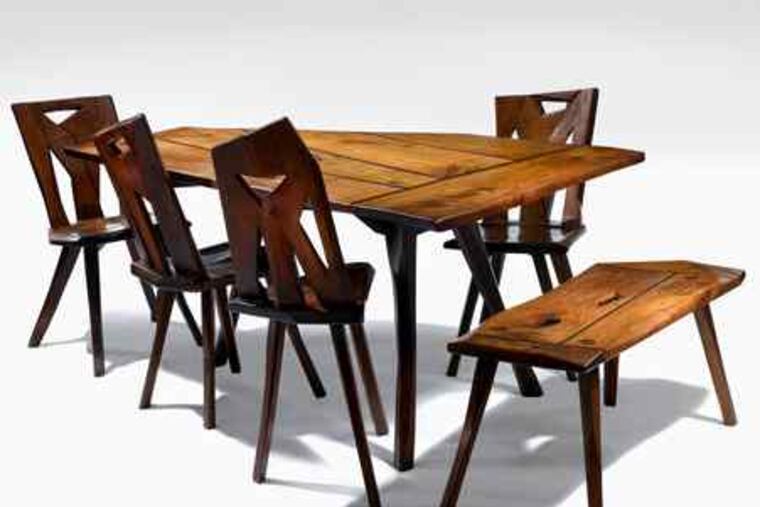
Wharton Esherick, who died in 1970 two months shy of his 83d birthday, was one of the Philadelphia region's most innovative and influential artists, yet his work hasn't received as much public attention locally as his legacy warrants.
Esherick began his career as a painter and printmaker - his last significant solo exhibition appears to have been one of prints at Chestnut Hill's Woodmere Art Museum in 1984 - but he's remembered primarily for his striking modernist furniture and his transformative architectural interiors.
Esherick has been characterized as the father of the American studio furniture movement; celebrated woodworker Wendell Castle says he was inspired to enter the field after meeting Esherick and seeing his work.
Esherick hasn't been entirely out of the public eye since his death. His work has been on display for years at the museum established in his former studio in Tredyffrin, Chester County, near Valley Forge National Historical Park. Now, the publication of a handsome book about his life and career and the opening of an exhibition at the University of Pennsylvania put him back in the spotlight in his native Philadelphia, where he studied art at the Pennsylvania Museum and School of Industrial Art (now University of the Arts) and the Pennsylvania Academy of the Fine Arts.
Published by Abrams, Wharton Esherick: The Journey of a Creative Mind, was written by Mansfield "Bob" Bascom, a former architect and structural engineer who has been married to the artist's daughter Ruth for more than 50 years.
The Bascoms were instrumental in preserving Esherick's studio complex as a historic house museum; Bascom was first director, then curator until he retired in 2007.
Bringing the book to completion took him 40 years, but it was time well-spent: Wharton Esherick combines the best features of a straight biography and a monograph, in that the life and the work receive equal treatment. Bascom grounds the book in interviews with the artist but draws on many other sources, which gives the narrative depth and spirit. It is profusely illustrated with photographs that illuminate the life story and describe the distinctive furniture and interiors that secured Esherick's reputation - and that the Esherick museum has preserved.
This is particularly important for what was perhaps the artist's most important single commission, the architectural transformation of the Curtis and Nellie Lee Bok house in Gulph Mills, which was demolished in 1989.
Fortunately, most of the important elements of the Bok interiors were saved, some in museums and others through private purchase.
(The Philadelphia Museum of Art, which owns the Bok house music room and one wall of its library, is creating a display of Esherick material it owns in Gallery 119.
(It comprises the library fireplace and music-room door, both regularly installed there, plus a painting, a carved sculpture, a sconce from the music room, and, at this writing, either a monumental radio cabinet or a music stand and library ladder. The installation will open this weekend and remain on view through January.)
As Bascom relates, Esherick decided at an early age that he wanted to be an artist. He began as a painter-printmaker; while he had some success with prints, he wasn't able to crack the market with oils.
Aside from a 1920 landscape called Moonlight on the Pines, the exhibition delivers scant evidence for his painting skill, but it does reveal a talent for creating hand-carved frames.
Esherick's woodcut prints are much more distinctively dramatic and visually powerful than his paintings (or his sculptures, for that matter). They connect directly to his later angular furniture and interiors, the best of which derived from an intensely expressionistic, cubist-influenced vocabulary of fractured planes and energetic vectors.
Carving frames nudged Esherick in the direction of wooden sculpture; that, in turn, led to furniture design and fabrication, which was to prove more commercially viable. Esherick wanted his furniture to be sculptural; the examples at Penn demonstrate that he achieved that ideal in ways that can be dramatic and, in terms of craftsmanship, remarkable.
In Bascom's book, this evolution unfolds organically and, in retrospect, inevitably. At Penn, the transition is abrupt because the exhibition is installed in two separated sections.
In the Kamin gallery of the Van Pelt Library, the visitor encounters a wide variety of materials in cases, from small sculptures to works on paper, photos, posters, letters, and books.
There's a lot of reading involved in this section, which lays out the artist's early life and its subsequent principal themes - his involvement with the Centaur bookshop in Center City, which commissioned illustrations; his involvement with Hedgerow Theatre in the Rose Valley artist's colony just west of Swarthmore, and his friendships with literary lions Sherwood Anderson and Theodore Dreiser, for whom he made a large writing table. (Hedgerow, in cooperation with Penn and the Esherick museum, is staging the adaptation of Dreiser's An American Tragedy that it premiered in 1935.)
Examples of furniture commissioned by some of Esherick's major patrons, particularly the Boks, photographer Marjorie Constant, and Helene Koerting Fischer, are on view in the Kroiz gallery of the university's architectural archives in the Fisher Fine Arts Library.
The selection isn't large, but it reveals the essentials of Esherick's aesthetic thinking, especially in the radical Farmhouse Dining Set of 1928 - an asymmetrical, five-sided table, four unique chairs (one with only three legs) and a bench.
The ensemble reflects Esherick's belief that furniture should express natural forces, harmonize with its intended location, and spiritually connect to human needs.
Bascom reveals something that might surprise even people familiar with Esherick's furniture (it certainly did me) - that for more than 30 years he collaborated with European-trained cabinetmaker John Schmidt, whose workshop was near his studio.
Schmidt's knowledge and skill were invaluable to Esherick, especially when he began to design furniture, according to Esherick Museum curator Paul Eisenhauer, because he wasn't trained in woodworking. Some pieces they produced are signed with both men's initials, others only with Esherick's.
As the exhibition suggests and as the biography makes abundantly clear, Esherick worked within a broad cultural milieu that extended beyond the sculpture studio and the woodworking shop. He was involved in theatrical productions, books and book publishing and, through his writer friends, with literature.
The book restores this bit of the city's cultural history to public consciousness, while reminding us that an artist's influence on society needn't be restricted by his medium. It further affirms that, in Esherick's case, elevated aesthetic ideas can be expressed effectively, and sometimes memorably, through functional objects.
Art: Wizard With Wood
Topics raised by the exhibition will be explored during the second-annual Anne d'Harnoncourt Symposium Friday and Saturday at the university. For information or to register, use contact information above.
EndText