Galleries: 'Communist Conspiracy' gets the space it deserves
If you're a regular gallerygoer in Philadelphia, Yevgeniy Fiks' installation at Temple Gallery will quickly remind you that shows of conceptual art rarely get this kind of space anymore. And if they do, the venue is usually a college gallery (as this is), a gallery devoted to conceptual art (that would be University City's Slought Foundation), a museum, an atmospheric, moldering historic building of some kind, or the great outdoors.
If you're a regular gallerygoer in Philadelphia, Yevgeniy Fiks' installation at Temple Gallery will quickly remind you that shows of conceptual art rarely get this kind of space anymore. And if they do, the venue is usually a college gallery (as this is), a gallery devoted to conceptual art (that would be University City's Slought Foundation), a museum, an atmospheric, moldering historic building of some kind, or the great outdoors.
Fiks' "Communist Conspiracy in Art Threatens American Museums," which was organized by the independent curator and critic Stamatina Gregory, has the entire, almost brand-new Temple Gallery - which can easily accommodate three solo shows - to itself.
This largesse turns out to have been the best approach to Fik's work. Viewers can experience the cohesiveness and obsessiveness of his ideas through his various projects installed in Temple Gallery's three large rooms.
When you learn that Fiks was born in Moscow in 1972 and immigrated to New York in 1994, his conceptual explorations of Soviet-era repression and the American communist movement seem to be the work he was destined to make. Aren't most artists trying to work through their childhood mysteries?
The projects that constitute "Communist Conspiracy in Art Threatens American Museums," whose title was borrowed from a 1952 quote by Rep. George A. Dondero (R., Mich.), who claimed that modern art was a communist plot devised to topple the West, are like chapters in a book. Each involves numerous, repetitive, pagelike images and hints at what's to come next. It's a form more evocative of operas and novels than art.
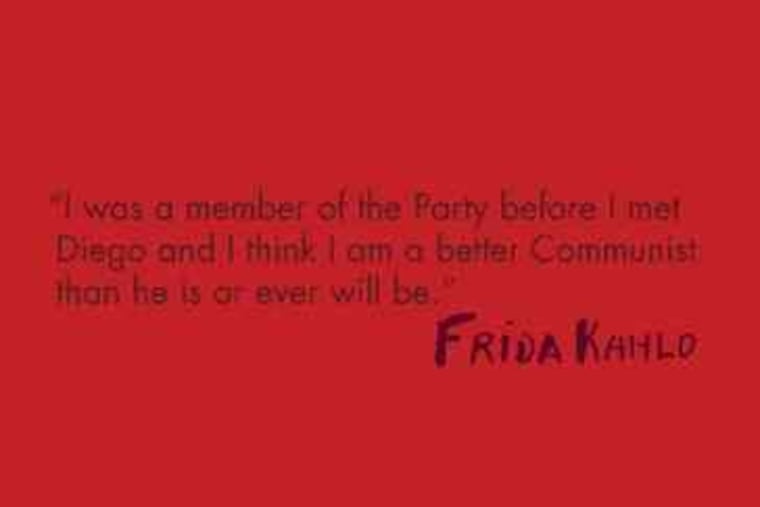
"Communist Tour of Russia," for example, is a series of seven digital prints on canvas, monochromatic red "paintings" that depict quotations in black lettering from Frida Kahlo, Marc Chagall, Stuart Davis, and other artists targeted by McCarthyism.
"Flag Drawings," consists of 15 apparently hand-rendered ink drawings by Fiks, each one showing an empty rectangle with a hammer and sickle in its upper left corner and a facsimile of an artist's signature in the lower right, one of the aforementioned artists or others who were admittedly, or suspected of being, communists.
And in an audio piece, recordings of Dondero's speeches being read by contemporary actors are played again and again. It's fascinating to hear his conspiracy theories spoken and to imagine their effect on their original listeners.
One could argue that Fiks takes some of his projects too far - we get the point already! - but he's clearly going for the hypnotic overdose, intentionally simulating the effect of brainwashing. And it works: You leave this show wondering how an installation whose individual components were so physically minimal and visually bland reeled you in with such force.
Fiks will be giving at lecture at Temple University's Paley Hall on Wednesday and a "Communist Tour of the Philadelphia Museum of Art" on Oct. 15. Visit the Temple Gallery website below for details.
Essence of Philly
To describe Jacob Lunderby's paintings as composites of his photographs of Philadelphia street scenes is accurate, but it doesn't quite do them justice. For one thing, only the most observant city dwellers will recognize actual places, or intersections of places. For another, there does not seem to be an attempt on the artist's part to have photographed the iconic Philadelphia cityscape. I think that Lunderby, who is based here, thought his paintings would express an an ineffable essence of the city. In that, they succeed.
The large paintings - and he's showing only large and small works - are the more literal, possibly because he has so much space on which to paint his meshings of photographic images and he's compelled to take advantage of the space.
In the smaller one, he appears to have cropped his photographic images, and the results are more emblematic than all-over. His black images on silver backgrounds are the most interesting of these, reminiscent of Andy Warhol's "Disaster" series.
Toothsome twosome
There is something irresistible about Joseph Hasenauer's paintings of a young woman and her adoring pet octopus at Bambi Gallery, although the actual renderings of the twosome leave something to be desired.
They're too unnuanced, but not flat enough. I'd like to see them in painterly flourishes or as plain as a billboard image. I think there's a children's book, here, minus the racier images.
Hasenauer's painting of the woman performing her morning ablutions at the sink, with the octopus behind her, offering her a toothpaste tube in one of its tentacles, is a winner.