Music: The Quarrymen, John Lennon's old mates, relive their time with the 'Nowhere Boy'
MUSIC AND FILM buffs may wait a couple weeks for the sensitively wrought John Lennon biopic "Nowhere Boy" to mark its official opening.
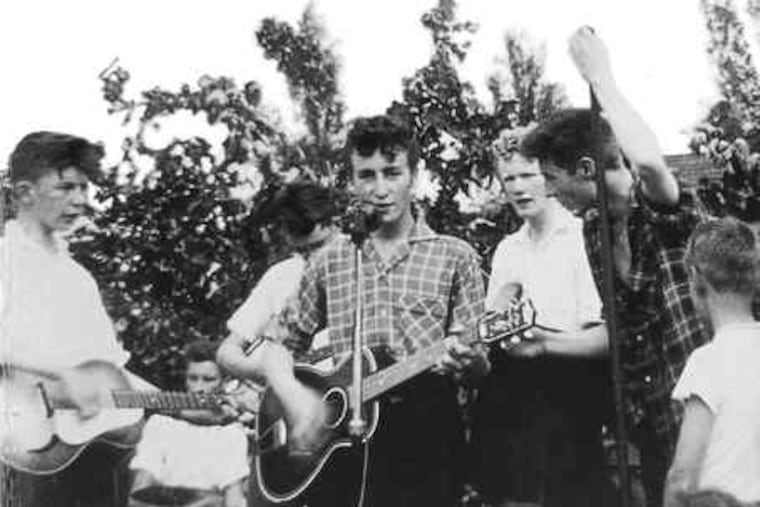
MUSIC AND FILM buffs may wait a couple weeks for the sensitively wrought John Lennon biopic "Nowhere Boy" to mark its official opening.
Or, more intriguing, you could enjoy a special sneak peek of the film on Tuesday at the Keswick, enhanced with a chat and performances by special guests who knew and worked with Lennon back in the day.
Scripted by the same bloke (Matt Greenhalgh) who visualized Joy Division's bleak world in the cult hit "Control," "Nowhere Boy" finally brings to the screen the fascinating saga of John Lennon's formative early years. There's an especially strong focus on his complicated relationships with two polar opposite "mums" - his stern Aunt Mimi and long-absent, freewheeling mother Julia - and the rebellious nature (but no wonder) that resulted.
Of course, the film also offers insights about the Liverpudlian's first forays into music at Julia's urging, forming the skiffle band the Quarrymen with classmates who could barely play, then luring in the more serious-minded Paul McCartney and George Harrison.
And you know what that got them.
But get this - 50-plus years later, some Quarrymen are still alive and well, playing better than they did back then and thinking good thoughts about John on the eve of what would have been his 70th birthday. They'll be popping in as the other big component of Tuesday's Keswick send-off for the film.
The night opens with a complete screening of "Nowhere Boy." Right afterward, you'll be able to question the veracity of the dramatized material in a Q&A session with Quarrymen survivors Rod Davis, Len Garry and Colin Hanton. After that, these guys will grab their musical gear and turn back the clock, serving up a set of goodtime skiffle (merging ragtime jazz, blues and country) tunes, including some they did back in the day with John - like the bawdy "Maggie May" and Beatles-adopted "One After 909."
Being impatient, though, we jumped at the chance to chat the other day with Davis to, um, preview the preview.
Q: I'm guessing this film has already played in Britain, since it was financed and shot there. How has it been received at home?
A: A little more coolly than it's now being received here, frankly. I think Americans think a lot more of John Lennon than we do in England, since he went to live in America and it took him to its heart.
Q: How true to life are the characterizations of his Aunt Mimi and mother Julia, and the rest of the guys who made up the Quarrymen? And what do you make of the film's intimations that Julia and John acted almost like girlfriend and boyfriend when they were together?
A: I only met Mimi once or twice, but we spent a lot of time rehearsing at Julia's house, and she seems accurately portrayed. She was a lot of fun, more like a big sister than a mum to John. I have to say that some of the imagery in the film [of mother and son cuddling] made me a little uncomfortable, but that is a psychological situation which happens sometimes when a parent has a child very young, they become estranged, and then reconnect. And that syndrome was certainly reflected in John's music. [Think "Mother," which closes the film.]
John, played by Aaron Johnson, is spot on. The Paul in the film [played by maturing child actor Thomas Brodie Sangster] doesn't quite resemble him as much as people would wish, and some events are "concertina-d" [compressed] for artistic license.
John didn't really put the Quarrymen together in two minutes in the boys room - it took a few weeks. But it's not a documentary, and the important thing is it does capture the feeling of how it was.
Q: You first met John when you were 5, and spent a lot of time in classes with him before he invited you to join the Quarrymen. What are your favorite memories of him?
A: We first went to Sunday school together. He was a little older - 6 or 7. Every Sunday we had a few pennies for the charity collection. He'd use his to buy gum. Yeah, he was a bad role model even then, absolutely a total villain but a lot of fun to be with. He was always cutting up in class, which got to be tedious after a while.
I was actually at the polar opposite from him - the bookish nerd. So I was a little surprised when he invited me into the group. It was probably because I had a banjo. But my parents were always warning me, "Stay away from that Lennon." That's what they called him.
Q: I've heard you turned down the chance to be in the Beatles, even though you'd quit the Quarrymen years before. Any truth?
A: I left the Quarrymen when Paul came in. They were moving in a rock direction and the banjo, which John had also started out playing, didn't really fit in. I left to keep on with my education, going to university at Cambridge. But I kept on playing, diversifying on other instruments - mandolin, guitar.
One day I ran into John on the street and shared that with him. And he said, maybe half-jokingly, "Can you play drums, too? We need a drummer, we're going to Hamburg." But I couldn't, and my parents would have killed me if I'd quit school halfway through to join a rock band that would "never amount to anything."
Q: How long has this "original Quarrymen" revival been going on?
A: We first got back together in a totally impromptu fashion in 1997 at an event celebrating the 40th birthday of the Cavern, the club where the Quarrymen played when it was strictly a jazz and blues joint, and rock was seriously frowned on.
It was a fantastic party, with lots of free booze, and even though some of us hadn't played at all for 40 years, let alone together, we were persuaded to get up and do a few numbers, with the thinking everyone was so drunk it wouldn't matter.
Then a little later, we were asked to do a benefit for the crumbling St. Peter's Church Hall where John first met Paul at a gig. We actually rehearsed for that one, and then the offers started coming in - Do you have a CD? Can you play for us?
I was a marketing lecturer at the local university, but we managed long weekends in Europe, then came over to do shows in Canada and the U.S. Now we really get around - Germany, Japan, Russia. It never stops.
Keswick Theatre, Easton Road and Keswick Avenue, Glenside, 8 p.m. Tuesday, $29.50 & $35, 215-572-7650, www.keswicktheatre.com.