Art: Eclectic staging of borrowed works at ICA
Phila. artist Virgil Marti combed Art Museum storerooms for an uncommon mix of sculpture, furniture, arcana.
In 1992, the Maryland Historical Society invited artist Fred Wilson to rummage through its collection, select objects that caught his eye, and organize them into an exhibition.
Wilson's show, "Mining the Museum," created a bit of a stir with its novel approach and established a fresh model for museum presentations.
Since then, a number of museums have imitated the society's example, to such a degree that artist-as-curator no longer seems like a novelty. Now, Philadelphia's Institute of Contemporary Art has taken up the idea, albeit with a twist.
The ICA couldn't enlist Virgil Marti to sift through its own collection because it's not a collecting institution. Instead, it collaborated with the Philadelphia Museum of Art, which owns tens of thousands of objects the public never, or rarely, gets to see.
These proved to be a treasure trove for Marti, a well-known Philadelphia artist who dances along the boundary between sober high art and flamboyant decoration.
From the Art Museum's storerooms, Marti has created "Set Pieces," an eclectic staging at the ICA of unconventional combinations of painting, sculpture, furniture, pottery, and related samples of decorative arcana, such as bronze floor lamps and ivory candlesticks.
The philosophical impulse behind this show, and others like it, is that artists see differently, so they're likely to detect aesthetic connections among disparate objects that might escape other observers, even art historians.
Given license to mix and match from a museum collection, artists inevitably will create unusual juxtapositions that stimulate visitors to look at the objects in new ways.
For example, Marti has arranged six 18th-century tilt-top tea tables in a semicircle facing a wall, against which he has placed a 1970 sculpture by surrealist Dorothea Tanning - a sofa on which two abstracted figures covered in the sofa's fabric (making them seem like an extrusion) seem entangled in a vaguely erotic clinch. The piece is called Rainy Day Canape, but one could call it Propriety Stares Down Prurience.
Tanning's sofa is one of a handful of modern and contemporary works in Marti's stew; mostly, he has drawn on the decorative arts and sculpture of the 18th and 19th centuries.
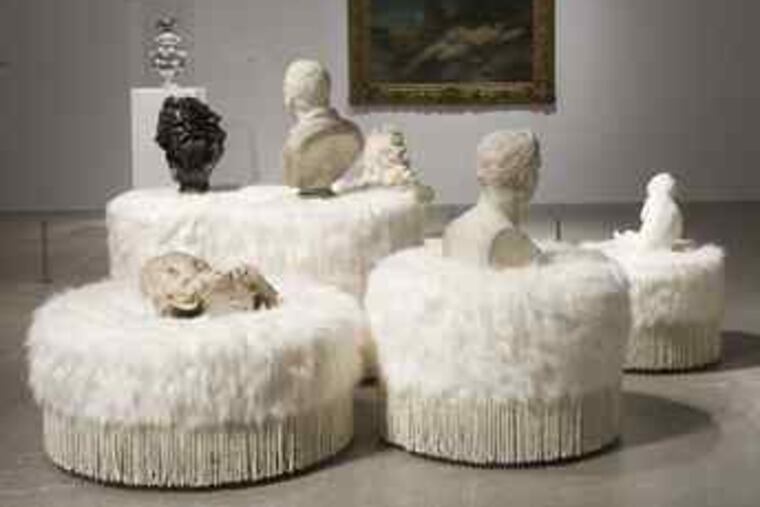
The concept of the "set piece" - a dramatically staged tableau that might suggest a narrative or symbolize a theme - is delightfully expressed through a group of 15 small bronze sculptures, animals and humans, on an elevated platform, and also by a group of white-marble portrait busts and one bronze set on drumlike pedestals covered with shaggy, white faux fur.
Marti has used a lot of mirrors in his installation, perhaps a reference to one of many set pieces in the film Citizen Kane; he acknowledges that film imagery plays an important role in his thinking.
He also has populated the show with a number of portraits, from Napoleon and George Washington to Abraham Lincoln, who is represented by casts of his face and hands. Some of these are displayed in a thematic section that includes a gilt-bronze bust of Voltaire and ceramic pieces from the Wedgwood factory.
Two splendid objects stand in isolation on either side of the gallery entrance, a 1795 porcelain coffeepot from Vienna and a 1755 French writing desk, in tulipwood, with multiple inlays and gilded bronze mounts.
These paragons of elegant design establish a tone of high quality, reminding visitors that despite the show's playfulness, museum standards apply.
"Set Pieces" stands as a serious work of art on its own, and yet it's liberating, not only because it's full of surprises, but also because visitors can interpret it freely, without preconceptions or didactic prompting.
Marti doesn't insist that you accept his choices, only that you consider the plausibility of the unorthodox.
Janet Fleisher was the only grand dame of the Philadelphia gallery scene whom I never got to know, even casually.
I encountered her once, in her eponymous gallery, sometime in the 1980s, but it was not more than a brief introduction. By then, Fleisher had left day-to-day affairs in the hands of the gallery's longtime director, John Ollman.
She was one of the first women to own an art gallery in Philadelphia. She began in 1952 with the Little Gallery, which became Janet Fleisher Gallery in the early 1970s (a change Ollman says she made reluctantly).
When she retired in 1996, Ollman became the owner, but her legacy lives on in the gallery name he chose, Fleisher/Ollman. That legacy is manifest in one simple fact: Of the exhibiting art galleries doing business here 58 years ago, only one other, Newman Galleries, remains.
To last that long in the chronically tenuous gallery business, a dealer needs an enduring vision, financial stability, and a bit of luck.
Fleisher certainly had the vision; she showed African, Oceanic, pre-Columbian, American Indian, and American folk and naive art well before these became widely accepted by the market.
Because she was connected to the Fleisher family (her husband, Robert, was a close relative of Samuel Fleisher), she had the resources to buy, for instance, pre-Columbian art when it was still reasonably priced, then to sit on it.
Likewise, her prescient investments in art outside the mainstream paid off when formerly obscure or marginal artists eventually became popular. Today, Fleisher/Ollman is known nationally and internationally for its foresight in exhibiting such untutored creative artists as Bill Traylor, Martin Ramirez, Howard Finster, and William Edmondson and, also, because of its experience, as a prime resource for research in the field.
Equally significant, I think, is the exuberant and adventurous spirit that Fleisher injected into the sleepy local gallery scene through her dynamic personality and her enthusiasm for meeting artists and showing exciting art.
A cosmopolite, she also ran, for some years, a gallery in Paris, where she met such modernist titans as Pablo Picasso and Alexander Calder.
The Philadelphia gallery scene has expanded exponentially since 1952, both in the range and quality of the art one can find on view in an average week. Janet Fleisher, who died Aug. 2 at 93, undoubtedly inspired others, especially women, to follow her example, which has contributed to the rich tapestry of art offerings one finds today in the city and region. For this, she deserves to be remembered with gratitude.
Art: Artist as Curator
"Set Pieces" continues at the Institute of Contemporary Art, 36th and Sansom Streets, through Feb. 13. Hours are 11 a.m. to 8 p.m. Wednesdays, 11 to 6 Thursdays and Fridays, and 11 to 5 Saturdays and Sundays. Free admission. Information: 215-898-7108 or www.icaphila.org.
Through Nov. 27, Fleisher/Ollman Gallery, 1616 Walnut St., is featuring "Four Decades," an exhibition that summarizes its history during John Ollman's tenure there
as director and owner. Hours: 10:30 a.m. to 5:30 p.m. Mondays through Fridays,
noon to 5 Saturdays. Information: 215-545-7562
or www.fleisher- ollmangallery.com.
EndText