Galleries: Art Alliance offers new takes on the old-time sitting room
Hard as it might be to envision in the age of texting and kitchen-as-entertainment center, the sitting room used to be the most happening room in a house. It was, among other things, the room in which Victorians gossiped with their friends over tea, discussed politics over stronger stuff, and hosted the occasional wake or seance.
Hard as it might be to envision in the age of texting and kitchen-as-entertainment center, the sitting room used to be the most happening room in a house. It was, among other things, the room in which Victorians gossiped with their friends over tea, discussed politics over stronger stuff, and hosted the occasional wake or seance.
The four artists invited to participate in the Philadelphia Art Alliance's exhibition "The Sitting Room: Four Studies" took all the room's former uses into consideration when planning their installations; they also paid heed to the history and architecture of the 1906 Beaux Arts-style mansion in which the Art Alliance resides, and to the privileged social circle in which its first owners, the Wetherill family, moved. Then, as artists predictably do, they did their own things.
Saya Woolfalk, who created her installation in one of the mansion's two sitting rooms (now galleries), imagined a futuristic, Utopian room in keeping with the stuffed-fabric humanoid and plantlike forms she has been making for some time.
Several stuffed figures inhabit her work, and a video of performers in Woolfalk-designed costumes plays on the mantelpiece. Woolfalk's paintings of a mysterious kingdom and photographic portraits of dandies add to her room's whimsical character.
In the adjoining first-floor gallery, possibly a former parlor, Carole Loeffler has hung five tents constructed from sewn panels of vintage fabrics, each functioning as a separate space for displays of arrangements of old chairs. It soon becomes obvious that the chairs are stand-ins for people and that their positions are meant to evoke the emotions that might arise in a formal reception space.
The two artists whose installations take up the second floor, Jennifer Angus and Ligia Bouton, are more practiced at their genres than Woolfalk or Loeffler. They also seem to have studied and borrowed from Victorian preoccupations and crafts long before they were chosen for this show.
Angus has produced the most eccentric and Victorian piece of the show, meant to recall the Victorian obsessions with collecting, exotica, and the deceased. Insect carapaces are used in decorative assemblages on the walls and as substitutes for humans in ornate Victorian dollhouses built by Angus. The brilliant blue walls against which the works are displayed, painted for this installation, are a reminder of the Victorian embrace of vivid color.
Three large galleries contain Bouton's three installations on the theme of Victorian parlor seances. Bouton, who enlarges parts of photographs of seances from the late 19th century and incorporates them into theatrical sets as freestanding objects, does not acknowledge the likelihood that staid, prosperous Philadelphia Quaker families of the period would have avoided contact with the spirits. But why not dream?
The real deal
It's generally hard to tell the real from the staged in "True Fiction," the current group show of photographs at the Philadelphia Photo Arts Center, and that's the point.
There are a few exceptions. Gregory Crewdson's large color photograph of a trailer in a landscape, from 2007, immediately struck me as less obviously staged than his earlier work but still masterminded by Crewdson. Yasser Aggour's digital images of "bloody" rams and a "wounded" zebra are clearly manipulated. And if Kelli Connell's portraits of women weren't posed, they certainly look as if they were.
Otherwise, the scenes captured by LaToya Ruby Frazier, Beate Gutschow, Bradley Peters, Taryn Simon, Chad States, and Elaine Stocki, as strange and unlikely as many of them are, seem utterly plausible.
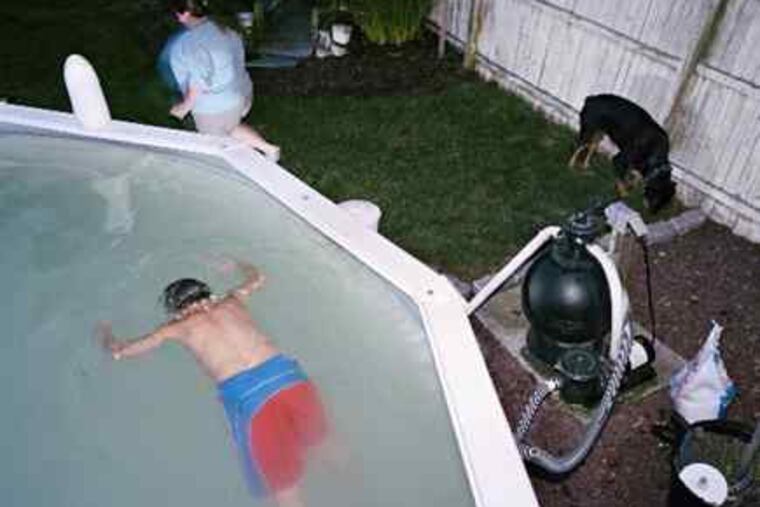
Stocki, whose color photographs show what appear to be homeless people in places where one might expect to find them - in a park, under a quilt - shoots her subjects from extreme perspectives and in unusually lit situations, giving her images, which appear to be unstaged, the drama of staged photos.
The industrial scenes in Beate Gutschow's huge black-and-white prints look like actual places but are in fact seamless composites of different locations.
At first, LaToya Ruby Frazier's extraordinary silver gelatin prints of her family and herself seem like straightforward documentary work, though you wonder how she managed to catch these intimate, unguarded moments. To learn that they are a collaboration between Frazier and her family makes sense, but it hardly diminishes the revelatory impact of her pictures.
Andrade outdoors
Everyone who has followed the Philadelphia art scene over the past few decades has seen the Op-Art paintings of geometric patterns of Edna Andrade, who died at 91 in 2008. What they might not know of her output - unless they saw the 2007 retrospective of her works on paper at the Woodmere Art Museum - are her landscapes before she turned to abstraction. Andrade's early watercolor and ink paintings, pastels, and drawings of forests and rocky outcroppings in Maine, Massachusetts, and Fairmount Park in "Edna Andrade: Drawings (19581993)" at Locks Gallery are wonderful to observe as they dissolve into the impressionistic daubs that eventually led to her taut, geometric abstractions.