Mavis Staples and Wilco leader find a fruitful collaboration
When Mavis Staples and Jeff Tweedy began working together last year, the leader of the Chicago rock band Wilco gathered up songs he hoped would meet with the approval of the gospel-soul vocalist.
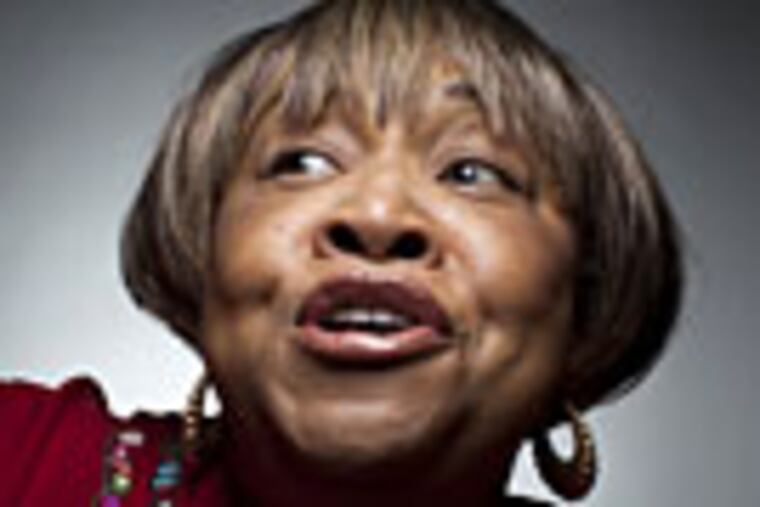
When Mavis Staples and Jeff Tweedy began working together last year, the leader of the Chicago rock band Wilco gathered up songs he hoped would meet with the approval of the gospel-soul vocalist.
Tweedy even had a title in mind for a song that he wanted to write for the 71-year-old Staples. The singer's husky contralto powered such early-1970s hits as "Respect Yourself" and "I'll Take You There," both recorded with the Staple Singers, the family band led by her father, Roebuck "Pops" Staples.
"He said, 'Mavis, I want to write this song for you; it's called 'You Are Not Alone,' " recalled Staples, who will perform at World Cafe Live on Monday.
The 43-year-old songwriter and guitarist told Staples that the title was lingering in his head. "I said, 'Well, then write it, Tweedy. Write it!,' " Staples says, in a conversation from her home on Chicago's South Side. She lets out a hearty laugh. "Because just that title . . . It sounded good to me."
Tweedy did write it, and it became the title cut of the new You Are Not Alone (Anti-), the latest late-career winner for Staples, in a streak that began with her 2007 album, We'll Never Turn Back.
That album of freedom songs, produced by Ry Cooder, revisited many of the anthems Staples - who refers to herself as "like a walking history book" - would sing with her family band while accompanying the Rev. Dr. Martin Luther King Jr. throughout the South at the height of the civil rights movement. And that streak continued with 2008's Live: Hope at the Hideout, a fiery set recorded in a small Chicago club before a select crowd, including Tweedy.
After the Wilco leader paid his respects to Staples, the two got to know each other in a Chicago restaurant. "We talked for about 2½ hours," Staples says. "He really opened up to me about himself and his family. I felt grateful . . . He had worked in a record shop as a kid, and he grew up listening to the Staple Singers. He told me how much he liked our music, especially my father. I said, 'Especially Pops? You didn't like me?' "
Tweedy was prepared to be intimidated by working with Staples, who was coaxed into the studio in the late 1980s by Prince and who turned down a marriage proposal from Bob Dylan in the 1960s - especially since it was his first time producing a non-Wilco project.
But Staples was "welcoming and warm," Tweedy says, by phone from his home on Chicago's North Side. "You're on her side for life within 10 seconds of meeting her."
"I love the Staple Singers," Tweedy says. "I love Mavis. I listened to everything I could find. I knew a lot about where she was coming from, going in. I just wanted to find out where she wanted to go, and then get out of her way."
The album was recorded at Wilco's studio, which Staples found to be "the perfect place. I walked in, and there was just a sea of guitars," she says. "I said, 'Tweedy, do you play all these guitars?' He said, 'I get around to it.' It's a funky place. Most studios are big, spacious places. This wasn't like that. It was like home."
The welcoming atmosphere included a caterer who kept the singer and her touring band well-nourished. "Lasagna, smothered chicken," she says. "Tweedy said to me, 'Now, Mavis, did Ry Cooder do that for you?' "
Along with two Tweedy songs - the title cut and the rollicking "Only the Lord Knows" - You Are Not Alone finds Staples applying her now-raspy, still-powerful voice to a handful of songs by rock-era writers: John Fogerty's "Wrote a Song for Everyone," and Randy Newman's "Losing You."
There are also older songs, such as the Rev. Gary Davis' rousing "I Belong to the Band" and two Pops Staples songs, the welcoming "Don't Knock" and the fire-and-brimstone "Downward Road."
Tweedy suggested "Wonderful Savior" and "Creep Along," which Staples had never sung but knew from recordings her father used to play by the Golden Gate Jubilee Singers. "These songs are older than me," she says.
The music brought back memories. Staples' father, a masterful slide guitarist, started the group that would become the Staple Singers when she was 8 years old. (He dropped the s at the end of the family name because he thought Staples Singers was too hard to say.)
The Staples patriarch enlisted his children Cleotha, Pervis, Yvonne, and Mavis, the youngest, in 1949, after he got fed up with the male members of a group he was singing with for not showing up for rehearsal. "He gathered us all up on the living-room floor and gave us these voices to sing," Mavis says. Eight-year-old Mavis sang bass.
Their first performance was "Will the Circle Be Unbroken" at church. After the congregation "clapped us back three times," Staples says, the Staple Singers were born.
Staples' generation-spanning career has many a landmark moment. She and her family met Dr. King in Montgomery, Ala., and often sang alongside him. As a young girl she frequently encountered vicious racism in the Deep South that she hadn't been accustomed to in Chicago.
When she was about 20, the Staple Singers were arrested in Memphis after a white gas station attendant referred to Mavis with the n-word and received a fist in the face from Pops. "I was never so scared in my life, I was sure they were going to take us out and lynch us," she recalls. (The Staples were released, she says, after the police chief realized what had happened.)
She elected to not marry Dylan after he asked Pops for his daughter's hand in the early '60s when they were on a TV show together. "We were too young," she says. The recordings the Staples made for Stax records in the late '60s and early '70s have been sampled by rappers like Ludacris and Ice Cube, and the family band can be seen in its heyday in the music movie classics Wattstax (1973) and The Last Waltz (1978).
Staples gave up music for a time after her father died in 2000 but was back recording with Have a Little Faith in 2004. When Tweedy suggested Newman's "Losing You," she was initially uncomfortable with it.
"I want to relate to a song," she says. "I can sing it better if I'm living it. And I can get over losing my husband, or my house. But I'll never get over losing my father."
With the deeply empathetic "You Are Not Alone," Staples took one of her father's lessons to heart.
"I'm thinking about the people who are so down, who are losing their homes, their jobs," she says. "I want them to know that they are not alone. I want to give them a reason to get up in the morning. If a person hears that song, I want her to think: She's singing that song directly to me."