Phila.'s Sidney Goodman shows a robust style
20 of his small works on display at La Salle.
The strength of the exhibition "Sidney Goodman: Small Paintings" featuring 20 oils at La Salle University Art Museum is that Goodman's robust, self-assured, human style is bound up with an expansive approach to daily experience. This distinguished Philadelphia artist accepts inspiration from motifs he can respond to emotionally, not on a purely optical level. That, and the informality of his subjects (with a figure or two often shown at a distance), sustains liveliness and variety, avoiding rigidity.
Goodman thus combines a commitment to perceptions that have particularly struck him - and that he sometimes sets down initially in a photo - with a wide range of quotidian pursuits, such as family outings or reflecting on old classical plaster casts at the Pennsylvania Academy of the Fine Arts, where he teaches.
A masterful portrait head of his father trumps everything else on view. Certain other paintings embody a jolting strangeness, including a man's grimacing face in which light doesn't dominate but instead acts as a strategic punctuation of the darkness around it. Also disquieting and pungent is the image of two men fighting hand-to-hand; the residue of violence isn't veneered with sentiment. Goodman paints late afternoon atmosphere suffused with haze, or billowing clouds of smoke and flickering light rising from a city fire.
But what makes a lasting impression in this work isn't to be found so much in the style he's developed, or in the subject matter, as in Goodman's awareness that the wonder of the world amid all of life's uncertainties remains intact, its frank invitation continuing to win us over.
This is especially felt in such paintings as his mysterious Pine Street View with its sensuous surface, velvety depth, and suggestions of narrative. Given our current thirst for stories, perhaps more of Goodman's work, small and large, will be seen soon. Until then, this event deserves attention.
It's Madeleine Viljoen's last show as director/curator, organized with help from Seraphin Gallery, which represents the artist. Viljoen just became New York Public Library's print curator.
New in Lansdale
The curtain-raising gallery artists' show at the new Water Gallery in Lansdale is exceptional for its very heartbeat. Its featured artwork by regional talent is of outstanding quality, and the gallery itself is astonishingly ambitious, having declared itself the only showcase of its kind in the upper tier of Philadelphia suburbs. But how can it be an artist-run commercial gallery, a for-profit co-op? Wait and see.
Water: Elemental Crafts & Fine Art Inc. is a new concept, offering opportunities to seasoned artists while nurturing young talent ("apprentice members"). Besides displaying painting, photos, ceramics, glass sculpture and jewelry, it aspires to idealistic missions such as serving as a focal point for art in the suburbs and for the revitalization of Lansdale.
This well-chosen show has the look of an argument artfully framed, encompassing some of the brashness of current trends. The founders are glass sculptor Aaron Wiener, painter Helen Mirkil, and photographer Brian H. Peterson (chief curator at Doylestown's Michener Museum).
The other four professionally oriented artist members are potter Koung Kang; jeweler Liat Pisco; Lansdale's mayor, Andy Szekely, showing his handmade furniture; and Mark Wangberg, maker of artist books and tapestries. Apprentices are painter Leah Koontz and photographer Amanda Toll.
Color, fast
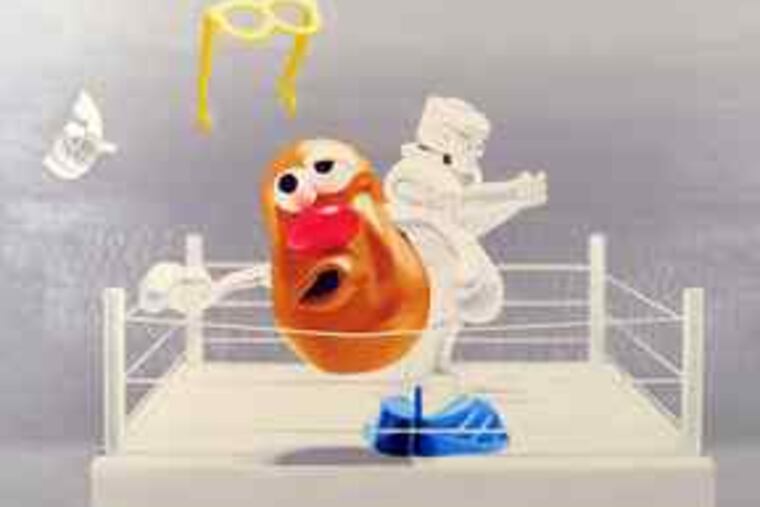
There's a flatness that jumps to the sound of color in Nick D'Angelo's "Paintings Achromic VI" solo at Rodger LaPelle Galleries. This Andorra artist delights in the physical qualities of paint, mainly white paint. And he puns eloquently on our attitude about turning the spotlight on some part of a scene, in effect blotting out the rest. His "white-out" of still lifes or figures except for a single bright-colored focal object intensifies each picture's already high-key tonality, and can create an uneasy balance of tensions defining his images of ordinary things.
At times, D'Angelo seems a wanderer here between two worlds, painting and illustration; while aspects of the work surely follow a painting tradition, the show does point to his graphic-design background. And something cocoons his pictures, insulating them from the ambiguities and dissonances of the world in which meanings need to circulate. His buoyant, peculiarly visual art therefore can best be regarded as enforcing a serious notion of play.