The singer does right by the songwriter
The smile on Isobel Campbell's face as she paused at the mike on Thursday spoke volumes. Eyes shut, focused on the layered sound her band was conjuring onstage at Johnny Brenda's, the Glasgow native seemed pleased. What singer/songwriter wouldn't be?
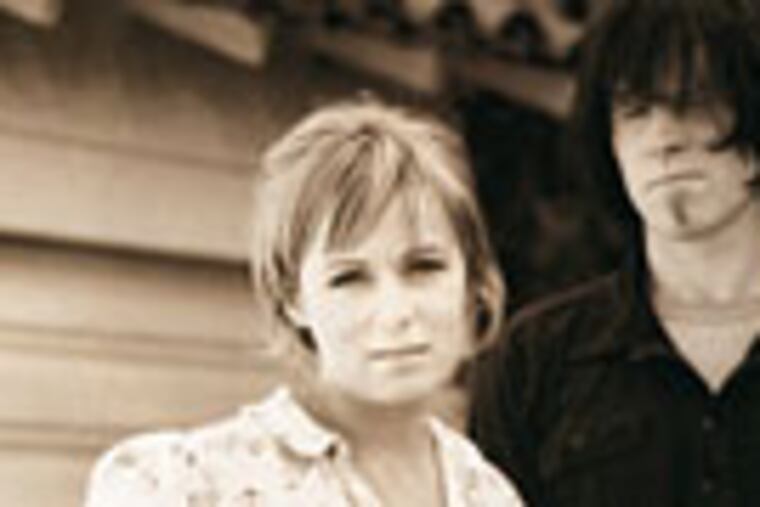
The smile on Isobel Campbell's face as she paused at the mike on Thursday spoke volumes. Eyes shut, focused on the layered sound her band was conjuring onstage at Johnny Brenda's, the Glasgow native seemed pleased. What singer/songwriter wouldn't be?
The Fishtown club's immaculate sound system was doing justice to her exquisitely understated rootsy-rock/country-tinged arrangements, brought off expertly by a Danish rhythm section of drummer Peter Dombernowsky and bassist Thøger T. Lund (already skilled in evoking a sparse, Southwest sonic ambience as members of Tucson's Giant Sand), and Scottish guitarist Jim McCulloch (ex-Soup Dragons), along with Seattle's Jeff Fielder on guitar, Dobro, and keyboards.
The key element, however, was former Screaming Trees vocalist Mark Lanegan and his deep, grittily textured yet mellifluous voice. Campbell, 34, has written three albums largely centered on his vocals, utilizing the marvelous instrument most recently on Hawk (which provided 10 of their 23 numbers). Thursday was the second night of Campbell and Lanegan's first U.S. tour, finally bringing stateside the blend of Campbell's high, breathy Scots purr and Lanegan's rumbling, whiskey-soaked tones. The underrated Lanegan, from Ellensburg, Wash., arguably represents the finest voice to emerge from the grunge era, an inspiration to Kurt Cobain - who played on his 1990 solo LP - and Soundgarden's Chris Cornell. His brooding interpretation of Hank Williams' "Ramblin' Man" on Thursday was a fine, dark read.
Lanegan, 45, and Campbell (a classically trained cellist, who left Scotland's "twee pop" ensemble Belle & Sebastian in 2002) have been serviceably likened to other contrasting male/female noir-pop pairings such as Lee Hazelwood and Nancy Sinatra; or Serge Gainsbourg and Jane Birkin (or Brigitte Bardot); but their union is distinct. Campbell is the orchestrator, often putting Lanegan up front, as on "Come on Over (Turn Me On)," where her key vocal contribution was an emphatic, sexy whisper of the title's parenthetical phrase.
Other originals and a welcome cover of late Gun Club leader Jeffrey Lee Pierce's "Free to Walk" had more vocal balance. Campbell also brought out Martha's Vineyard singer/songwriter Willy Mason (the night's solo acoustic opener) to duet on "No Place to Fall," one of Hawk's two Townes Van Zandt covers (Mason is also on the album). Lanegan later impressed anew, closing with his original "Wedding Dress."