On Movies: Death-row drama stays true to life
In Conviction, based on a nightmare true story, Sam Rockwell plays Massachusetts convict Kenneth Waters, sentenced to life in prison in 1983 for a murder he didn't commit. It took his sister, Betty Anne Waters - Hilary Swank with a hardscrabble Bay State accent - 18 years to get Kenny released. A barkeep and a high school dropout, Betty Anne got her GED, went to college and then law school, in pursuit of her brother's exoneration.
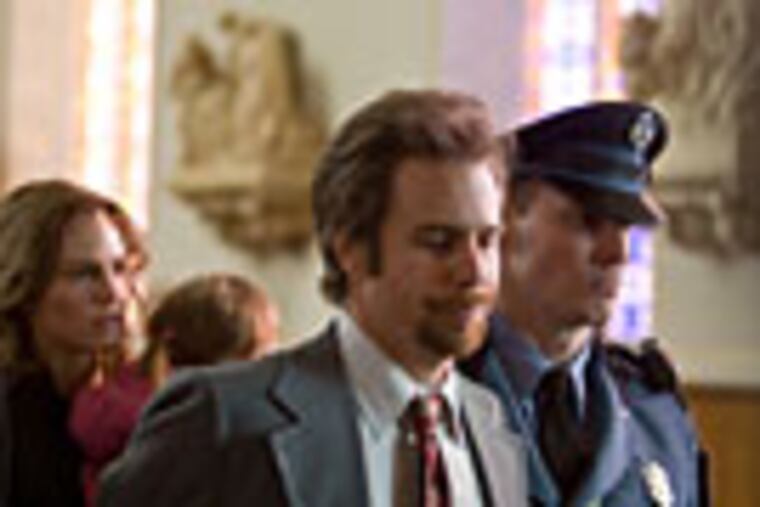
In Conviction, based on a nightmare true story, Sam Rockwell plays Massachusetts convict Kenneth Waters, sentenced to life in prison in 1983 for a murder he didn't commit. It took his sister, Betty Anne Waters - Hilary Swank with a hardscrabble Bay State accent - 18 years to get Kenny released. A barkeep and a high school dropout, Betty Anne got her GED, went to college and then law school, in pursuit of her brother's exoneration.
"It's a remarkable story, and a beautiful film, I think," says Rockwell, whose portrait of this volatile man ("He certainly wasn't a Boy Scout") rings with authenticity. Conviction screened Saturday and will screen again on Tuesday as part of the Philadelphia Film Festival. It begins its commercial run Friday at the Ritz East and the Rave Motion Pictures at the Ritz Center/NJ.
By the nature of the tale, Rockwell and Swank don't have much screen time together. There are flashbacks, with kid actors in their respective roles, establishing the close ties between the two. And there are a series of short, intense scenes in which Betty Anne visits her sibling in prison - meetings spaced over the years of his incarceration.
Rockwell says that it was tough to convey the closeness Kenny and Betty Anne shared, the intensity of their bond, in those few exchanges.
"They're beautifully written scenes, but truncated," says Rockwell, "so, yeah, it was quite a challenge."
That's where training came in, says Rockwell, who studied with the legendary William Esper - practitioner of the Meisner Technique - earlier in his career. "You really learn to break the script down. You look at actions, motivations. You do a lot of research about prison, you find out about the real guy, you work on the dialect. It's like building a house, or making a gumbo. You know - you just throw it all in there, and hopefully it works."
Rockwell, 41, says, too, that Conviction's director, Tony Goldwyn, was "really good about making sure that we never feel sorry for ourselves, never played the victim. So we were constantly trying to take care of the other person, even if we're in pain. And I think that was the key to their relationship."
Rockwell, who played Robert Downey's adversary, Justin Hammer, in Iron Man 2 and James Reston Jr. in Frost/Nixon, has been to prison before - on screen, that is.
In 1999's The Green Mile, Frank Darabont's adaptation of the Stephen King book, Rockwell was the chilling mass murderer Wild Bill Wharton.
"I did a lot of research for that," he recalls. "I talked to prison guards and I read a book called Slow Coming Dark - interviews with death-row inmates. I watched documentaries, like Scared Straight. . . . And for Conviction, I was reading [Jack Abbott's jailhouse letters to Norman Mailer] In the Belly of the Beast . . . and I talked to an exoneree in Michigan. And I've known a couple of people, friends of mine, who were in prison. . . . It's a very interesting subculture, the prison subculture.
"But this film also presents a really terrifying possibility. As you get to know these exonerees, you realize that there's a possibility that this could happen to any of us. Planted evidence. Circumstantial evidence. The wrong place at the wrong time. . . . It's a very scary idea."
Rockwell has managed to mix work on smaller indies with bigger Hollywood fare, Broadway theater with goofball screen comedies, collaborating with directors such as Jon Favreau (Iron Man 2 and the forthcoming Cowboys & Aliens), David Gordon Green (Snow Angels and the forthcoming The Sitter), and turning in a remarkable one-man effort in Duncan Jones' eerie sci-fi parable Moon. Rockwell first met with Goldwyn about the Conviction project six years ago, when the director was talking to prospective actors. And then, last year, he got the call, and the role, "almost at the last minute - just four weeks before shooting."
There's a darkly ironic twist to the story of Kenneth Waters, who was, thanks to his sister's efforts - and the efforts of the Innocence Project, the nonprofit that uses DNA testing to invalidate convictions - finally released from jail, and cleared of murder and armed-robbery charges, in 2001. Six months later, taking a short cut home, he fell off a 15-foot wall and died. There's no mention of Waters' fate at the end of the film.
"It is very sad," Rockwell muses. "But, you know, he died a free man. . . . He was a happy man when he died."
Rockwell says that Goldwyn was "very conflicted" about whether to add the somber postscript to the film.
"It was a hard decision. But I think that, ultimately, that's not what the movie's about. It's more about his freedom, and their relationship - Betty Anne's and Kenny's. It's really a love story, and not to be corny, it's about the transcendent power of love. I think if people were seeing the movie and then they get that news [at the end], it would totally shatter the experience. It negates the whole film, in a way.
"And that's not what the movie's about."
Borgnine is back. With his barrel chest, hearty laugh, and trademark gap-toothed grin, Ernest Borgnine has played the heavy, the hero, the schlub, and the sidekick. He started in movies (The Whistle at Eaton Falls) in 1951. Frank Sinatra hit him with a bar stool (From Here to Eternity) in 1953. He won the best-actor Oscar, for Marty, in 1956 - his lowly Bronx butcher beating out fellow nominees James Cagney, James Dean, Sinatra, and Spencer Tracy. (Whoa!) He's in The Dirty Dozen and The Wild Bunch, The Poseidon Adventure and the original Escape From New York.
And, of course, there's McHale's Navy.
And now, at a mere 93, Borgnine gets to steal a couple of scenes from Bruce Willis in Red. In the explosive action romp, Borgnine plays the CIA's crusty records keeper, deep in the vaults at Langley. He's the institutional memory, even if the documents have all been redacted.
"I'm an old-timer, and they needed an old-timer," says Borgnine, on the phone from his Beverly Hills home the other day. Red opened in theaters on Friday. "They were very happy and I was very happy. Turned out to be one heck of a good picture."
Borgnine spends "a week here and a month there" in Malvern. His wife, Tova, is the famous QVC perfumer, and after bunking at a Sheraton near the TV merchandising behemoth for many years, the couple decided to buy some real estate. Their home looks out on a golf course, says Borgnine. "It's lovely."
As for Red, Borgnine's been cheerfully promoting the film, even if he's only in it for a couple of minutes. And he's started lobbying for a sequel. "This time they better give me a gun," he cracks. And he wants a scene with Helen Mirren.
"She can shoot me any time."