Seymour Remenick at Lancaster Museum: A quintessential Phila. landscapist
How much greater than a "little master" was Seymour Remenick (1923-99) and how complex was his vision seen in his current "Paintings and Works on Paper" exhibit at Lancaster Museum of Art?
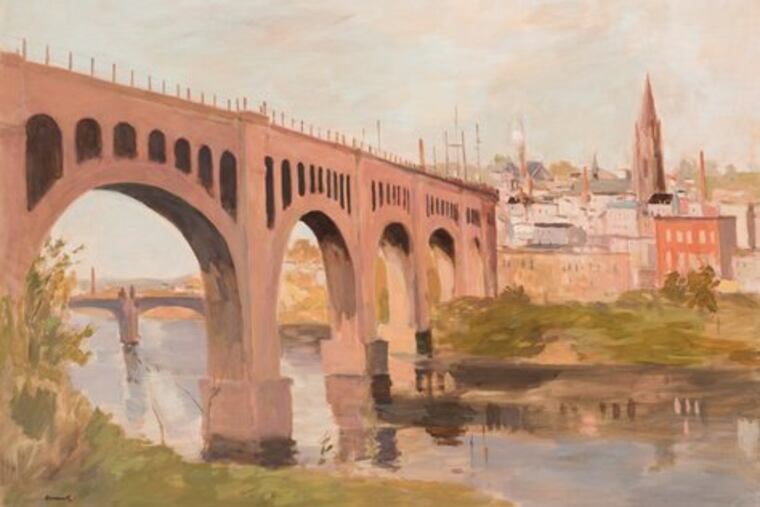
How much greater than a "little master" was Seymour Remenick (1923-99) and how complex was his vision seen in his current "Paintings and Works on Paper" exhibit at Lancaster Museum of Art?
Even as it hangs in the balance whether Remenick finds his place among the smaller immortals as a painter, no display of 20th-century American art would be complete in our region without at least one work by this artist, his generation's quintessential Philadelphia scene painter.
The Remenick display features 102 oils and pen-and-ink drawings, many loaned by collectors (Edward I. and Dorothea Bernstein represented substantially) and fewer from the artist's estate. Lancaster Museum executive director Stanley I. Grand fulfills a mission of small art museums here by spotlighting a very deserving artist who has been overlooked. And besides his own very informative essay for the show's catalog, the guide also contains writings on art by Remenick, and remarks by Stuart Shils, a former student of the artist at Pennsylvania Academy of the Fine Arts.
The American-born son of immigrant parents from the central Ukraine, Remenick grew up in South Philadelphia and was a lifelong resident of this city. Drafted while at Temple's Tyler School of Art on scholarship, he served in the U.S. Army's second wave at the Normandy offensive in 1944. Remenick later studied painting with Hans Hofmann, but it didn't take. Nor was he a true realist.
But Remenick soon began developing a personal style combining a modern sensibility with influences from Brueghel, whose straightforwardness and simplicity he admired. And Remenick experienced early success exhibiting in New York. Besides good press coverage of his scenes painted outdoors in many places and his still lifes, he often sold out entire gallery solo shows before opening day, the buyers including celebrities and prominent private collectors.
New York's Davis Gallery was one of his particular haunts at this time, Peridot Gallery another.
The catalog has a fascinating account of art critics' comments on work of Remenick and others. Some artists began taking up social commentary, but Remenick did not. Always an independent spirit, Remenick in 1972 bowed out of the whole New York gallery system that had nurtured him.
Thus, left completely to his own devices, Remenick again and again turned to Manayunk and Roxborough to sketch and paint. Manayunk in particular became for this artist "an alternate reality, an idealized city on a hill" that with all its striking church steeples felt like an intimate European village - so distant from our bustling city downtown. And he was like painter Paul Gauguin in French villages long ago. We're told that Remenick roamed quiet Manayunk streets before painting them, usually without people. He chose plenty of other subjects, but the sheer number of Manayunk views is extraordinary.
A keen observation by Paul Resika, an artist friend of Remenick's, touches on an important point in the show's catalog. "Atmosphere in landscape painting, missing for 100 years - eclipsed by impressionism and modern art - was Remenick's gift to us," he said.
Grand cites other reasons this artwork offers a new vision. We look at art differently than 40 or 50 years ago. People are now ready to appreciate one person's subjective, quiet, and honest response to the world. This show brilliantly makes the case that Remenick's atmospheric paintings are "silence made visible." This then surely is the work of a substantial master - as simple, straightforward, and uncomplicated as they come.
Mixed-media whimsy
Whimsically improbable is how you might describe Moe Brooker's new mixed-media paintings and drawings in his "Shorthand for the Real" solo show at Sande Webster. Among the most purely spontaneous of his works, they are among the most seemingly abstract. Style is determined by the loose improvisation that he initiated more than a decade ago, before he'd put the rectilinear geometry of cubism behind him. Brooker takes satisfaction in his capacity to invoke feelings through color, space, and proportion. Colors evoke moods or states rather than images, generalized states of existence rather than specific ones. And of course the effects of color in his work are often compared with those of music. And stay tuned.
Brooker, chairman of the city's Art Commission, will receive the Hazlett Memorial Award for the Artist of the Year from Gov. Rendell on Nov. 27 at the Kimmel Center.
Charles Kalick strikes a new expressive/decorative balancing act in his geometric abstract painting show "Division," also at Webster. Compartmentalized pockets of space along raised corridors of densely textured surfaces favor a limited range of boldly contrasted color. Linear scaffolding derived ultimately from cubism as it developed during the emergence of modern painting now has joined with luxuriantly sensual effects learned from the primitive. These shape a true identity in a positive way.