On Movies: Norton serves time, but 'it's not a con film'
TORONTO - Edward Norton has been behind bars before. In fact, the intensely serious actor made his big splash in moviedom playing a Chicago altar boy accused of murder, on trial for his life and messing with Richard Gere's head, in the 1996 hit Primal Fear. A few years later, in American History X, Norton was a neo-Nazi skinhead sentenced to prison on manslaughter charges.
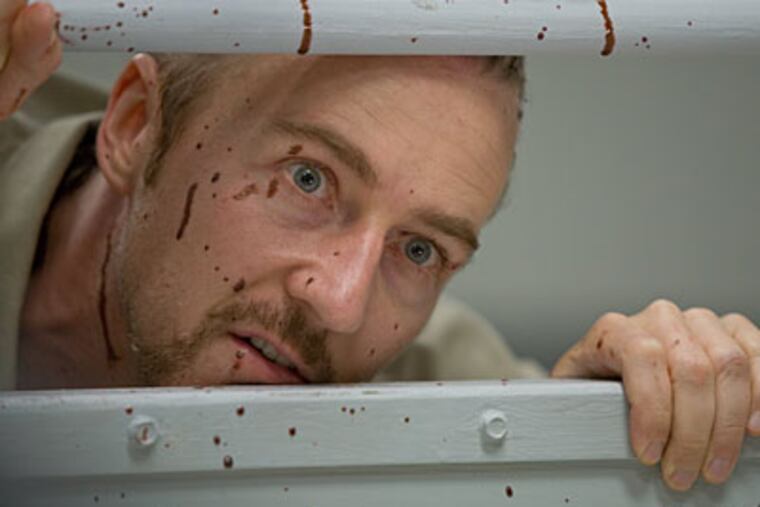
TORONTO - Edward Norton has been behind bars before.
In fact, the intensely serious actor made his big splash in moviedom playing a Chicago altar boy accused of murder, on trial for his life and messing with Richard Gere's head, in the 1996 hit Primal Fear. A few years later, in American History X, Norton was a neo-Nazi skinhead sentenced to prison on manslaughter charges.
And here he is again.
In Stone, Norton is Gerald "Stone" Creeson, an arsonist doing time at a Michigan penitentiary. He's tattooed. He has cornrows. He talks in the rhythms of the street. And he's doing everything he can to get parole - including encouraging his wife, an unexpectedly strong Milla Jovovich, to seduce the prison official overseeing his case. And that would be Robert De Niro.
Stone, directed by John Curran, opened Friday at the Ritz East and Rave 16 at the Ritz Center/NJ.
"It's not a con film," says Norton, at the Toronto International Film Festival last month for Stone's premiere, and to appear with Bruce Springsteen ("I've known Bruce for a long time - I'm a big fan"), moderating a public conversation at a screening of the documentary The Promise: The Making of Darkness on the Edge of Town.
"Stone is almost allegorical, something more akin to a Bergman film than, say, a thriller, which is why I became interested in it," Norton explains. "John was really looking at the nature of authenticity and spiritual transformation, and not just a caper, not just [a story about] one person trying to manipulate another person."
The scenes between Norton and De Niro - in De Niro's character's office, the two men face-to-face with a desk between them - have the intensity of a stage play. (Indeed, Stone started life as an unproduced theater piece, written by Junebug's Angus MacLachlan.) De Niro's Jack Mabry is just a few weeks from retirement, a man with an empty marriage (to Six Feet Under's Frances Conroy) and an emptiness in his soul.
Norton and De Niro had worked together before - in the problem-plagued heist film The Score, which is best known for being Marlon Brando's swan song. But the two actors vigorously and visibly up the ante in Stone.
"It was definitely, definitely, very gratifying to work again with him," says Norton, who is 41 now, and, like De Niro, lives in New York.
"Not that we didn't have a real nice time on the other one, but there was a quality to the depth of what was being investigated in this film. In my dream of working with Bob again someday, this was definitely in it, and as we were working . . . even while we were in the scenes, doing the scenes, I was so fascinated by what he was doing. . . .
"Bob was going way beyond even what John or I had envisioned as a portrait of this person, in this state of moral crisis, internal crisis. It was so consistent with things that we all appreciate in him, and yet I felt like I was watching him go to a level of investigation of himself, and his own life, and being a certain age that was so - it was really exciting for me to get to do something where I felt like he was digging into a new zone.
"It was really fun."
Norton says that they shot those electric encounters in Jack's office "one a day, for about a week, knocking them out."
Stone also marks the second time that Norton and director Curran have collaborated. The Painted Veil, which Norton produced and starred in opposite Naomi Watts, adapted from the W. Somerset Maugham novel, was helmed by Curran.
"You just start to develop a shorthand, a level of trust, a level of relaxation," says the actor. "You're less self-conscious."
Norton clearly thinks highly of his director. The pair are teaming a third time, developing a series for HBO about the Lewis and Clark expedition, adapted from the Stephen Ambrose book Undaunted Courage. "It's big, very big," says the actor, who is writing and producing with Curran.
And Norton says that with Stone, Curran has pulled off something that's difficult to make these days: "a serious, reflective film. . . . It's almost like a meditation on certain themes of faith and spiritual transformation and moral decay . . . and the idea that moments of illumination can come through strange experiences. . . .
"I think the last thing I saw that walloped me in the same way was that German film The Lives of Others, which I thought was so, so beautiful, and had that quality of filmmakers that I like, like Bergman - and even Milos Forman."
Norton recently revisited Forman's Oscar-winning One Flew Over the Cuckoo's Nest, with Jack Nicholson as the misfit mental patient and Louise Fletcher as the asylum's give-no-ground head nurse. And it walloped.
"That film has become so famous that people, I think, almost forget what it's actually like," the actor observes. "When you go and watch the film you see how long they just stay with things, they just stay with it and stay with these conversations, and you watch the intensity of this power struggle unfold between her and him."
New Shyamalan project? The Hollywood Reporter reports (from Hollywood, no less) that M. Night Shyamalan is working with another noted Philadelphian, Will Smith, developing a sci-fi project, One Thousand A.E. It'll be under the production auspices of Will and Jada Pinkett Smith's Overbrook Pictures, and it's likely to star the couple's son, Jaden Smith. Shyamalan, says the Reporter, will direct, but isn't writing. An executive at Shyamalan's Blinding Edge Pictures couldn't confirm the news.
Shyamalan also still has what he's termed his "supernatural Taken" project, with Bradley Cooper, Gwyneth Paltrow, and Bruce Willis loosely attached, and Shyamalan is waiting to hear whether he'll get a green light for The Last Airbender II. (Foreign grosses on The Last Airbender have been stronger than domestic: $183.5 million vs. $131.6 million, which adds up to a tidy $315.1 million.)