Galleries: Photos and collages trace artist Paul Cava's development
Not long after his arrival in Philadelphia in 1975, Paul Cava undertook the day job that artists are frequently attracted to but rarely are able to navigate: He opened a gallery and ran it himself.
Not long after his arrival in Philadelphia in 1975, Paul Cava undertook the day job that artists are frequently attracted to but rarely are able to navigate: He opened a gallery and ran it himself.
During the day, Cava impressed the city's astute gallerygoers with his provocative, cosmopolitan eye (Mel Bochner, Francesco Clemente, Neysa Grassi, Ray Metzker, Jock Sturges, and Tom Nozkowski are all veterans of shows at the former Paul Cava Gallery). At night, he dedicated himself to his own photo-based collages and, for a period, paintings and drawings.
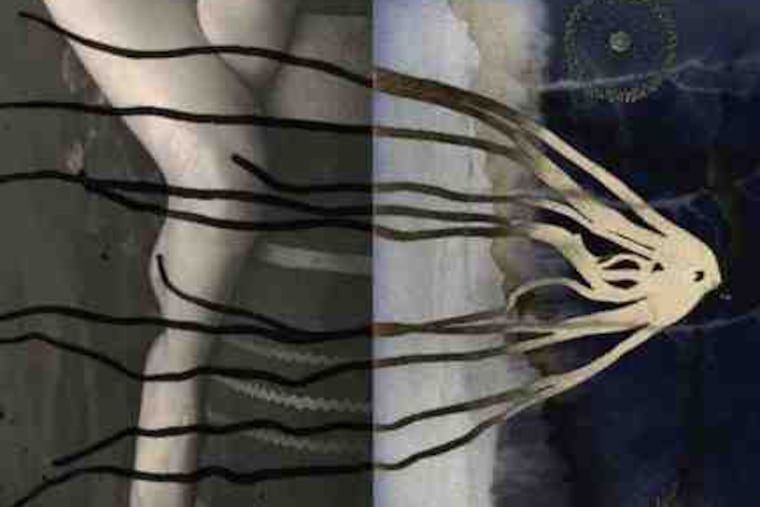
Cava's retrospective, "Paul Cava/30 Years," at the University of the Arts' Rosenwald-Wolf Gallery, offers an unusual view of the development of an artist - in this case, of one whose interests were already informed and refined when he began making art. Born and raised in Brooklyn, he had been a poet and the editor of his college literary magazine, and had earned an undergraduate degree in cinematography before entering the graduate program in photography at the Rochester Institute of Technology.
The two earliest works in this survey - the photograph Untitled (Bicentennial) (1976), of two intersecting walls, one of which, with its torn poster, looks more like a painting than a wall next to its uniformly brick counterpart, and Bobby and Jackie (1974, printed as a unique Iris print in 1999), a blurred photograph of a man and a woman having sex - embody most of the attributes that were to distinguish Cava's photo-based collages over the next three decades. The only missing element is collage, but it is certainly hinted at through the image of that torn poster on the wall.
The show's organization parallels the horizontality of Cava's practice, too. Although the show opens with a group of early collages, curator Sid Sachs has not hewed to a chronological presentation. For the most part, Cava's works are displayed according to his preoccupations - among them eroticism, lyricism, the nude, and layering of images - and his habits of reexamining and reworking his themes, his embrace of and versatility with various printing techniques, and his use of found vintage negatives and prints. For example, if you follow the exhibition around the room as most people will see it, you'll encounter Bobby and Jackie after a series of collages made over Cava's reprints of vintage pornographic images.
Having seen Cava's works in smaller shows, I would not have thought of him feeling an affinity for the work of Robert Rauschenberg or the painter Sean Scully, as he states in his show's pamphlet, but the common ground is obvious here. The biggest surprise - although perhaps not, given Cava's penchant for reexploration - is his recent return to the single camera image, as in his photograph PMA (Golgotha) (2010), which is sure to send the curious on a trek through the Philadelphia Museum of Art.
You leave this exhibition with the feeling that you have been granted access to a rare and mysterious - and often marvelous - illustrated book that is usually kept hidden.
2 at LGTripp
Rebecca Jacoby, a printmaker turned painter, and Miriam Singer, a printmaker and painter, who have solo shows at LGTripp Gallery, seem at first to be a disparate pairing. Jacoby's paintings are abstractions of floating, semi-recognizable forms, the descendants of William Baziotes and Philip Guston, while Singer's drawings are dense "maps" of places as she experiences them on foot or by public transportation. They are linked by their preferred colors (all colors, all together) and fondness for an unfinished image and surface.
Jacoby's paintings make up a uniform body of work, but they need not have been so much alike. Her use of a predominantly blue-green background color in most of these paintings gives them a formulaic look, even when the activity atop is engaging.
Singer is still feeling her way, too, but her drawings, like the Surrealists' game Exquisite Corpse (but played by Singer only), are wonderfully intense. They're occasionally too reminiscent of self-taught work, which the artist herself probably knows.