In 'For Colored Girls,' Kimberly Elise again shines through storm
How does she do it? How does Kimberly Elise remain so serenely poised while playing women who endure the unendurable?
How does she do it? How does Kimberly Elise remain so serenely poised while playing women who endure the unendurable?
You may remember Elise as Beloved's Denver, physically and emotionally bruised from growing up in a house haunted by the ghosts of slavery. You may remember her as Helen, the title character in Diary of a Mad Black Woman, literally kicked to the curb to make way for her husband's new trophy wife.
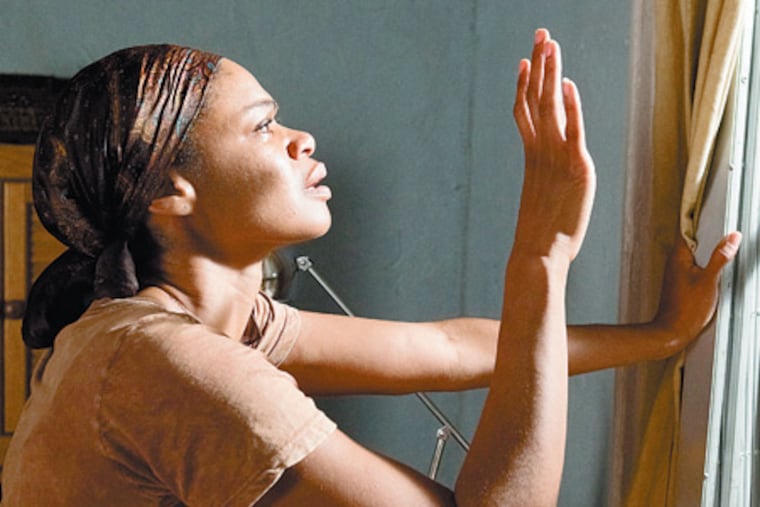
And you sure won't forget her as Crystal in For Colored Girls, opening Friday, Tyler Perry's update of Ntozake Shange's landmark 1975 play. Shattered by her husband's abuse of her and their children, Crystal sweeps up the shards and puts herself back together.
Of her wrenching performance, Elise says, "There are still pieces of my heart on the floor from when we shot that scene" - the one in which Crystal's war-damaged husband, played by Michael Ealy, follows through on his threat to hurt the children.
"You're never quite the same after a scene like that, says the willowy, 43-year-old actress. "To let Crystal flow through me, well, I felt like lead. I went in with five gray hairs and came out with 50." (From her cascade of raven hair, you wouldn't know it.)
"The body doesn't know it's acting," Elise says at the Four Seasons Hotel in Philadelphia. "I surrendered fully to Crystal, but I had to purge her." Her "detox diet" of yoga and meditation helped.
Still, she confesses, she hasn't seen the finished film, in which her superlative performance is matched by those of Thandie Newton, Phylicia Rashad, and Kerry Washington.
"We were on a magnificent race together, like a relay team," Elise says. "One of us would run as fast as she could and then hand off the baton. We have such reverence for the material. Ntozake has seen it, and she's '85 percent happy' with it."
(Shange told the New York Times that Perry "did a very fine job, although I'm not sure I would call it a finished film.")
"I haven't seen it because I have to protect myself as an actor and a mother," Elise adds. "I have to complete the process of healing."
She's been here before. By her late husband, Maurice Oldham, Elise has two daughters, Ajableu, 20, who's studying art history and psychology at the American University of Paris, and Butterfly, 12, an aspiring performer. Like many of the characters she has played, but most especially Crystal, Elise knows that you have to go through the storm if you want to get to the rainbow.
She and Oldham married in 1989 and divorced in 2005.
"Eighteen months after we divorced, he died of a massive blood clot," Elise recalls. "I know he's in great love. I'm sorry he can't see the girls. But they know that they were loved and are loved."
Today she is "blessed" with a wonderful partner, Carl Seaton, director of the domestic dramas One Week and Of Boys and Men. "This man has come in where another man has gone, stepped in for the one who can't be here."
Paying her dues
Kimberly Elise Trammel was a 9-year-old in Minneapolis when she told her parents, an executive and a teacher, that she wanted to be an actress. Eminently practical, they suggested she write to "Mr. Fixit" at the Minneapolis Tribune to inquire what she needed to reach her goal.
"The paper wrote back immediately telling me that I should get a photo head shot and talk to the local unions about prospects for work," she recalled in 1998, right before the release of Beloved and the birth of Butterfly.
Her first part was a bit in a Wendy's commercial, and "that hamburger got me my degree" at the University of Minnesota. Two film shorts and a stint at the American Film Institute convinced Elise that "directing is something I'm good at, but it's not my gift." Hollywood would concur.
She waitressed in Los Angeles and was discovered by producer Dale Pollock, who cast her as one of the bank-robber babes in Set It Off (1996). Since her debut, she's been one of the industry's go-to gals.
In demand
Director Jonathan Demme cast her in Beloved and liked her so much he asked her to play opposite Denzel Washington in his 2004 remake of The Manchurian Candidate.
Washington liked her so much that he asked to get her cast as his wife in the medical melodrama John Q, which he did not direct, and as the mother of civil-rights activist James Farmer in The Great Debaters, which he did.
Between recurring roles on television's Close to Home and Grey's Anatomy, Elise has worked with Tyler Perry twice.
"Tyler really went to the mat for me on Diary," she says. "Studios wanted other actresses. Tyler wanted me."
Elise doesn't mind when people quip that she's evolved from the mad woman in Diary to the sad woman in For Colored Girls. "I like movies that resonate, that give voice to the voiceless," she says.
She doesn't want to choose between doing movies that make money and those that make a difference. She's thinking For Colored Girls will do both. She was drawn to Crystal because the troubled wife and mother stands for what she herself believes.
"It's what I tell my daughters: Know that your birthright is to shine your light, and don't let anybody deny you of that right. Take responsibility for your life."