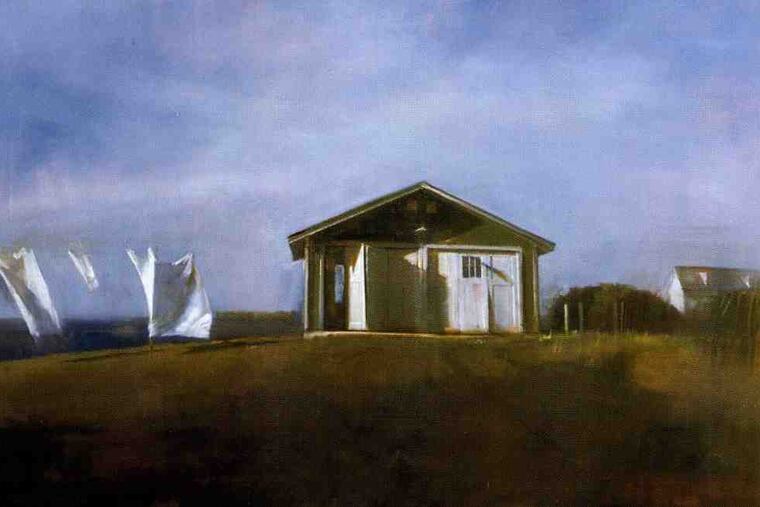
Randall Exon has a gift for the bold optical gesture. And the title of his show, "Randall Exon: At Home," at Wallingford's Community Arts Center combines direct observation with imagination and memory. So if you try searching for precisely
where
he painted any of these 17 oils or six watercolors - whether in a familiar-looking locale in our region, where he lives, or perhaps near his family's old South Dakota homestead, or in Ireland's County Mayo where he spends time each year - you won't find it.
Instead, Exon's work invites our quiet response to subtle qualities that never grow old, since they keep renewing themselves, replenished by the love this artist has for the visible world.
Exon distills his experiences into symbols and metaphors, achieving qualities people can readily identify with. Call it a metaphor, call it a gesture. He also uses layers of paint that enable him to obtain atmospheric effects and translucence in these paintings. He produces imagery that borders on sentiment without crossing the line into sentimentality, yet at times, the intensity of his direct observation shows a tilt toward the surreal. He doesn't hesitate to revise any canvas or panel painting he's dissatisfied with. He'll scrape out sections of it and repaint.
Exon's stellar achievement, widely admired, is his mastery in interpreting space and distance. He captures it resoundingly, for example, in his Rule of Twelfths, a large canvas and one of the few portraying human figures. Shown are a father and son he encountered by chance, as they tracked shorebirds against a vast rocky shoreline at Ballycastle in Ireland, where Exon is a continuing fellow at Ballinglen Arts Foundation, a nonprofit group with strong Philadelphia connections.
He also has been a professor in studio arts at Swarthmore College since 1982. To my knowledge, this is the first large solo by a Swarthmore faculty member at the neighboring art center in Wallingford. And it's a beauty.
10 'friends'
With its latest exhibit, the Main Line Art Center has hit upon something quite unusual and really interesting - an enterprising regional group show that hangs together wonderfully, and springs from a new concept. It's happening because this show's organizer, Chuck Thurow, led off by choosing to exhibit work by Danielle Bursk. She, intent on focusing on her own particular artistic vision, then suggested a "community" of artists who inspire and encourage that vision. These 10 are featured here.
Bursk made all the connections through Facebook and other social media - thus the show's title, "Between the Studio and Facebook." These area artists don't necessarily know one another.
A mature strength emanates from works by Bursk, two of her mammoth ink-on-paper pieces together having the look of an argument well framed. The resonant buildup of these shapes by dense hatchings of line is poignant. Other images highly abstracted from nature abound in the show, notably Ayami Aoyama's masterfully carved marble sculptures revealing a delicacy and sensitivity without timidity, as Amie Potsic's tender nature photos and Gregory Brellochs' cloud drawings also do.
This show, never less than pungent, also includes Elyce Abrams, Justin Bursk (Danielle's husband), Anne Canfield, David Coyle, Brenna Murphy, Hiro Sakaguchi, and Kathryn Zazenski. It's a welcome remake of the yearly Betsy Meyer Memorial show format.
From the loom
Alan Magee, a painter, is after more than style and a change of medium in his "Tapestries" show at Gallery 51. Featured here are 12 large-scale jacquard tapestries woven on a Belgian loom to his exact digital specifications, after starting out as exceptionally detailed paintings.
Trained as an illustrator, this Newtown-born artist had a considerable career in that field before moving to Maine in the 1970s and becoming a representational painter best known for portraying large pebble-shaped stones in Zen-like images.
Magee touches another genuine vein of nature-attuned seriousness with three profoundly moving tapestries of wounded human heads. These enormous works offer a sober acknowledgment of the appalling human consequences of war. Their three-dimensional quality is enhanced by there being no fewer than 500 gradations of gray in these black and white textiles. (By contrast, his textiles of symbolic common objects employ subtle colors.)
Surely Magee's most brilliant moments here occur in his tapestries of battered human heads, never before exhibited.