Art: Visions stained by the Holocaust
Area exhibitions show three artists struggling to comprehend the greatest of atrocities.
The Holocaust may be one of the most daunting subjects that artists have ever confronted. I suspect even Goya would have been humbled by the magnitude of its depravity.
Si Lewen certainly was, and yet he has transcribed his searing memories of Buchenwald at its liberation into powerful art. Samuel Bak, who survived a forced labor camp as a boy, has done likewise. Jacob Landau lacked their direct experience of this monumental atrocity, yet he, too, addressed the Holocaust with a ferocious passion.
Relatively few artists remain who looked the Holocaust in its malevolent eye. Landau, born in Philadelphia in 1917, died in 2001. Lewen, who lives in Montgomery County, is still working at age 92. Bak, a generation younger at 77, is also active.
By a coincidence of scheduling, the work of all three is on view, or soon will be, within the region. Landau is at the Noyes Museum of Art in Oceanville, N.J., through Jan. 2. Bak's paintings are hanging at Swarthmore College through Dec. 12. A selection of Lewen's drawings from a series called "A Journey" will open at the James A. Michener Art Museum in Doylestown on Dec. 4.
All three exhibitions are modest in scale, yet each packs an emotional punch, even when, as in Bak's paintings and Landau's prints, the particulars of the Holocaust aren't depicted.
The fact that all three artists are Jewish undoubtedly intensifies their responses to what they learned and experienced of industrialized war and genocide.
Landau and Lewen belong to the generation of Jewish artists that became committed to humanism and social justice because of the two world wars, the Great Depression, and the Holocaust. Landau lived most of his adult life in Roosevelt, N.J., a town founded in the 1930s as a kind of working-class commune. Ben Shahn was a friend and neighbor.
One of Landau's legacies to the Philadelphia region is the 10 stained-glass windows he designed for Reform Congregation Keneseth Israel in Elkins Park. Generally he's remembered as a master printmaker, especially for his Dante Cycle, Prophetic Cycle, and Holocaust Suite.
Most pieces in his Noyes Museum exhibition are prints, with some drawings and watercolors. All but two are lent by Monmouth University in West Long Branch, N.J., which received a gift of more then 300 works from the Jacob Landau Institute in Roosevelt.
Landau's images are typically dense and complex, especially the seven lithographs in the Dante Cycle. This suite expresses his thoughts on the troubles of civilization, particularly "the tragedy of human choosing."
Fragmented figures being torn apart reflect Landau's observation that "to choose is to bear the consequences of having chosen." In The Ninth Circle, a mass of human beings clumped into a ball suggests that this condition is universal.
Some images are more bluntly Goyaesque, such as one of figures impaled on a thorny bush and the woodcut Modern Prometheus, a man tied to a stake being bayoneted by a soldier. The small oil The Garden of Earthly Delights depicts, ironically, a group of emaciated figures.
Si Lewen's approach to the theme of suffering is boldly expressionistic. The Michener Museum will show 21 images from the 72-panel series called A Journey, a narrative that tells how an imaginary traveler comes upon a concentration camp without realizing what it is, is invited inside and fed, and is subsequently imprisoned and dies.
The works are described as drawings even though they're executed in thinned black oil paint on paperboard. They were lent by the nonprofit International Institute for Restorative Practices in Bethlehem, Pa., which owns all of Lewen's oeuvre and houses the Si Lewen Museum.
Lewen made the Journey images from the late 1950s to the early '60s; they were subsequently published as a book. They connect directly to his recollections of walking into the Buchenwald concentration camp several days after the camp's SS guards had fled the approach of U.S. soldiers.
Lewen was born in Lublin, Poland, in 1918; his family moved to Berlin when he was an infant. As a teenager he encountered the violent anti-Semitism that accompanied the rise of Hitler. When he was 14, he and a brother escaped to Paris; in 1934, helped by relatives, he emigrated to New York City.
A Journey eventually materialized, he explained, because "[n]o matter how often I tried and succeeded to escape the images of war and Holocaust, inevitably Buchenwald would loom up again, and appear incomprehensible."
The storyboard-like suite, which anticipates the "graphic novel" phenomenon featured in another current Michener exhibition, is easily grasped, even in abbreviated form. The scenes appear to have been quickly drawn with a brush and the figures are elemental. Yet even in visual shorthand Lewen is able to re-create the horror of his face-to-face encounter with the Devil.
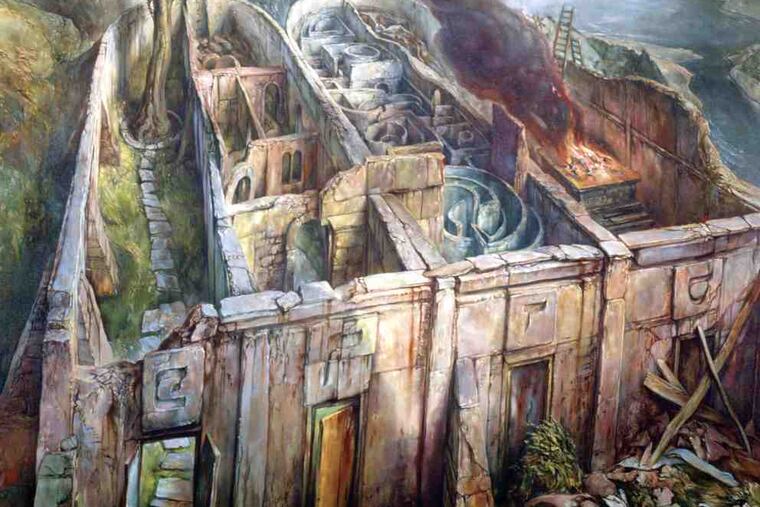
Samuel Bak's paintings at Swarthmore College soften the terror a bit without compromising the dystopian vision of human failing. They're allegorical and symbolic, meticulously detailed and painted in a gentle pastel palette that at first seems at odds with their spirit.
Also born in Poland (in Vilna, which is now Vilnius, Lithuania), Bak came closest to the Holocaust's hellish breath. He lived in the Vilna ghetto until the Germans tore it down, then he was sent, still a boy, to a work camp. He escaped, and found refuge in a Benedictine convent. He and his mother were the only members of his extended family to escape being killed.
After several years in a displaced-persons camp in Germany, he emigrated to Israel in 1948. He lived there until 1956, then moved to Paris. Between 1959 and 1993, when he settled in a Boston suburb, he was constantly relocating, to Rome, Israel again, New York City, Israel a third time, Paris again, and Switzerland.
The exhibition's 18 paintings are full of images of destruction (ruined buildings), cultural vandalism (piles of discarded books and a shattered cello), and dislocation (severed tree trunks).
Through the idioms of landscape and cityscape, Bak portrays a world of bare ruined choirs, the residue of war and the cultural pogrom visited upon Europe's Jews by the Nazis.
There aren't many people in his pictures, although a man figures prominently in what might be the most surreal picture. He sits inside a huge pear that has been halved; he holds another pear that he has gnawed, and a knife. In a video interview, Bak explains that the pear represents human knowledge, and that the man is testing its limits.
Even though Bak's paintings describe the aftermath of cataclysmic forces, their spirit is more melancholy than angry. Bak portrays civilization as fragile and mankind, represented in one painting by giant chess pawns, as victims of fate and the demonic human impulses that reached an apogee in the Holocaust.
Art: Holocaust Images
 The Samuel Bak exhibition continues in the List Gallery at Swarthmore College through Dec. 12. Hours are noon to 5 p.m. Tuesdays through Sundays. Free admission. Information: 610-328-7811, 610-328-8488 or www.swarthmore.edu/Humanities/art/Gallery.
The Jacob Landau exhibition continues at the Noyes Museum of Art, 733 Lily Lake Rd., Oceanville, N.J., through Jan. 2. Hours are 10 a.m. to 4:30 p.m. Tuesdays through Saturdays and noon to 5 Sundays. Admission is $4 general and $3 for visitors 65 and older and students with ID. Information: 609-652-8848 or www.noyesmuseum.org.
Si Lewen's "A Journey" will open at the James A. Michener Art Museum, 138 S. Pine St., Doylestown, on Dec. 4 and run through March 6. Hours are 10 a.m. to 4:30 p.m. Tuesdays through Fridays, 10 to 5 Saturdays, and noon to 5 Sundays. Admission is $10 general, $9 for seniors, $7.50 for college students with ID, and $5 for visitors 6 to 18. Information: 215-340-9800 or www.michenerartmuseum.
org.
EndText