SOAP gives vocalists the chance to test their opera chops
Opera often comes across as a stuffy art form, with expertly trained singers in elaborate costume belting out glass-shattering arias for the rich and cultured. But little of that image applied to the scene at Starving Opera Artists of Philadelphia (SOAP) at the Moonstone Arts Center last week.
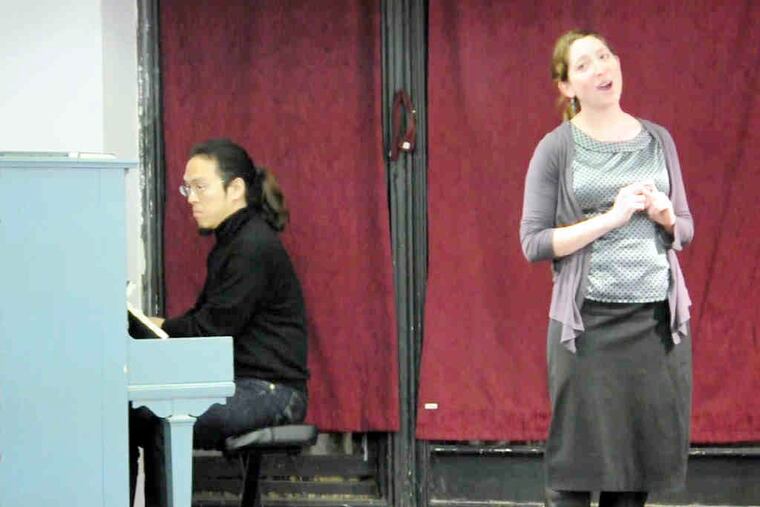
Opera often comes across as a stuffy art form, with expertly trained singers in elaborate costume belting out glass-shattering arias for the rich and cultured. But little of that image applied to the scene at Starving Opera Artists of Philadelphia (SOAP) at the Moonstone Arts Center last week.
Hosted by fledgling company Poor Richard's Opera, SOAP is akin to an opera open mike night. Young singers preparing for competitions or summer-program auditions get the opportunity to test out an aria in front of a welcoming audience - their friends.
Sidney de Lapeyrouse, co-director of Poor Richard's, likened SOAP to a 19th-century salon, but instead of someone's fancy mansion, it happens in a bookstore, with accompaniment provided on Moonstone's weathered blue piano.
"Auditions are what we live for these days, and any chance to give an aria before an audience is great," said co-director Katy Gentry, who completed a master's degree in classical vocal at Temple University's Boyer College of Music and Dance in 2009. "You get that opportunity all the time in school, but once you're out of school, you don't have that chance anymore."
Valerie Haber, who met de Lapeyrouse and Gentry while working at the Opera Company of Philadelphia, called the night "heightened practice."
"Opera repertoire takes a lot of repetition to stick in your body," said Sarah Davis. She also hooked up with the Poor Richard's ladies at the Opera Company of Philadelphia. "You go through many phases and build [arias] with lots of layers."
Even among friends, Davis and Haber said they still have performance jitters, but practicing in front of an audience allows them to work through problems before they go on auditions. "When you get up to do this, you lose your breath," Davis said. "It's good to learn how to manage that."
As with the others performing that night, any evidence of stage fright left Davis' face as she began singing.
Before each performance, singers explained their arias in casual tones, making jokes and talking about their affinity for the characters or the music. "Most people hate this aria, but I love it," said Emily Eisen before she performed "Kommt ein schlanker Bursch gegangen" from "Der Freischütz" by Carl Maria von Weber.
But as soon as accompanist Yoonhak Beak struck the opening note on the blue piano, their bodies noticeably stiffened. They stood up straight and their facial expressions changed to reflect the tone of the music. As the arias ended, the singers' bodies once again relaxed.
It was like pulling back the curtain on a character, allowing the audience to see what is normally reserved for backstage. The same experience is rarely gleaned from professional opera, where the performers are far away and remain in character.
There were some stumbles. Samantha Geraci-Yee forgot her place during "Adieu, notre petite table" from Massenet's "Manon," but quickly recovered. Give the girl a break, she had worked a 10-hour shift that day.
But Geraci-Yee's situation's what SOAP's about. She works a day job, but really what she wants to do is sing. SOAP gives her that opportunity. After the first round of arias were finished, most of the singers hopped onstage again to do another one.
SOAP was open to anyone who wanted to hear opera on a Monday (a $5 cover paid for the space) and de Lapeyrouse and Gentry plan on having more. Check out Poor Richard's Opera's Facebook page for more information.
Other upcoming plans for the company include the performance of two one-act operas in the spring. But de Lapeyrouse said that SOAP "is for us as much as it is for the audience."
Marlee MacArthur - who, unlike most performers, didn't study classical voice at the university level - echoed de Lapeyrouse.
"It's really great for me because I can get up onstage and sing musical theater or pop music or karaoke, but I'm still learning who I am as a classical singer," she said. "It's great to do it in a supportive atmosphere with people who love me."