Art: Photographer Mark Cohen, painter Tom LaDuke featured in Philadelphia exhibits
Street photography ruffled the waters of that medium in the 1960s by offering a way of making pictures that seemed to reject the traditional ground rules - choose a subject thoughtfully, frame it meticulously, and adjust exposure carefully before releasing the shutter.
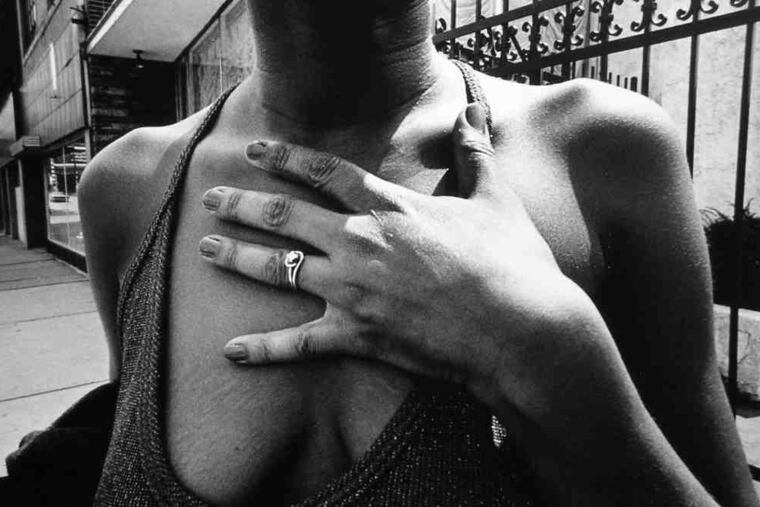
Street photography ruffled the waters of that medium in the 1960s by offering a way of making pictures that seemed to reject the traditional ground rules - choose a subject thoughtfully, frame it meticulously, and adjust exposure carefully before releasing the shutter.
Street photographers such as Lee Friedlander and Garry Winogrand seemed to be firing away randomly, without observing any of these rules. Often one couldn't tell what the subject of a photograph was supposed to be. One might be looking at an empty intersection or blurred reflections in a shop window, framed eccentrically and shot on impulse.
It takes time and patience to become accustomed to this way of looking at the urban environment. Eventually, though, one discovers that street photographers were picking out subtle descriptive clues and personal interactions that animate most urban environments.
Mark Cohen, born in 1943, was a younger member of the cohort that established street photography as a legitimate, sometimes puzzling, but frequently stimulating tactic.
He stands out from the pack for two reasons. Cohen didn't work in bustling metropolises but in his hometown of Wilkes-Barre, where he still lives, and nearby Scranton.
More obvious when you see an exhibition devoted to his work at the Philadelphia Museum of Art, he was extremely confrontational, almost aggressive, and heavily dependent on chance to capture his images.
Using a wide-angle lens, he would walk along, holding his camera in front of his body rather than pressed to his eye, and click the shutter as he approached a likely target. Sometimes he used flash, which, needless to say, startled and sometimes annoyed his victims.
Cohen's technique pushes shoot-from-the-hip photography not only to ultimate randomness but to maximum intrusiveness - call it ambush photography.
You might wonder whether such a method, which Cohen continues to practice, could possibly produce anything of value, or even of interest. Well, it does.
The Museum of Modern Art thought enough of his work to give him a solo show in 1973. The current Art Museum show, of about 70 prints, most from the 1970s, is the most extensive examination of his work here since 1981, when he was exhibited at the Pennsylvania Academy of the Fine Arts.
Most of the prints are black and white, and all are printed from negatives; Cohen has resisted the digital revolution. "I just never got to it, I'm just not curious about it," he remarked when his show opened in the museum's Perelman Building.
That's an aside; the real interest here is the fact that Cohen offers a roomful of moments that are usually recognized and savored only after we see them on film. In real life, they are so transitory and unremarkable that they pass unnoticed.
A few picture titles suggest not only the nature of the subjects, but how gloriously ephemeral they are - Chiffon Scarf/Leopard Coat, Flashed Man on Square, Radio Strapped On, Boy Twisting Shirt, Running Boys, Hanging Bedspread, Bare Back in Jeep, Dog Legs/Plaid Pants (yes, just the legs, but that's what you get when you don't aim).
Now and again one comes across pictures that show more than a closeup of a startled man washing his hands in a men's room, such as a bit of a downtown street or a backyard. These bits and pieces don't quite add up to a composite of small-town life, but they tickle one's nostalgia receptors just enough to trigger a smile of recognition.
Cohen also shows us something we don't usually see: how people respond to being photographed when they don't expect it. In essence, he's recorded the less benign side of how photographers capture their prey.
Layering ambiguity. Tom LaDuke is a Los Angeles artist who makes what I consider to be conceptual paintings, meaning that the images are less interesting for what they are than for what they suggest about how we interpret what we see.
When we look at his paintings, how much of what they say to us consists of pure visual stimuli and how much consists of memories and illusions that unconsciously distort those perceptions?
It's an intriguing question, and while LaDuke's method of addressing it is plausible, the eight paintings he's showing in the Morris Gallery at the Pennsylvania Academy of the Fine Arts don't deliver a clear-cut answer.
LaDuke's basic tactic is to combine projected, reflected, and appropriated images in various combinations. Our task is to see if we can distinguish one type of input from the others.
The exercise is framed on two levels of complexity, first in three paintings from 2007-08 and then in five made during 2009-10.
The first three offer a less complex reading because each involves two sources - a film still and an image that reflects part of LaDuke's studio. The later paintings add to this a third layer, colorful fragments from Old Master paintings.
All LaDuke's paintings are challenging to decipher because most of the surfaces are painted in airbrushed grisaille. It's like staring into a steamed-up bathroom mirror.
One moment you think you recognize a motif, such as the portrait of Pope Innocent X by Diego Velazquez; a moment later it dissolves into a doll's face from the film Eternal Sunshine of the Spotless Mind.
One can scrutinize the painting Creaking Oars, which uses a still from the Coen Brothers' film Miller's Crossing, and readily conclude that there really isn't much there beyond shifting gray shadows.
The more recent paintings, with their colorful clusters of abstracted shards, are even more confounding - first because of the vivid contrast between the grisaille and the bright colors, but also because the latter appear to float above the gray.
Had I not been able to refer to curator Julien Robson's gallery notes, I never would have been able to guess the sources of these fragments, which range from Edouard Manet's The Execution of the Emperor Maximilian to Caspar David Friedrich's The Chalk Cliffs on Rugen. As for the film stills, the most recognizable is from A Clockwork Orange, used in the painting Sharp, Distance.
These are provocative paintings that represent a considerable amount of skillful labor and imagination to create. They remind us of the extent to which film and video have come to influence our responses to observed reality.
Yet both technically and intellectually, they're just a bit too murky and enigmatic to fulfill their objective. Robson's notes are a big help, but relying on them is, of course, cheating.
Art: Surprise Attacks
EndText