'Little Prince' at Bristol Riverside Theatre: A profound little puppet
For the Little Prince, the moments of truth come during a bracing intergalactic journey to the outer reaches of man and the inner depths of friendship.
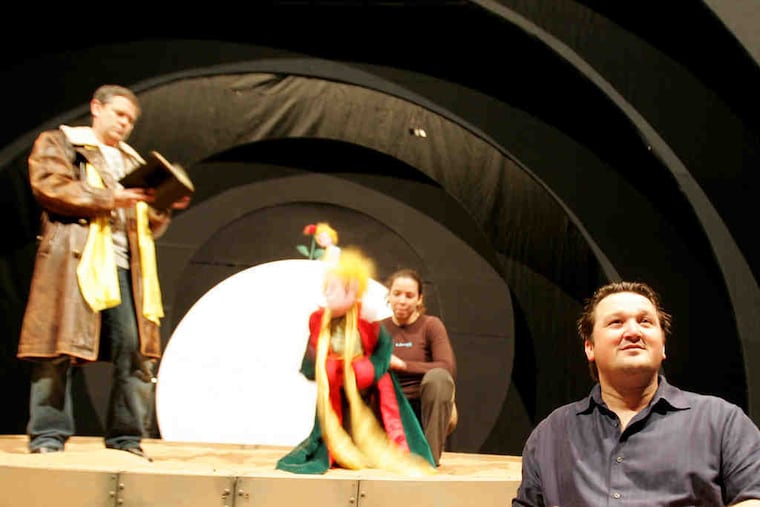
For the Little Prince, the moments of truth come during a bracing intergalactic journey to the outer reaches of man and the inner depths of friendship.
But for the Little Prince puppet, made by Emmy Award-winning puppeteer Michael Schupbach in conjunction with Bucks County's Monkey Boys Productions, the moment of truth came more than a year ago, as it slumped on a sofa.
It was there - auditioning by itself in front of the writers of a theater adaptation of French aviator Antoine de Saint-Exupéry's beloved book The Little Prince - that the puppet, with its shock of yellow hair and face ready for emotion and epiphany, met its destiny.
"It's always a good sign if the character looks alive when nobody's performing it," Schupbach, 38, recalled last week. His puppet quickly won over writers John Scoullar and Rick Cummins, and the long-held dream of Monkey Boys founder Scott Hitz became a reality: The puppet version of The Little Prince, directed by Hitz, was on its way to the stage. It runs Tuesday through Feb. 13 at Bristol Riverside Theatre.
The puppet, with signature flowing velvet cloak and silk cuffs, has no mouth, which gives it a malleable expressiveness, suitable to a play that tells a child's tale - of a boy who rules an asteroid, explores other heavenly bodies, and meets a downed aviator in the middle of the Sahara - but in fact was inspired by the philosophy of French existentialism.
Even propped on a chair, it projects sweetness and yearning, innocence and maturity. One can easily imagine it on a journey of understanding and immortality, grappling with the uncertainty of trying one's best to take good care of another, in this case a rose that lives on the prince's asteroid and is threatened by sheep, not quite protected by its thorns.
"I was too young to know how to love her," says the prince, voiced and moved by actress Leila Ghaznavi in an early scene. "With the help of some migrating birds, I set out to discover the cosmos. . . . Truth is, I was too young to understand anything at all."
Indeed, existential yearning is a lot of weight to put on one puppet, but the production is filled with puppets that function on metaphorical and literal levels, on visual jokes and layers of meaning. After all, what is a puppet if not a symbolic representation of reality?
"I was warned early on about doing this piece," said Hitz, who founded Monkey Boys in 2000 with fellow puppet designers and builders Marc Petrosino and Michael Latini, all of whom cut their puppet teeth on the Broadway productions of Avenue Q and Little Shop of Horrors. "It's so based in metaphor, it's easy to get lost in the metaphor."
The show is conceived in the style of Avenue Q, with the puppeteers visible on stage as they work the puppets. The stage is a giant circle of cork dust, which doubles as both a sandbox and the desert into which the aviator narrator's plane crashes.
Hitz was a former artistic director with Mum Puppettheatre in West Philadelphia, which closed in 2008. Monkey Boys keeps a set of Horrors puppets - including the large meat-eating plant Audrey II, currently in their workshop for a little tailoring - for rent to theater companies. The three partners' work has been seen everywhere from Lincoln Center and Carnegie Hall to Comedy Central.
The Little Prince, once conceived in puppets, seemed a natural fit for Bristol Riverside Theatre, just a few minutes from the Monkey Boys workshop in an old textile mill in Bristol. The theater currently is working on a national tour for The Little Prince, which was developed in workshop performances at Cape May Stage last fall.
With The Little Prince, Schupbach, who dressed Big Bird and designed puppets for Jim Henson's Muppet Workshop, Avenue Q, and TV's Bear in the Big Blue House, had broad grounding for the whimsical yet profound visual metaphor of the puppet.
His Little Prince lacks not only a mouth but also hands, which are supplied by humans (usually Ghaznavi with one hand on the puppet's back and another through a sleeve; Schupbach supplies the other hand when needed).
For the Prince's journey to six planets, each housing one man, Hitz came up with a volleyball motif to represent the planets, which lent itself to many variations.
For the planet of the king with the big ego, the enthroned monarch is as big as the ball and takes up most of the planet.
For the busy lamplighter, actor/puppeteer Petrosino carries a 6-foot pole that lights a lamp at its end, which itself is a round globe occupied by a tiny lamplighter lighting a tiny lamp.
The mirroring of the man and the tiny figure - one controlling the other; which one is the actual character? - yields a rich metaphorical confusion, appropriate to a play whose central character is working out the big issues of love, friendship, and existence.
"With puppets you have the visual metaphor," Schupbach said. "The lamplighter is not in control of his life. Everything is out of reach, 6 feet away."
And what of his rose, whose fragility so troubles the Prince?
As is the way of puppets, the most simple-seeming object in actuality contains a complex mechanism for moving its leaves, bowing, and otherwise expressing the full florality of the rose, played by Carol Anne Raffa.
Lenny Haas plays the Aviator, the lone human character without a puppet, though his yellow scarf morphs into the snake (the exact nature of this scarf-snake was still in development last week in rehearsals, a more elaborate snake puppet having been, literally, shelved).
It is only with the heart that one can see rightly. What is essential is invisible to the eye, Saint-Exupéry wrote in the tale's most famous line. By projecting this memorable story onto beautifully and creatively rendered puppets and objects, putting literal meaning just out of sight, the creators have managed to infuse it with their own sensibilities. And who better than puppet builders who specialize in childlike depths of meaning to take on The Little Prince?