Artist's documentation adds realism to works.
N.C. Wyeth's captivating images of the Civil War
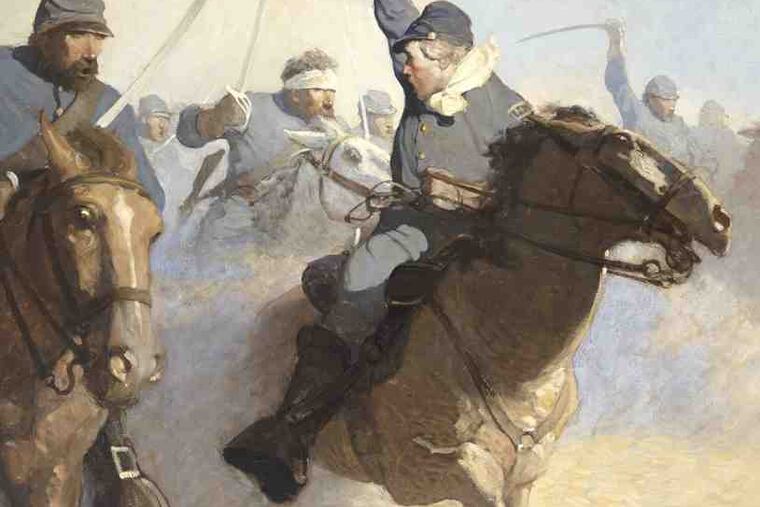
The star of history painter and illustrator N.C. Wyeth (1882-1945) was ascending in 1911, around the 50th anniversary of the start of the Civil War. Given the widespread national interest in that monumental event, the Chadds Ford artist made a heartfelt, melodramatic attempt to connect with it.
Now, as the commemoration of the 150th anniversary begins, we're presented with the Brandywine River Museum's captivating exhibition "Romance in Conflict: N.C. Wyeth's Civil War Paintings." This elaborate display is so painstakingly felt and seamlessly put together that it must be recommended as a major show of its kind, one certain to attract Civil War history buffs and the general public alike.
The appeal of Wyeth's American history subjects usually is their tone of moral grandeur and civic importance. But for his Civil War art - murals, portraiture, book illustrations, posters, calendars - Wyeth leaned heavily on the realism of known images and firsthand reports of battles, soldiers' lives, and civilian homefront episodes; he did his own documentation for illustrations for Mary Johnston's epic novel The Long Roll; such deep involvement in his themes injects power. Still, he modified the rational aspect of his method, giving it a romantic impulse related to heroism that helps explain the "romance" in the show's title.
The exhibition calls attention to a national desire at the time to focus on duty, loyalty, and bravery rather than gore and grim specificity - expectations Wyeth met with his portrayals of war as a courageous struggle and its combatants as noble warriors. The show does have that edge of feeling that can lift artwork above being merely historic or decorative.
Also featured are preparatory paintings for Wyeth's two Missouri State Capitol murals, other oils from public and private collections, Lincoln portraits, selected props and reference materials Wyeth used to create pictures, as well as Winslow Homer wood engravings. And yes, the participation in the war by black soldiers on opposing sides is addressed.
A must-see.
Line up
Drawing is increasingly being seen as a stand-alone medium, rather than a preliminary step to finished work. Kelly Wallace of London, Ontario, wants to create drawings that rival the magnitude of painting and the physicality of sculpture. In his "Capital Salvage" show of 23 works at Seraphin Gallery, he also insists he can do it without resorting to drama. The intricacy he prefers is truly surprising.
Straight off, Wallace salts aspects of remembered places with a special poignancy (Sarajevo after a residential-area bombing in the Bosnian conflict, a tornado-damaged prairie locale, and Capital Salvage, which seems to picture the demolition of an old theater). There's a luxury of sensation combined with intricate adjustments of a single faint image in space. Spare and economical, his work reaches for stability and structure; there's humility and a sense of continuity with the past while embracing the present. Everything is created with straight lines, close together. It's on the level of draftsmanship that these works excel. Line offers a subtle indication of each subject's interior life. But the bulking-up of sculpture awaits.
Anne Canfield, her rather whimsical sensibility still mining the consciousness of daydreams and childhood memory in her solo "No Match for My Tiny Fortress," also at Seraphin, includes a cast of small characters ranging from mermaids to docile domestic animals. Never flashy, her casually painted linear reveries have an occasional accent, usually color, that seems almost to sing out.
Lots at LaPelle
The large display "On the Move" at Rodger LaPelle Galleries, featuring 40 gallery artists, has the virtues of both youth and maturity. The place itself retains something of the atmosphere of a private studio, there being no rush to exhibit the "latest thing," which so often makes big group shows look both dutiful and straggly.
Rising above the general level of paintings here are representational pieces by Fred Danziger, Allan Grow, Terrence Laragione, Joe Naujokas, and Robert Waddington. New to the gallery are Rebecca Miller, Reza Nahaie-Ghanad, Adam Peiffer, Patrice Poor, Brian Senft, and David Campbell Wilson.
122 N. Third, Phila. To Feb.27. Wed-Sun 12-6. Free. 215-592-0232.