Jonathan Storm: The computer wins 'Jeopardy!' showdown. Big!
Its human contestants shook their heads in awe as an IBM computer demonstrated Wednesday night for the first time that humans can program a machine to analyze and understand the trickiest vagaries of natural language.
Its human contestants shook their heads in awe as an IBM computer demonstrated Wednesday night for the first time that humans can program a machine to analyze and understand the trickiest vagaries of natural language.
And also play a pretty mean game of Jeopardy!
With a two-game total of $77,147, a computer called Watson dominated the two former giants of the quiz show, 74-game winner Ken Jennings and all-time money champ ($3.2 million) Brad Rutter, more than tripling Jennings' second-place total of $24,000.
After being crushed in Game 1 on Monday and Tuesday, Jennings pushed the machine in the second game Wednesday, but lost on the final question about 19th-century novelists. The answer, "Bram Stoker," whose Dracula featured another nonhuman creature that gave humans fits, combined with Watson's daringly big $17,973 bet, pushed the machine to victory.
"I, for one, welcome our new computer overlords," Jennings wrote along with his answer, echoing a classic line from The Simpsons.
Built over four years at a cost of more than $30 million, Watson itself was in the room next to the temporary Jeopardy! stage at IBM's T.J. Watson Research Center near New York. Both building and machine are named for the man who led the company from a small manufacturer of office and business equipment into an international computing giant.
Lead scientist David Ferrucci told TV critics at their winter gathering in California last month that the project, like Deep Blue, which beat world chess champ Garry Kasparov in 1997, was designed to push the computer into a new realm.
IBM researchers, he said, sought "something that ultimately will give us the ability to look at huge volumes of text, do a better job at understanding them, and [pull] out the information that humans are looking for, the precise facts, the precise opinions."
Some of Watson's advances are already being used in medicine, publishing, and finance, he said.
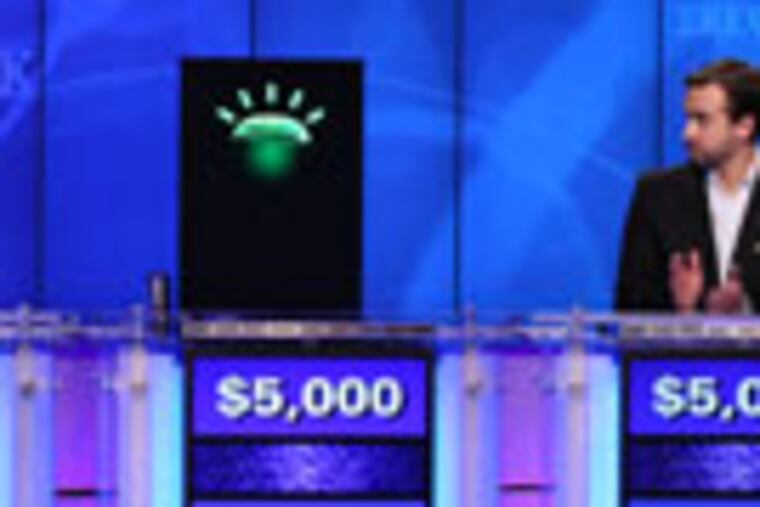
Representing the machine, between its two human contestants onstage, was an avatar that flashed different colors representing the amount of work its "brain" - the size of 10 refrigerators, with the power of 2,800 large-capacity desktops - was doing each millisecond.
Watson's "hand" was a mechanical device designed to mimic the action of a human thumb. Timing the buzz-in is a crucial skill in Jeopardy!; the IBM engineers sought to equalize the playing field, rather than give their machine an electronic advantage. Several times Monday and Tuesday, Jennings and Rutter were able to beat the computer to the buzzer, even though an on-screen graphic showed the computer's top choice was correct.
Brilliant most of the time, the computer did make ridiculous gaffes. Ferrucci groaned Tuesday, with the rest of the IBM in-crowd at the taping, when Watson completely blew the answer to Final Jeopardy, the one-question trial in which contestants can bet all their money.
"Toronto," the machine answered to a question about airports in the category of "U.S. cities." It seemed as if nobody at IBM had taught the computer what U.S. meant.
Just as it was confident in Final Jeopardy on Wednesday, the machine seemed to know its deficiency Tuesday, betting only $947 of its $36,681.
Still, making use of "machine learning," in which a computer itself generalizes concepts from specific data, Watson was able to understand cuckoo-sounding categories such as "Hedgehog Podge" and "Etude Brute" and come up with questions, in the age-old and forever annoying Jeopardy! backward tradition, for the usual crazy quilt of answers.
Its betting strategy was opaquely shrewd to human brains.
With $15,000 in its bank Tuesday, it bet $6,435, on "Daily Double" question, a much more precise number than breathing players ever use. "I won't ask," said Jeopardy! host Alex Trebek.
Trebek, who prides himself on being a smarty-pants, knew there was no way the computer, which can't see or hear, and received all its questions electronically in the same time frame as the human contestants, could answer.
Maybe next time.
Watson's victory demonstrated that for machines, seeing, hearing, and who knows what other human capabilities are just a matter of time.