Robert Frank became famous for a series of photographs made during 1955 and 1956 that were published in a book called
The Americans.
Born in Switzerland in 1924, Frank had been living in the United States only since 1947 when he made a cross-country trip financed by a Guggenheim Fellowship, the first ever given to a European-born photographer.
The 83 images that he selected for The Americans established him as one of the most influential photographers of the 20th century. The pictures were both antiheroic and antiromantic; they depicted Americans engaged in banal activities in the most ordinary settings.
Frank's naturalistic style could also be characterized as anti-art, but that was fine with him. As he explained: "I knew that you could somehow make pictures that were different from 99 percent of what you saw. I didn't think of that as art; I felt it was just my way of expressing something."
Given Frank's stature in modern photography, an exhibition of his work in the Berman Museum at Ursinus College is a must-see, especially because it contains many images from before The Americans.
None of the 42 black-and-white photographs have been exhibited previously, although a few have been published. They were made in Europe, South America, and during Frank's Guggenheim tour across the United States. In a sense, this body of work both prefaces and extends The Americans stylistically and thematically.
You might wonder, as I did, how and why this body of work came to Ursinus. The entire collection is owned by Thomas Jefferson University, which received it as a gift from a New York collector named Arthur Penn, a friend of Jefferson physician David Levin.
The collection is being shown at Ursinus because, according to Susan Shifrin, the Berman's associate director for education and cocurator of the show, "Jefferson wanted to do something educational with this material, and Ursinus has a close connection to the university as a feeder school."
F. Michael Angelo, the university's archivist and the other cocurator, said that some medical faculty and selected students would visit the exhibition in April as an exercise in "close looking," in which art-viewing attitudes are applied to techniques of taking patient histories. Jefferson is involved in a similar cross-fertilization with the Pennsylvania Academy of the Fine Arts.
The show's title, "Spaces, Places and Identity: Robert Frank Portraits," suggests how Frank thought of his photographs - as character sketches, or portraits, of places. He identified with place so thoroughly that even some actual portraits are identified only geographically, such as the photos of African Americans titled Frogmore, S.C.
Some photographs are quite clearly specific to place, while others, especially those made in America, are more ambiguous in that regard. Likewise, some are composed more or less traditionally, while in others Frank bends or even breaks accepted rules.
For example, in one particularly striking example, Frank aimed his camera down a cobbled street in a New York City industrial neighborhood to achieve a vanishing point.
He was standing next to a truck whose side mirror projects into, and disrupts, the orderly spatial recession while inserting a fragment of reflected space from behind. Street photographers in the 1960s and '70s also used this trick of cubist disorientation.
Frank's photographs can seem ordinary, but there are usually telling details and oddities to be scrutinized. He has a sharp instinct for subjects that establish the identity both of the people and where they live.
As examples of what he called "quiet people and peaceful places," Frank photographed a row of mailboxes along a rural road in Nebraska - some open, some closed - and a gravestone seen from the back, so it's anonymous.
Frank's work occasionally reveals echoes of other photographers, particularly Bill Brandt and André Kértesz, and even, when a mannequin in a store window caught his eye, of Eugène Atget. A 1947 New York City picture of religious images juxtaposed with a beer advertisement recalls Walker Evans.
Yet this collection reminds us that Frank's most consistent skill is his ability of distill a location into a single eidetic frame.
My favorite print is one of his location "portraits" - a small Paris park covered in snow, sectioned by dark tree trunks, a woman seated on a bench, a sleek car in the middle distance, and, the final touch of Proustian perfection, a reflective pool of water around the base of the closest tree.
After spending time with these pictures, you might come to agree with Frank's pictorial philosophy, that "something must be left for the viewer. He must have something to see. It is not all said for him."
Easy to say, hard to achieve.
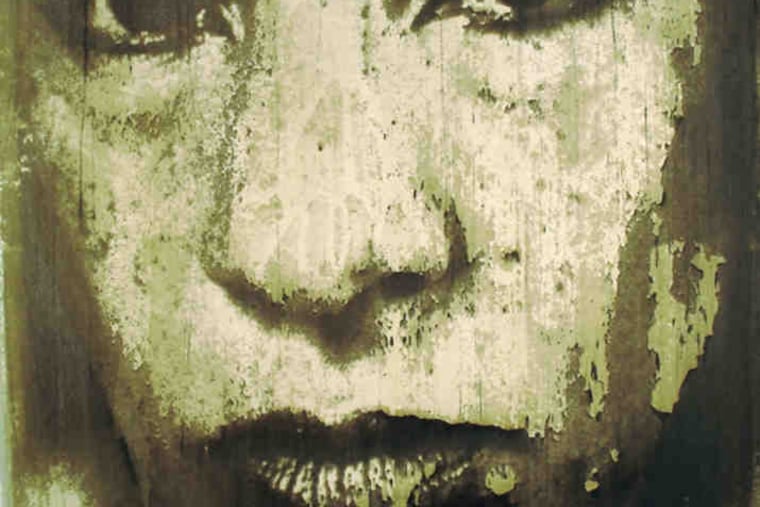
Upstairs, real portraits. As a counterpoint to Frank's documentary selectivity, the Berman has installed a show of Don Camp's distinctive portraits in the upstairs gallery. Teacher and artist-in-residence at the college, Camp has become well-known in Philadelphia for his striking, large-scale faces rendered in streaky, earth-toned pigments.
As he discloses in a moving biographical essay in the Frank exhibition catalog, Camp was inspired by Frank's unorthodox compositional tactics, which he encountered in a magazine he bought while living in France during the mid-1960s. He likened Frank's compositions to "free-form jazz, [they] seemed improvised and new."
Camp became a committed photographer while serving in the Air Force. After his discharge, he worked for nine years as a newspaper photographer. Eventually, he decided that his studio work should reflect his experience as "an African American male living in America."
His images, initially of black men, take the form of what he describes as "casein monoprints" made on rag paper with light-sensitized earth pigments. The images look distressed, often fading away at the top of the head, as if they had been exposed to weather.
This correlates with their emotional tenor, which evokes people who have persevered in a protracted struggle against intolerance and persecution.
At the Berman, Camp has expanded his subjects to include women and white people. Hung close together in a small room, the 18 faces create a cohort of imposing and dignified survivors.
Art: Places and Faces
The Robert Frank and Don Camp exhibitions continue in the Berman Museum at Ursinus College, 601 E. Main St., Collegeville,
through April 17. Hours are 10 a.m. to 4 p.m. Tuesdays through Fridays and noon to 4:30 p.m. Saturdays
and Sundays. Free. 610-409-3500 or www.ursinus.edu/berman
On March 26, the college will sponsor a symposium on arts-based education in medical schools. Participants will include Dr. Charles Pohl of Thomas Jefferson University. Seating is limited; reservations are recommended. Contact Sue Calvin at 610-409-3500.
EndText