Shoring up the Boardwalk Empire
ATLANTIC CITY - When Judge Nelson Johnson wrote Boardwalk Empire, his history of corrupt Atlantic City, he certainly had no idea the Prohibition-era chapters would inspire the celebrated HBO series.
ATLANTIC CITY - When Judge Nelson Johnson wrote Boardwalk Empire, his history of corrupt Atlantic City, he certainly had no idea the Prohibition-era chapters would inspire the celebrated HBO series.
But he did know this: The chapter on the African American involvement in the creation of the resort - Chapter 3, titled "A Plantation by the Sea" - was destined to be the basis for another book.
"It became apparent if you remove the black experience from Atlantic City's history, then the town never comes to be," Johnson said in a phone interview from his chambers in the Atlantic County Civil Courthouse in Atlantic City.
"When you have two generations where 95 percent of the hotel workforce was African American, then how does this town ever develop as a regional, national resort unless you have the black experience?
"Intellectually this really bothered me," he said. "I knew a single chapter wasn't going to do it."
The resulting book, The Northside: African Americans and the Creation of Atlantic City (Plexus Publishing, $24.95), appeared late last year and has sold about 2,500 copies. It is now in its second printing. Boardwalk Empire, published in 2002, has sold close to 100,000 copies, said Plexus publisher John Bryans.
Johnson said that when the resort was being created in the late 1800s and early 1900s, the Philadelphia job market was strong enough that most white workers were happy to take employment in that thriving economy and visit the new seaside resort on their days off.
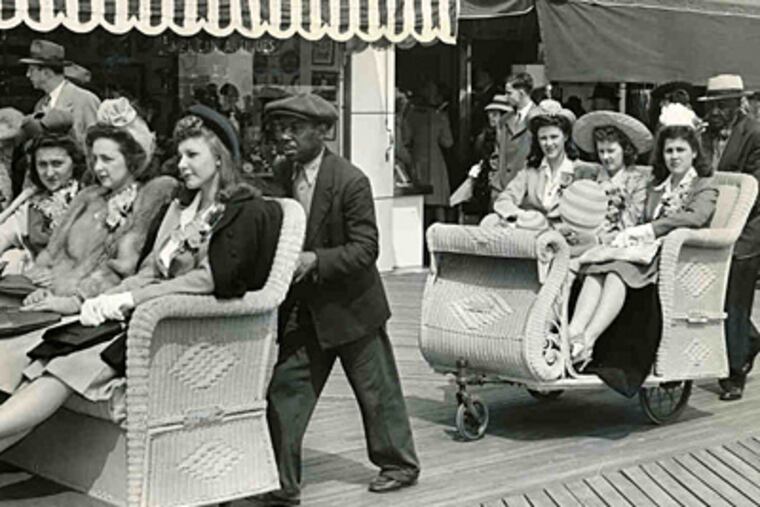
As a result, he writes, Atlantic City's developers recruited freed slaves and the children of slaves from the upper South to build the railroad to Absecon Island and then to staff the boardinghouses and hotels.
Until the economy worsened in the 1930s, virtually every hotel worker in Atlantic City was African American.
"It definitely became part of the appeal of the resort," Johnson said. "What you had was obliging black people in uniform doting over white people, even in the boardinghouses. When you came here, you really felt like you were somebody special."
Prevented from living in the parts of the resort closest to the beach, this black community built a thriving neighborhood known as the Northside, bordered by Arkansas, Connecticut, and Arctic Avenues on back to the bay. The area developed into a culturally and intellectually rich community of doctors, lawyers, jazz clubs, and churches. The summer gathering spot was the beach at Missouri Avenue, designated by the city for African Americans and staffed with an all-black beach patrol. Known as Chicken Bone Beach, it was visited by the likes of Sammy Davis Jr., Ella Fitzgerald, Jackie Robinson, and the Rev. Dr. Martin Luther King Jr.
"We were vibrant and we had the things that were needed," said Ada McClinton, a pioneering educator who grew up on the Northside and still lives in Atlantic City. "There was no other way to do it but that way. The black community was almost self-sufficient because we had to be. We had our own doctors. There were seven doctors on the Northside. We had lawyers. We had pharmacists. We had people who had electric businesses. Because of where we were, we became self-sufficient."
As in many cities, the civil rights movement and increased economic opportunity led to an exodus from the city and a dispersal through other neighborhoods once off limits to black people.
"At one time, you couldn't even live in Venice Park," McClinton said, referring to a nearby neighborhood, now a thriving middle-class home to many black families. "So [with increased opportunity] you could move to other areas. The power of being together was sort of dissipated."
That trend has continued into Atlantic City's more recent history in the casino era, as many, if not most, upwardly mobile casino workers moved "offshore" to communities such as Egg Harbor Township and Galloway.
The book details the impact of the summer of 1964, when the Democratic National Convention was held in Atlantic City. The overall effect of that event was disastrous for the city - the world found out the once-bustling place was now the pits. But the events surrounding the Mississippi Freedom delegation's attempts to be seated at the convention - and Fannie Lou Hamer's dramatic testimony before the credentials committee - had a profound effect on a generation of local black leadership that played host to a national movement that summer.
"It was a big opportunity to see 'Hey, we have the ability to do things,' " said Johnson. "They are so proud of that summer. They played host to thousands of people from across the country in homes, churches, the YMCA. They were part of the civil rights movement."
The book, which includes original cover illustrations by Atlantic City artist Tyrone L. Hart, does not look at more recent racial dynamics in Atlantic City, including community response to a casino-driven tunnel project that required razing homes in the Westside, a middle-class black neighborhood; the ongoing question of whether the casino industry has fulfilled its original mission to reinvigorate the city itself; and, most recent, Gov. Christie's plan to carve out a tourism district for state control, which Mayor Lorenzo Langford angrily criticized as "apartheid" last week in a newspaper column.
But the unusual dynamics created by a city whose primary mission is to entertain out-of-towners, and has spent much of its history in the clutches of political bosses like Nucky Johnson, the Nucky Thompson of HBO fame, persist.
"This is the ultimate legacy of Nucky Johnson," said Judge Johnson (no relation). "This is the sad thing. This town never developed the traditional means for the exercise and transfer of power. Johnson perfected the system of corruption so well. Everyone who came after him said, 'I'll be the next boss.' That's still what's going on. Whenever there's an election, there's this crazy scramble for power that's always a free-for-all."
Several of Johnson's key sources for the book did not live to see it published, including Sid Trusty, a musician and folk historian who pushed Johnson to write the book after reading Chapter 3 of Boardwalk Empire nine times; activists Horace J. Bryant Jr. and Pierre Hollingsworth; and casino executive Redenia Gilliam-Mosee, who helped forge community ties.
Given the aging of so many of these key figures in the history of black Atlantic City, in the end, Johnson said he was just relieved the book was published with at least some of his primary sources still alive, including McClinton and Elwood Davis, who both vividly remember the Freedom Summer of 1964.
As for Boardwalk Empire, Johnson said he was most gratified not by the HBO series, but by the fact that three colleges - Rutgers, Stockton, and Princeton - are using the book in urban history classes.
"I'm thrilled that these people who really helped me are still alive," said Johnson, who plans no book tour but says he will never turn down a church, library, or school.
"When you have first-person accounts from people who experienced something, it's like a piece of gold thread, you can tie together the story."